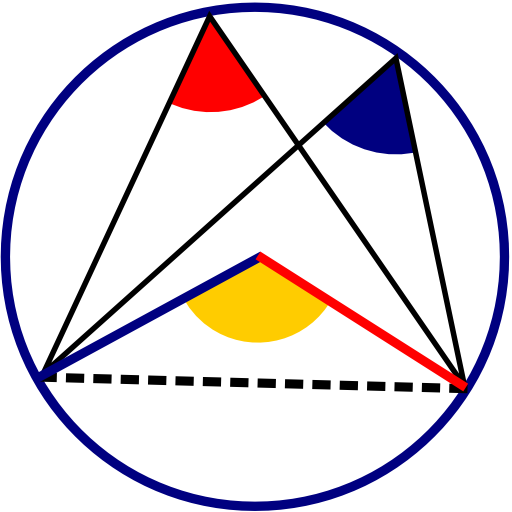
Welcome to #104 of the Math Teachers At Play (MTaP) blog carnival. A blog carnival is a regular blogging round up coordinated by someone (in this case Denise Gaskins) that moves around different blogs each edition. This time, I’m taking a turn.
You're reading: Posts Tagged: Puzzles
Puzzlebomb – December 2016
 Puzzlebomb is a monthly puzzle compendium. Issue 60 of Puzzlebomb, for December 2016, can be found here:
Puzzlebomb – Issue 60 – December 2016 (printer-friendly version)
The solutions to Issue 59 can be found here:
Puzzlebomb – Issue 60 – December 2016 – Solutions
This will be the last regular monthly Puzzlebomb – in future, there will be occasional one-offs but regular editions are taking a break. If you have any ideas for puzzles, please send them in! Previous issues of Puzzlebomb, and their solutions, can be found here.
CP’s solid used as the basis of a puzzle
Back in 2013, our own Christian Lawson-Perfect came up with a way of making a solid from the smallest non-Hamiltonian graph, the Herschel Graph. Called the Herschel Enneahedron, it’s got nine faces (three squares and six kites) and the same symmetries as the graph itself.

The most recent news is that Spektrum magazine – sort of a German version of New Scientist – has included in its regular puzzle column a Herschel Enneahedron-related challenge. Here’s Google’s best effort at translating it:
Please make a polyhedron of 3 squares and 6 cover-like kite rectangles with suitable dimensions (in your thoughts, drawings or with carton). What symmetry properties does it have, how many corners and edges? Is it possible to make a (Hamilton-) circular path on its edges, which takes each corner exactly once and does not use an edge more than once?
Before you get out your cartons and start working on this, given that we started from a graph which isn’t Hamiltonian, you may have a slight spoiler on the answer here… but the solution given includes some nice videos and explanation as to how the solid is formed.
The maths of the Grime Cube
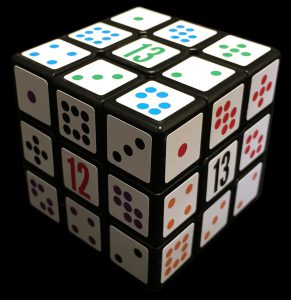 Not content with already having five cubes named after him, internet maths phenomenon James Grime has now developed a new Rubik’s cube-style puzzle for internet maths joy merchants Maths Gear. I’ve been slightly involved in the development process, so I thought I’d share some of the interesting maths behind it.
Another name for a Rubik’s cube is ‘the Magic Cube’ – and Dr James Grime wondered if you could make a Magic Cube which incorporates its 2D friend, the Magic Square.
Mathematical advent calendar 2016 roundup
There seem to be a bumper list of mathematical advent calendars this year, even though the stellar efforts of Katie and Christian’s Aperiodvent Calendar 2015 aren’t being repeated. There aren’t yet enough for an advent calendar with a different mathematical advent calendar behind each door, so we thought a straight round up was the way to go.
Puzzlebomb – November 2016
 Puzzlebomb is a monthly puzzle compendium. Issue 59 of Puzzlebomb, for November 2016, can be found here:
Puzzlebomb – Issue 59 – November 2016 (printer-friendly version)
The solutions to Issue 59 can be found here:
Puzzlebomb – Issue 59 – November 2016 – Solutions
Previous issues of Puzzlebomb, and their solutions, can be found here.
Puzzlebomb – October 2016
Puzzlebomb is a monthly puzzle compendium. Issue 58 of Puzzlebomb, for October 2016, can be found here:
Puzzlebomb – Issue 58 – October 2016 (printer-friendly version)
The solutions to Issue 58 can be found here:
Puzzlebomb – Solutions 58 – October 2016 (printer-friendly version)
Previous issues of Puzzlebomb, and their solutions, can be found here.