Here’s a round-up of a few newsy things we didn’t cover on the site in the month of December.
You're reading: Posts Tagged: arXiv
Timothy Gowers has launched a new arXiv overlay journal
 Sir Timothy Gowers has announced on his blog a new journal, Discrete Analysis, of which he will be the managing editor. Rather than a traditional journal, this will be an open-access ‘arXiv overlay’.
The arXiv has enabled MathJax!
A bit of slightly overdue but welcome news: the arXiv has enabled MathJax on paper abstract pages. Authors have regularly been using LaTeX syntax in their titles and abstracts, but now the arXiv typesets them automatically for you.
Not mentioned recently on The Aperiodical
Summer is a busy time for this site’s hard-working triumvirate, so we haven’t been keeping on top of the news as much as we’d like. There’s been some quite interesting news, so here’s a quick round-up of the most important bits:
The Good, the Bad and Gowers
Prof Sir Tim Gowers has published a couple of very interesting posts on his blog this week, explaining his thinking behind a couple of announcements to do with Open Access.
How the shape of the glasses causes bubbles in Guinness to appear to sink
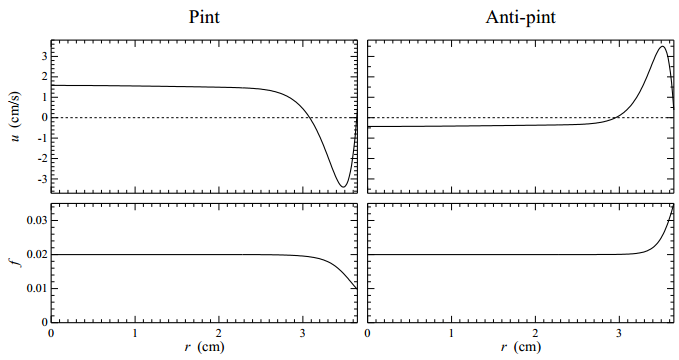
A paper in the arXiv, discussed on the Physics arXiv Blog, investigates what the blog post called “one of the more intriguing conundrums in fluid dynamics”: why bubbles in Guinness appear to sink as the drink settles and the head forms.
Laziest torus identified
Or, in similarly simplified headlinese, “Math finds the best doughnut”. A little bit more precisely, Fernando C. Marques and André Neves claim in a preprint on the arXiv to have proved the Willmore conjecture, that the minimum achievable mean curvature of a torus is $\frac{2}{\pi^2}$.
The article I linked to is some surprisingly non-stupid coverage from the Huffington Post. It seems they have a maths professor writing a column. I will never understand that site. I don’t know if there’s a Serious Business way of framing this, but the result is nice to know.
Richard Elwes has written a very short post on Google+ with some more real-maths information about what’s going on.