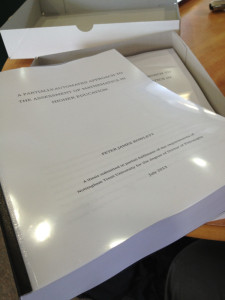
Peter Rowlett, editor-at-large of this site, has submitted his PhD thesis. More news as it arrives.
Peter Rowlett, editor-at-large of this site, has submitted his PhD thesis. More news as it arrives.
There’s no new integer sequence review this week, because David and I are taking a break before the Grand Finale Ultimate Showdown of Dreams next week. To tide you over, top chap Brady Haran has recorded a Numberphile video with Tony Padilla explaining each of the six sequences in the final in his Enthusiastic Maths Outreach™ voice.
If you haven’t made your mind up yet, maybe the video will sway you. Or will it sow doubt into your previously made-up mind???!?!?!?!!?!?! Anyway, it’s a very good video.
The Integest Sequence 2013 will be announced next week in a glitzy celebrity gala event. There’s still time to vote for your favourite sequence, and there’s still time for us to decide how much attention we’ll pay to your vote. Everything’s still to play for!
Integest Sequence 2013 Public Vote
Last week, A001462 – Golomb’s sequence – booked its place in the final. In retaliation for last week’s palaver, this week Christian has picked all the sequences. Unfortunately, the British Summer is happening today so we’re failing a bit, intellectually.
With that in mind, it’s time for round 4 of…

Here are the rules: we’re judging each sequence on four axes: Aesthetics, Completeness, Explicability, and Novelty. We’re reviewing six sequences each week for four weeks, picking a winner from each. Then, we’ll pick one sequence from the ones we reviewed individually before this thing started, plus a wildcard. Finally, a single sequence will be crowned the Integest Sequence 2013!
For the benefit of overseas readers, or British readers in full-time employment, I should briefly explain the concept of daytime TV quiz phenomenon Pointless. The pinnacle of British public service broadcasting, it’s shown at 5.15pm every weekday on BBC One and is hosted by Alexander Armstrong of comedy double-act Armstrong & Miller, and Richard Osman of comedy double-act Armstrong & Osman. We shall investigate how we can use maths to analyse the show, improve our chances of winning it, and ultimately perhaps improve the show itself.
The aim of the game is in each round to give the most obscure correct answer to a given question. Each question ($Q$) has a large set of valid answers $A_Q$, questions perhaps asking contestants to name “Films starring Bruce Willis” or “Countries without an O in their name”. All the questions have been asked to 100 members of the public prior to the quiz (call this set $P$), and they each have 100 seconds to name as many examples as they can (giving rise to a set $A_p\subseteq A_Q$ for each $p\in P$. The contestant gets a point for every one of the 100 people who named their answer $a$:
\[ \mbox{score}(a) = \begin{cases}
| \{p\in P : a\in A_p \} | & \mbox{if}\ a\in A_Q \\
100 & \mbox{if}\ a\not\in A_Q.
\end{cases} \]
So an obvious answer like Die Hard or France will score a lot of points, and an obscure answer like Striking Distance or Central African Republic will score fewer points. Points are bad (hence the title) so it’s better to dredge up an obscure answer than stick with something safe. However an incorrect answer like Avatar or Mexico scores the maximum 100 points. At the end of the round the contestant with the most points is eliminated.
Summer is a busy time for this site’s hard-working triumvirate, so we haven’t been keeping on top of the news as much as we’d like. There’s been some quite interesting news, so here’s a quick round-up of the most important bits:
#TweetMyThesis E-assessment is limited. I propose individualised work marked by hand to reduce plagiarism in HE maths coursework. It works!
— Peter Rowlett (@peterrowlett) July 8, 2013
#TweetMyThesis is the latest in a line of similar initiatives asking you to condense your thesis into 140 characters. This time it was proposed by Times Higher Education on Twitter. I’m also aware of #TweetYourThesis, #tweetyrPhD, #TweetYourPhD and numerous individual conference versions. I’m unsure whether 2010’s #BUthesis is the first, but it might be.
My title remains ‘A Partially-automated Approach to the Assessment of Mathematics in Higher Education’. My deadline is less than three weeks away.
Last week, A001220 – the Wieferich primes – booked its place in the final. This week, David has picked six sequences all on his own to form Bracket 3 of…
Here are the rules: we’re judging each sequence on four axes: Aesthetics, Completeness, Explicability, and Novelty. We’re reviewing six sequences each week for four weeks, picking a winner from each. Then, we’ll pick one sequence from the ones we reviewed individually before this thing started, plus a wildcard. Finally, a single sequence will be crowned the Integest Sequence 2013!