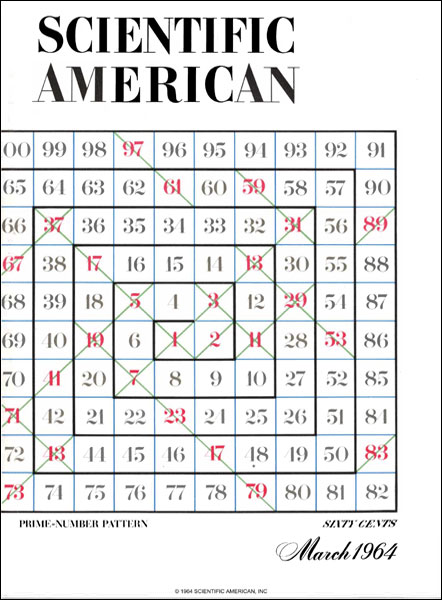
I’m slowly working to (sort of) recreate Martin Gardner’s cover images from Scientific American, the so-called Gardner’s Dozen.
This time it’s the turn of the March 1964 issue. In the article ‘The remarkable lore of the prime numbers’, later included as chapter 9 in Martin Gardner’s Sixth Book of Mathematical Games from Scientific American, Gardner describes how Stanislaw Ulam in a boring meeting doodled a grid of numbers, spiralling out, then circled the primes. “To his surprise the primes seemed to have an uncanny tendency to crowd into straight lines.” These Ulam sprials, discovered the year before, contain lines related to prime-generating functions, which I have written about recently.
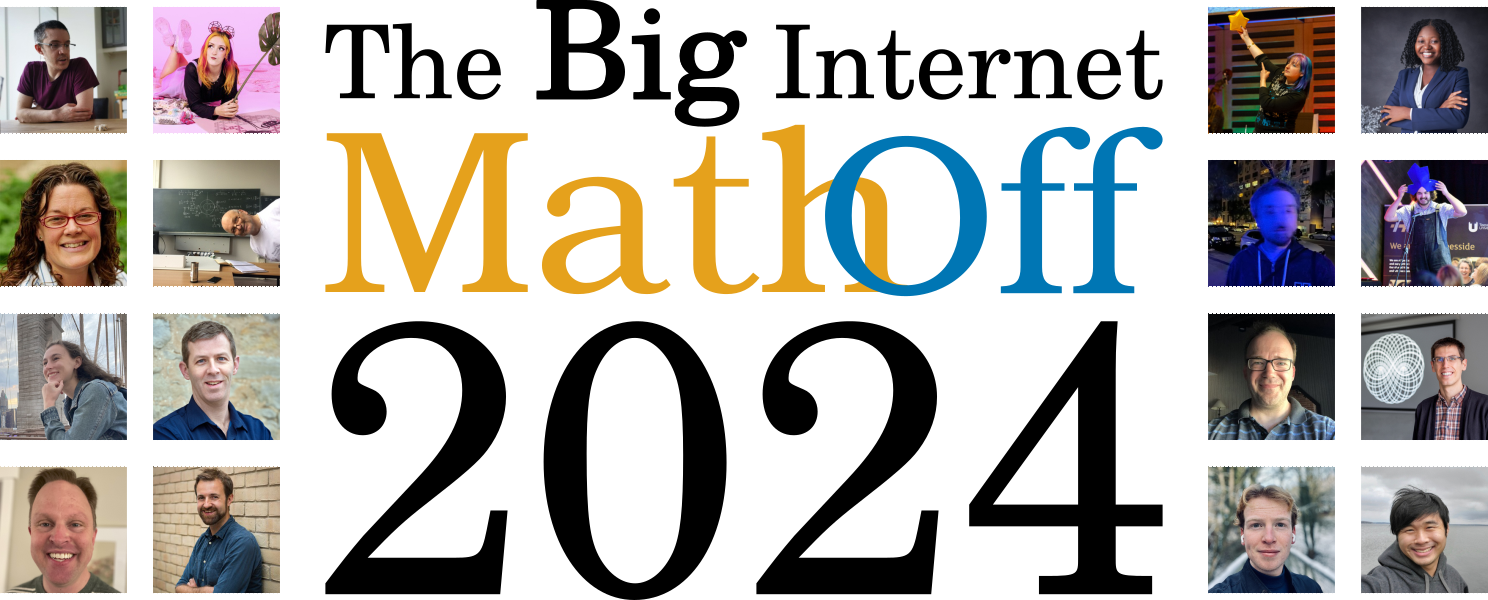
In 2018 I ran a just-for-fun competition to find “The World’s Most Interesting Mathematician”. It was so much fun that I ran it again in 2019 and 2020. And then big things happened in my life and the wider world and I haven’t had the energy to do it again.
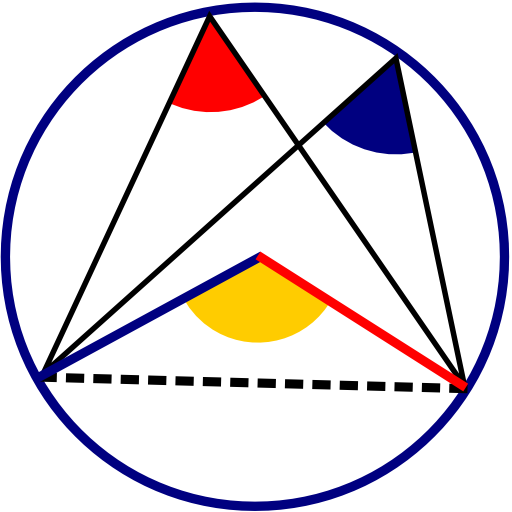
It used to live, unloved, in the A-level formula book: a mysterious result relating the area of a triangle to its sides. The most interesting thing about it was its name: Heron’s formula. (As far as I can make out, the chap’s name was Hero of Alexandria, and if you do a possessive in Greek it goes into the genitive case, which makes it Heron’s Formula. You might want to debate this; I regretfully decline.)
So there I was, peacefully proofreading Matt Parker’s forthcoming book Love Triangle when I was shocked by a vicious — and frankly unprovoked — assault on the very idea of Heron’s formula.
Here’s a round-up of some of the mathematical news we saw last month.
Maths News
Thomas Hales and Koundinya Vajjha have claimed a proof of Mahler’s first conjecture, that the most unpackable centrally symmetric convex disk in the plane is a smoothed polygon. (via Greg Egan)
It’s been announced that the first President of the newly-formed Academy for the Mathematical Sciences (AcadMathSci) will be Professor Alison Etheridge OBE FRS, a professor in Probability at the University of Oxford, and a world expert on stochastic processes and their applications. She will take up the role on 17 June 2024.
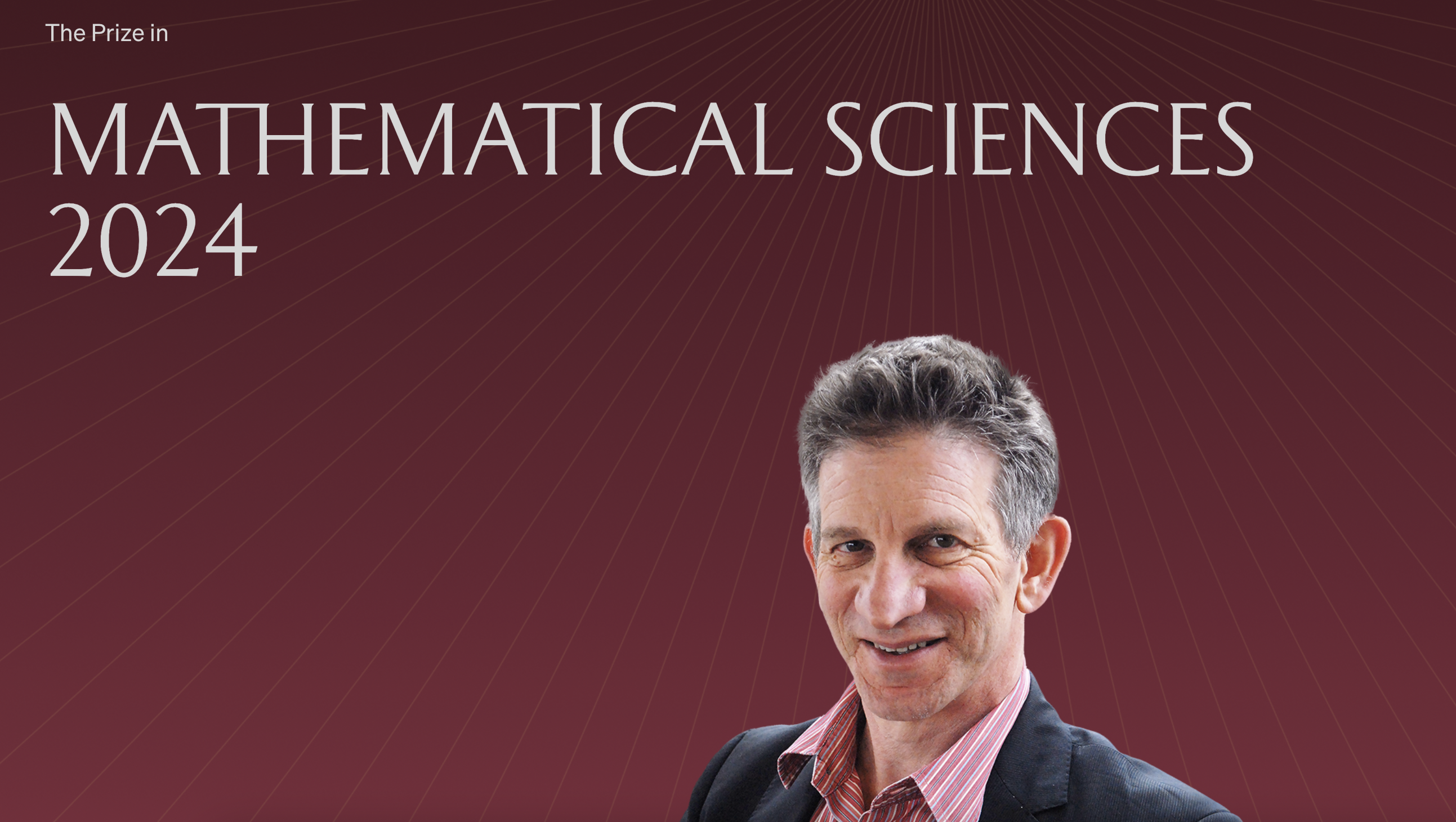
The Shaw Prize in Mathematical Sciences 2024 has been awarded to Peter Sarnak, “for his development of the arithmetic theory of thin groups and the affine sieve, by bringing together number theory, analysis, combinatorics, dynamics, geometry and spectral theory.” (via Paysages Mathématiques)
The UK Government have announced the new set of King’s Birthday Honours. Here’s our selection of particularly mathematical entries for this year. If you spot any more, let us know in the comments and we’ll add to the list.
Philippa Bonay, Director, Operations, Office for National Statistics. Appointed OBE for Public and Charitable Services.
Anne Davis, Professor of Mathematical Physics, University of Cambridge. Appointed OBE for services to Higher Education and to Scientific Research.
Paul Fannon, Fellow, Christ’s College, Cambridge, and Volunteer, United Kingdom Mathematics Trust. Appointed OBE for services to Education.
Ian Hall, Professor of Mathematical Epidemiology and Statistics, University of Manchester and Senior Principal Modeller, UK Health Security Agency. Appointed OBE for services to Public Health, to Epidemiology and to Adult Social Care, particularly during Covid-19.
David Marshall, Lately Director of Census, Northern Ireland Statistics and Research Agency (now Northern Ireland chief electoral officer). Appointed OBE for services to Official Statistics and Census-taking in Northern Ireland.
Bruno Reddy, Founder and Chief Executive Officer, Maths Circle, Ampthill, Bedfordshire, and creator of Times Tables Rock Stars. Appointed OBE for services to Education.
Sam Rose, Deputy Director, Data and Analysis Division, Department for Transport. Appointed OBE for services to Advanced Analytics
Matthew Woollard, Professor of Data Policy and Governance, UK Data Archive, University of Essex. Appointed OBE for services to Data Science
George McMath, Lately Deputy Principal, Northern Ireland Statistics and Research Agency, Northern Ireland Civil Service. Appointed MBE for services to the Northern Ireland Census.
Get the full list from gov.uk. Spot anyone we’ve missed? Let us know in the comments.
The next issue of the Carnival of Mathematics, rounding up blog posts from the month of May 2024, is now online at Girls’ Angle.
The Carnival rounds up maths blog posts from all over the internet, including some from our own Aperiodical. See our Carnival of Mathematics page for more information.
A few weeks ago I heard someone casually refer to ‘that formula of Euler’s that generates primes’. I hadn’t heard of this, but it turns out that in 1772 Euler produced this formula:
\[ f(x) = x^2 + x + 41\text{.} \]
Using this, \(f(0)=41\), which is prime. \(f(1)=43\), which is also prime. \(f(2)=47\) is another prime. In fact this sequence of primes continues for an incredible forty integer inputs until \(f(40)=41^2\). It might generate more primes for higher inputs, but what’s interesting here is the uninterrupted sequence of forty primes.
This got me wondering. Clearly \(f(0)\) is prime because 41 is prime, so that much will work for any function
\[ f(x) = x^2 + x + p \]
for prime \(p\), since \(f(0)=0^2+0+p=p\). Are there other values of \(p\) that generate a sequence of primes? Are there any values of \(p\) that generate longer sequences of primes?
I wrote some code to investigate this. Lately, I’ve taken to writing C++ when I need a bit of code, for practice, so I wrote this in C++.
I figured the cases where \(f(0)\) is prime but \(f(1)\) isn’t weren’t that interesting, since \(f(0)\) is trivially prime. In fact, \(f(x)=x g(x)+p=p\) when \(x=0\) for any prime \(p\), but saying so doesn’t seem worth the effort.
So I kept track of the primes \(p\) whose functions \(f(x)=x^2+x+p\) generate more than one prime, and the lengths of the sequences of primes generated by each of these. This produced a pair of integer sequences.
I put the primes that work into the OEIS and saw that I had generated a list of the smaller twin in each pair of twin primes. I was momentarily spooked by this, until I realised it was obvious. Since \(f(0)=p\) and \(f(1)=1^2+1+p=p+2\), any prime this works for will generate at least a twin prime pair \(p,p+2\).
What about the lengths of the sequences of consecutive primes generated? The table below shows the sequences of consecutive primes generated for small values of \(p\). Most primes that generate a sequence produce just two, and \(p=41\) definitely stands out by generating forty.
I was pleased to see this sequence of lengths of primes generated was not in the OEIS. So I submitted it, and it is now, along with the code I wrote. (I discovered along the way that the version where sequences of length one are included was already in the database.)
Anyway, I amused myself by having some C++ code published, and by citing Euler in a mathematical work. Enjoy: A371896.