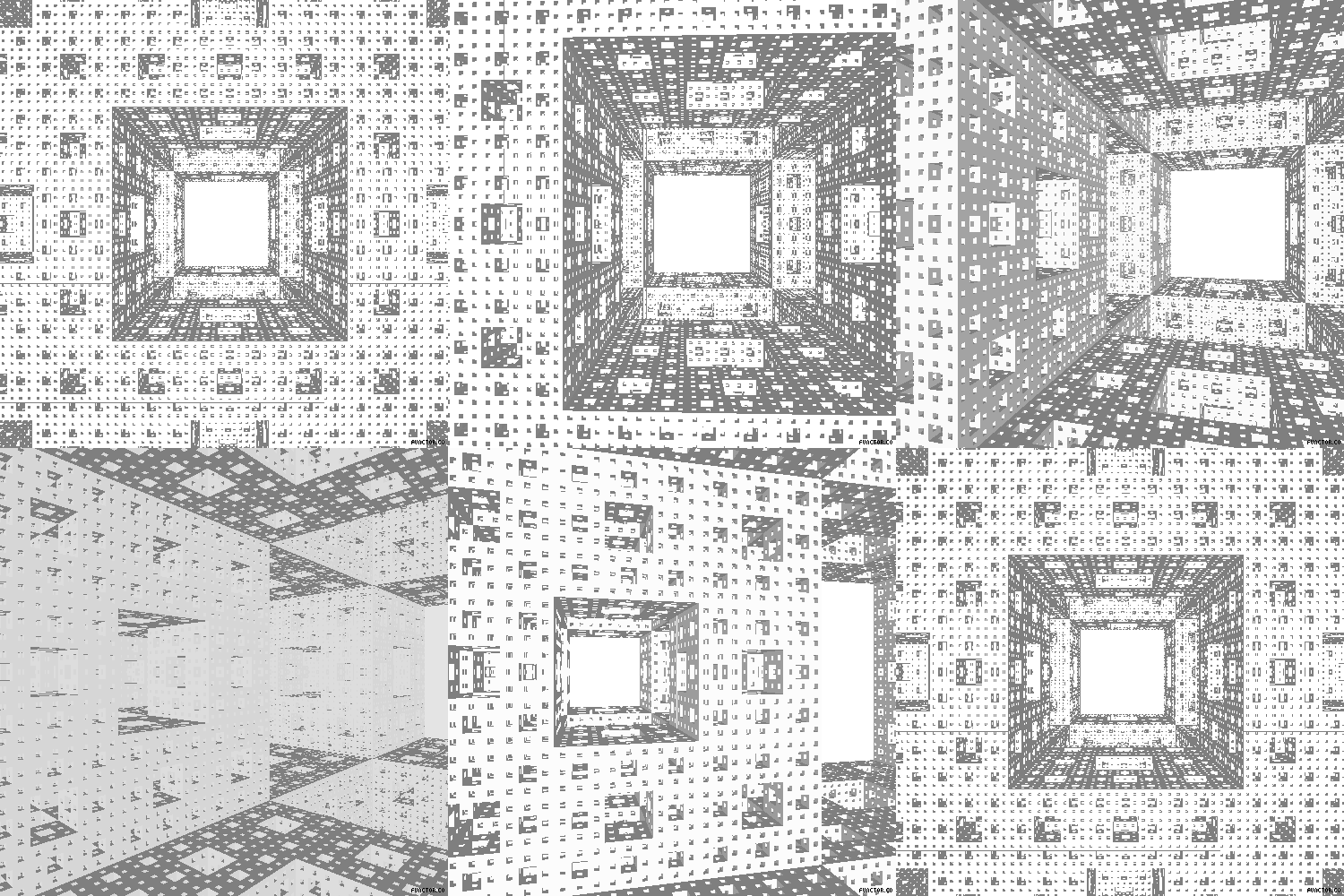
 I really really like this zoom into a Menger sponge made by Reuben Thomas of functor.co.
I really really like this zoom into a Menger sponge made by Reuben Thomas of functor.co.
[youtube url=http://www.youtube.com/watch?v=UY7l_UgHhBQ]
via NotCot.org
Mathematicians! Stop what you’re doing! I’ve almost certainly got something more interesting for you here. It’s been a good while since I last updated you on the contents of my Interesting Esoterica collection, and I have a proportionate number of mathematical curiosities to entertain and bewilder you with.
In case you’re new to this: every now and then I encounter a paper or a book or an article that grabs my interest but isn’t directly useful for anything. It might be about some niche sub-sub-subtopic I’ve never heard of, or it might talk about something old from a new angle, or it might just have a funny title. I put these things in my Interesting Esoterica collection on Mendeley. And then when I’ve gathered up enough, I collect them here.
In this post the titles are links to the original sources, and I try to add some interpretation or explanation of why I think each thing is interesting below the abstract.
Some things might not be freely available, or even available for a reasonable price. Sorry.

David and I sat down again and talked about maths a bit more. I’m calling this number 1 because it suits both our counting systems: David can call this the first podcast of a new series, and I can say the one we put out under All Squared was number 0. Everyone wins!

Podcast: Play in new window | Download
Subscribe: RSS | List of episodes
Somehow all three of us missed this before it started: “Andrew Dilnot, chair of the UK Statistics Authority, brings to life the numbers that highlight the patterns and trends that have transformed Britain”. A History of Britain in Numbers is a series of ten 15 minute programmes broadcast on BBC Radio 4. It looks like someone at the BBC has decided to extend the very popular A History of the World in 100 Objects format to a family of series A History of X in Y.
Dilnot was the first presenter of the long-running series More or Less, an Aperiodical favourite.
Listen: A History of Britain in Numbers at BBC Radio 4, or the Omnibus programme containing the first five episodes, or the podcast of the whole series.
You’ll almost definitely also like More or Less.
via Tim Harford on Twitter.
You might already know about the idea of crocheting hyperbolic surfaces, invented by Daina Taimina in 1997. Well, since then, the idea has been developed considerably, and I don’t think it would be hyperbolic to say people have got a bit carried away.
Margaret and Christine Wertheim, who are a science writer and a poet/performer respectively and The Institute for Figuring collectively, started work on a crochet coral reef in 2005 using Taimina’s ideas. Since then, it has grown into a vast international effort involving over 7,000 people working together to create something that’s a mixture of mathematical neatness, fascinating art exhibit, and environmental awareness project.
Anyway. the reason I mention all this is that the Wertheims want to publish a book about the project, and they’re raising money to do it on Kickstarter.
Raymond Johnson, a mathematics education graduate student, has started a wiki to “bring greater visibility and connectedness to mathematics education research.” The blurb on the site’s front page does a good job of explaining itself, so I’ll just repeat it here.