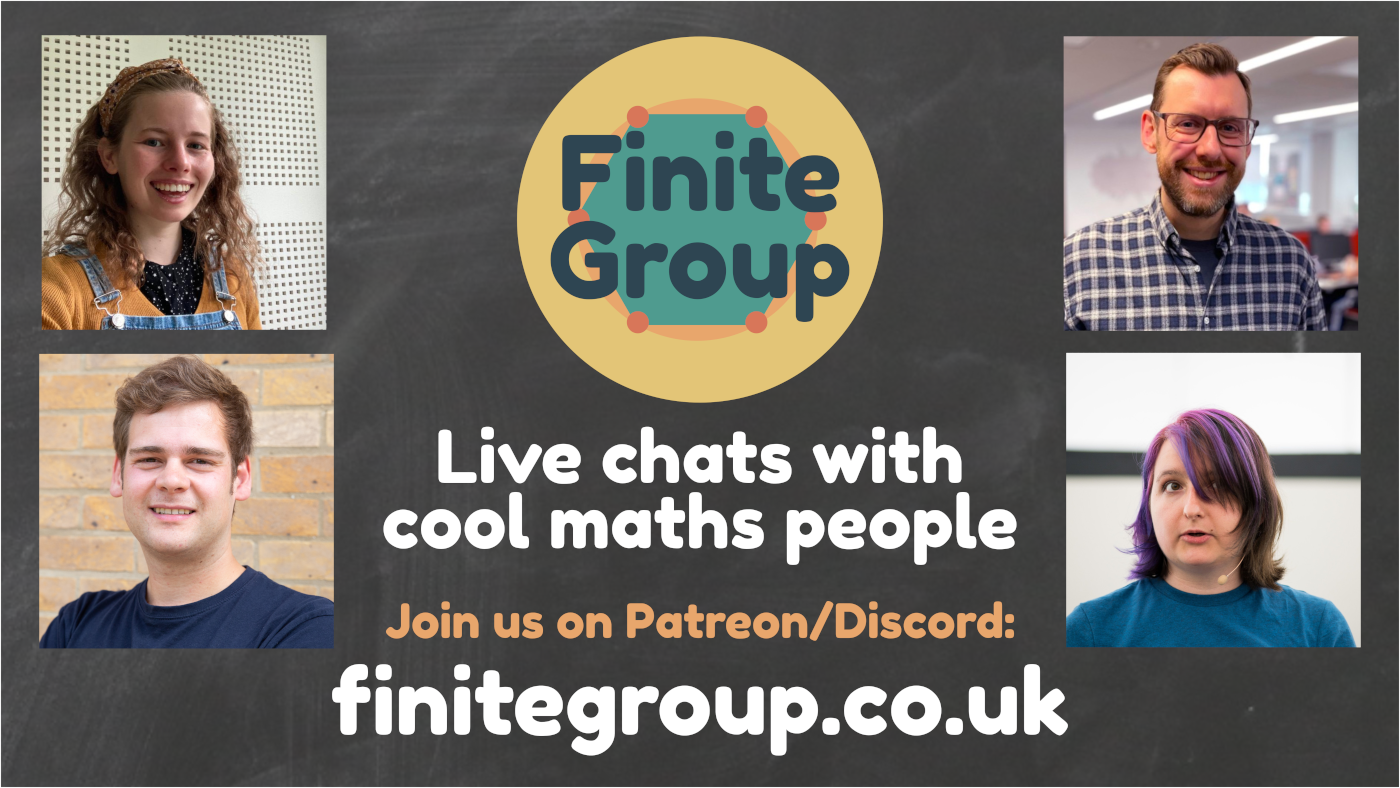
As we wrote about recently, we (Katie and Peter, along with our friends Sophie Maclean and Matthew Scroggs) are involved in an exciting new initiative – an online maths community that gets together via online chat and monthly video events. The first event happened yesterday evening, and will be available to watch for free on YouTube for the next couple of months.
This is a taster – if you’d like to join the online community and attend next month’s event, you need to join the Finite Group (starting from £4/month).
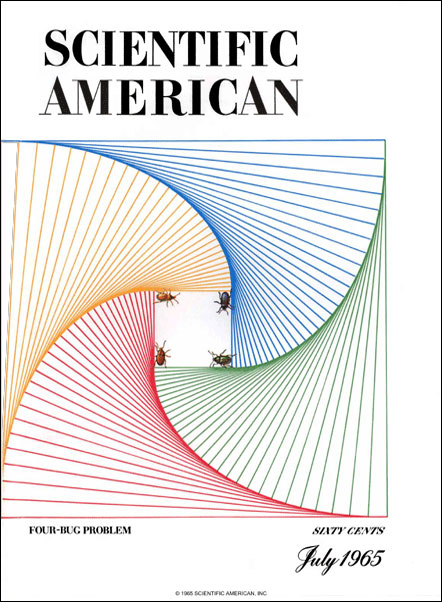
Reminder: I’m occasionally working to (sort of) recreate Martin Gardner’s cover images from Scientific American, the so-called Gardner’s Dozen.
This time I’m looking at the cover image from the July 1965 issue, accompanying the column on ‘op art’ (which became chapter 24 in Martin Gardner’s Sixth Book of Mathematical Diversions from Scientific American).
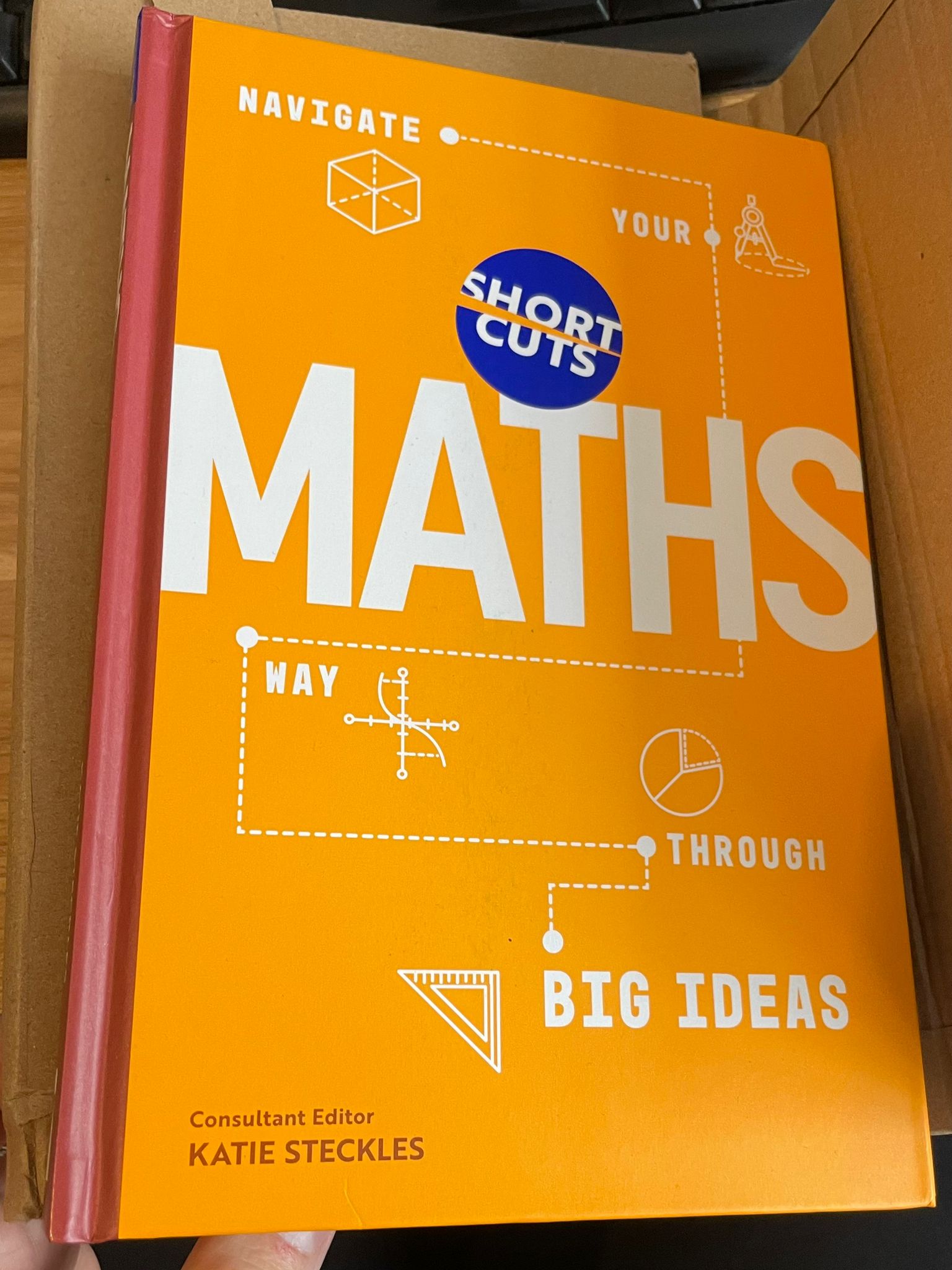
Our own Katie and Peter have collaborated on a new popular maths book, along with friends of the site Alison Kiddle and Sam Hartburn, which is out today. Short Cuts: Maths is an “expert guide to mastering the numbers behind the mysteries of modern mathematics,” and includes a range of topics from infinity and imaginary numbers to mathematical modelling, logic and abstract structures. We spoke to the four authors to see how they found it writing the book and what readers can expect.
How did this project come to be?
Peter: From my point of view, Katie approached me to ask if I’d like to be involved, which was very exciting! She’d worked on a couple of books with the same publisher and was asked to commission authors for this one.
Katie: The publishers wanted to make this book – one of a ‘Short Cuts’ series which needed a maths title – and asked me to be commissioning editor, which meant I could write some of it and ask others to write the rest. I chose some people I’ve worked with before who I thought would have something interesting to say about some topics in maths (in particular, the topics I know less about, so they could help me with those bits!)
Alison: As I was the last of the four of us to come on board, I think everyone had already expressed a preference for their favourite bits to write about, but luckily that left me with the two best topics, logic and probability.
Do any of you have previous experience of working on a project like this?
Alison: I’ve been involved in writing a book before but that one was about maths education, for an audience of mainly teachers, so this was a different sort of challenge, writing for a general audience with different levels of maths prior knowledge and enthusiasm.
Sam: I’ve worked on many books in the same genre as a copyeditor and proofreader, but this was my first time as an author. I enjoyed seeing how the publishing process works from the author’s point of view – it’s definitely had an impact on my editorial work!
Peter: My first time in popular book form, though I felt it used a bunch of skills I’ve developed in other work. And Katie is so great at organising projects that it went really smoothly.
What’s the book like?
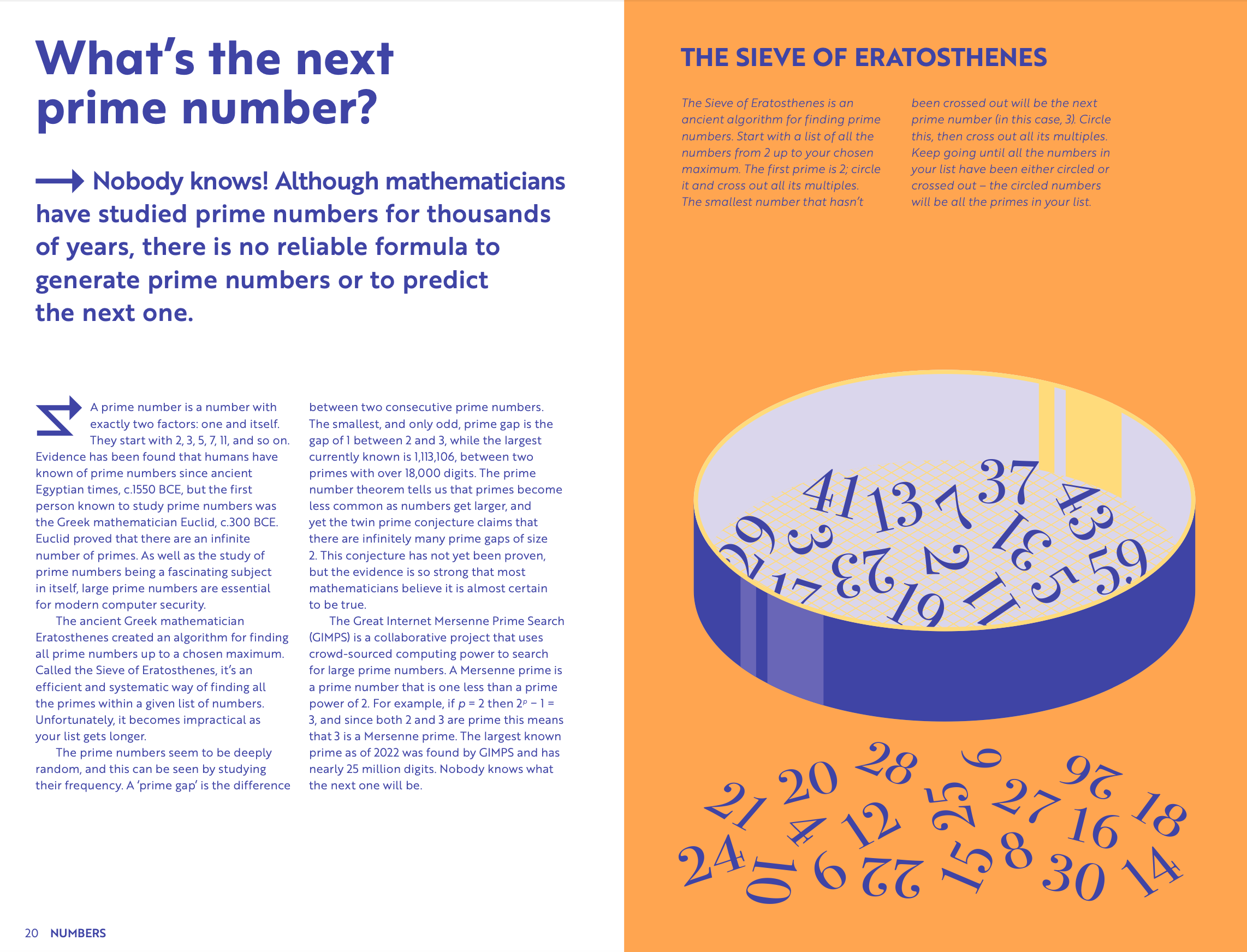
Sam: It’s a book you can dip into – you don’t need to read it from front to back. Each page is self-contained and answers a question, and we tried to make the questions as interesting as possible (two of my particular favourites are ‘Is a mountain the same as a molehill?’ and ‘Do Nicholas Cage films cause drownings?’).
Alison: We had quite a strict word limit to write to, which was a bit hard to get used to at first as I have a tendency to use ten words when two will do – but this turned out to be a blessing because it focussed us all on what the really important concepts were, and we found ways to express those concepts in a concise manner.
Katie: I love how the style of the book builds in these gorgeous illustrations – we worked with the illustrator to make sure they fit with the text, but also bring out fun aspects of the ideas we’re talking about.
Who do you think would enjoy reading this book?
Sam: I’d like to think that anyone who has a vague interest in maths would get something out of it. Even though it delves into some deep mathematical topics, we’ve (hopefully!) written it in such a way that it’s understandable to anybody with school-level maths. But I’d hope that experienced mathematicians would also be able to find something new, or at least fun, in there.
Alison: I’m definitely going to be recommending it to the students I work with. The bite-size dipping in and out model is great for them to skim read so they can find out a little bit about the mathematical ideas that appeal to them. Particularly useful for people preparing for university interviews where they want to show off that they know some maths beyond the usual curriculum!
Katie: My mum’s definitely getting a copy for Christmas – and not just because I was involved in writing it: she’s not from a mathematical background but I think she’d enjoy the straightforward explanations and discovering new ideas.
What’s your favourite bit?
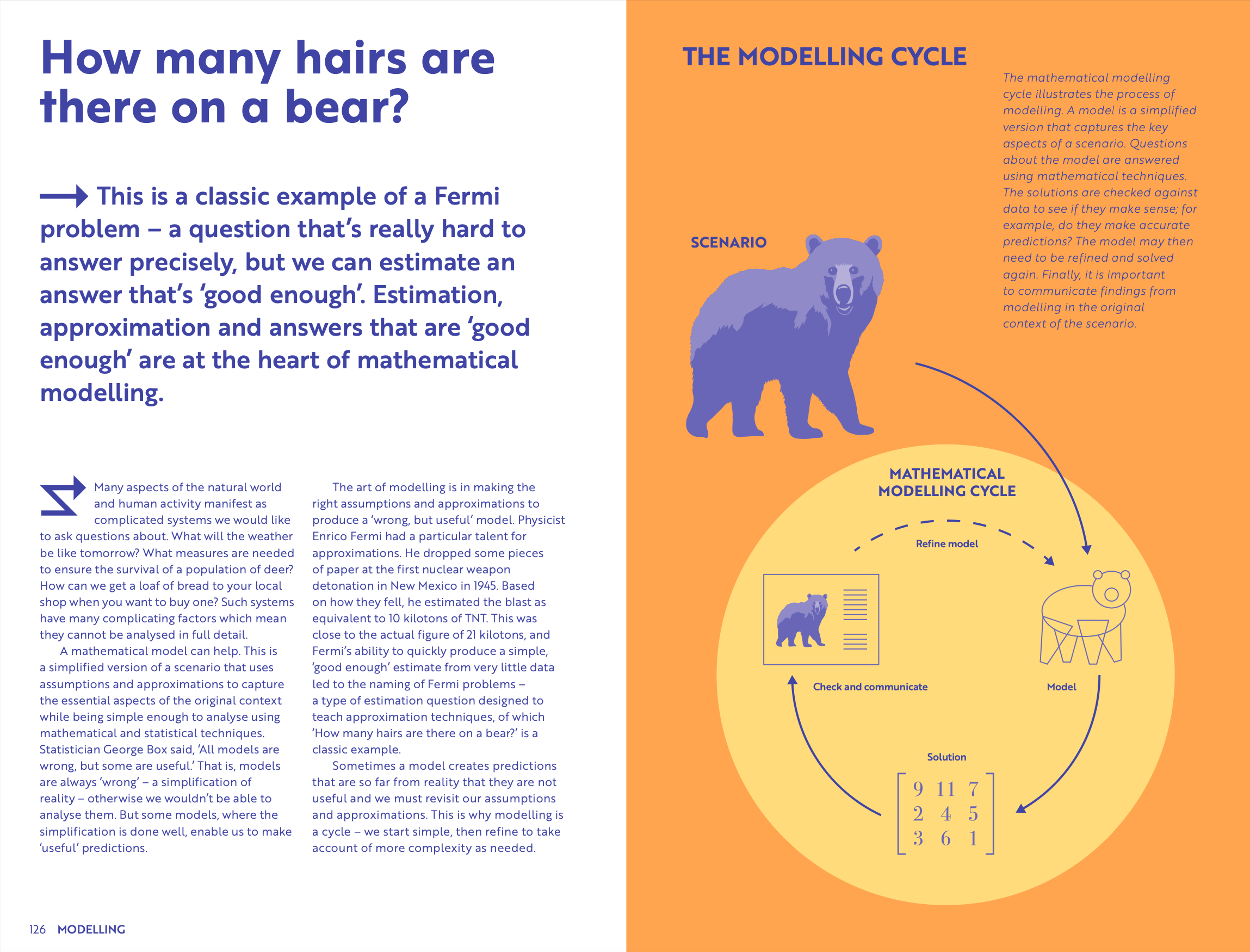
Sam: The publisher did commission some lovely illustrations. The bear in the modelling cycle is a particular delight!
Katie: Yes! We love the modelling bear. I also liked being able to share ideas people might not otherwise encounter if they read about mathematics, like how mathematical modelling works, or what topology is, or some of the nitty-gritty of mathematical logic.
Peter: There are loads of quick summaries of areas of maths I know less about, which is really nice to have. The illustrations are great — the baby failing to manage a crocodile always makes me chuckle, and I can’t wait to show my son the game theory dinosaurs!
Short Cuts: Maths is available to buy today from all good bookshops.
“Wouldn’t it be nice if there was a place where maths people could hang out and create cool maths things?” This idea was put to me a couple of years ago, and has stuck with me. It does sound nice.
Fast forward to 2023, and social media is collapsing. Some people have chosen a direction and are marching off towards Mastodon, Bluesky, Threads, or a number of other platforms. Some people are trying to keep up with multiple of these, but feeling spread too thin and wondering if it’s worth the effort (ask me how I know!). But many people are taking the opportunity to step back and think again. People are rethinking whether they want to conduct their online social lives in public. There is a surge in private communities, things like WhatsApp groups, Slack channels and Discord rooms. These have the advantage that you aren’t part of the ‘engagement’-driven content push, but they have disadvantages too – you have to know the right people to get into the group.
Meanwhile, wouldn’t it be nice if there was a place where maths people could hang out and create cool maths things?
So we’re creating it. We’re calling it The Finite Group (who doesn’t love a punny maths name?). “We” is Katie Steckles, Sophie Maclean, Matthew Scroggs and me. It’s going to be a maths community that gets together to share and create cool maths things, that supports creators to do their work within the group and on the wider internet.
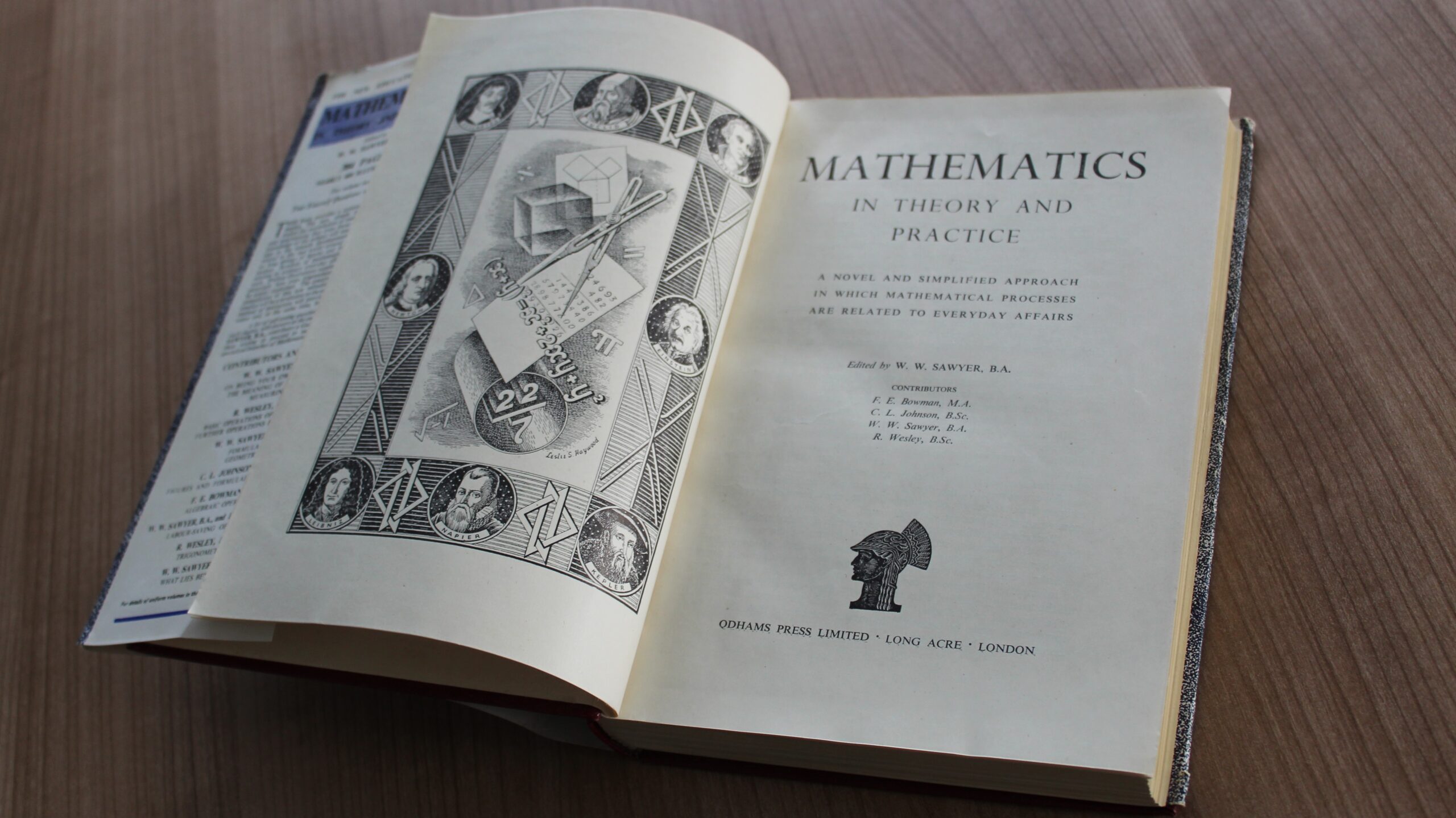
A conversation about mathematics inspired by an old textbook, Mathematics in Theory and Practice, edited by Warwick Sawyer. Presented by Katie Steckles and Peter Rowlett.