Having discovered this wonderful design for a paper Enigma machine, which uses a standard size crisp tube and does a pretty good job of encoding things like an Enigma machine, I decided it was worth trying it out. What better opportunity to use something which can encode secret messages than to send messages between two monthly Maths Jam events via the medium of Twitter? The public sending of the messages would be incomprehensible to anyone not willing to get their hands dirty with a crisp tube and scissors. Unless they’ve got an actual Enigma machine.
You're reading: Columns
Manchester MathsJam July 2012 Recap
This month we had two new attendees, as well as some regulars. We talked about lots of different things, although one recurring theme was the Crisp Tube Enigma machine, which we were using to send coded messages to Newcastle MathsJam. There will shortly be a video chronicling our achievements, and I’ll post a link to the video and writeup here once it’s ready.
Reframe

Reframe by Adam Scales, Pierre Berthelomeau, Paul van den Berg.
Capula Expanded Dodecahedron by Pedro Reyes

MathsJam Annual Conference 2012 booking now open
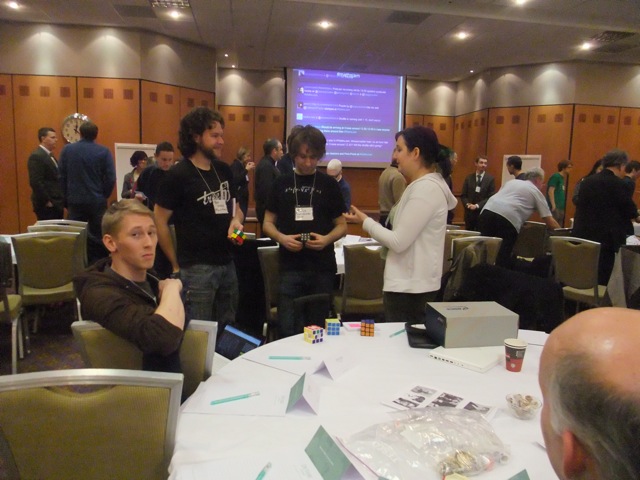
Booking is now open for the 2012 MathsJam annual conference. As well as being a regular monthly event in pubs all over the UK and the world, MathsJam has an annual gathering on a weekend in November, where attendees enjoy lightning 5-minute talks, long coffee breaks and general mathematical hanging out – as well as MathsJam’s standard “puzzles, games, problems, and sharing fun stuff with like-minded self-confessed maths enthusiasts”.
This year, the conference will take place at Wychwood Park, near Crewe, on the weekend of 17th-18th November 2012. The Aperiodical editorial team will almost certainly be in attendance, so watch this space for details of the exciting things we have planned for the weekend.
Places cost £165 for one person or £250 for two people for the whole weekend, with discounts for the unemployed, the early, and those who don’t need a room at the conference park.
More information: MathsJam 2012.
Duck Physics: review of an emerging field
Peter Rowlett*
* corresponding author
The emerging field of duck physics offers a theoretical exploration of the standard model of particle physics and its implications for ducks. This review takes a chronological approach and documents early developments of this exciting new discipline. The field of duck physics promises interesting results for ducks and has already started to develop results that have been reapplied to the standard model Higgs.
The 4th of July, a day previously of little significance, may now be celebrated as ‘Higgs day’. Many Americans marked the discovery with fireworks and it’s nice to see such celebration of science. The discovery led to an amusing (to me, anyway) exchange on Twitter. Old tweets get lost, and the hashtag we used is already gone from Twitter search, so I am recording the conversation here.
It all started with @C_J_Smith‘s assertion:
We have a Higgs!
— Calvin James Smith (@C_J_Smith) July 4, 2012
Pedantically, I pointed out:
or, rather, two teams have independently discovered a new particle which behaves like a Higgs ;) Looks like a duck, etc.
— Peter Rowlett (@peterrowlett) July 4, 2012
Of course Calvin knew this:
absolutely! We’ve a new boson – now to find out if it is a #Higgs (or a duck)!
— Calvin James Smith (@C_J_Smith) July 4, 2012
And this is when the fun started. A tweet from @MA1CAL started a new hashtag:
it is, however, unlikely to be a duck ;-) #vivaduckphysics
— MA1CAL (@MA1CAL) July 4, 2012
Being unfamiliar with duck physics, I asked the obvious question:
my physics is a little rusty; what does the standard model say about ducks? #vivaduckphysics
— Peter Rowlett (@peterrowlett) July 4, 2012
@MA1CAL revealed that vast possibilities were offered by this exciting new research area:
precious little – although there is a penguin process #vivaduckphysics
— MA1CAL (@MA1CAL) July 4, 2012
I called for further collaborators:
Further research needed re how ducks decay in GeV collisions #vivaduckphysics
— Peter Rowlett (@peterrowlett) July 4, 2012
In an example of multiple discovery (the usual way by which science progresses), one of the early key results in the field was developed independently by @lizmallard and @markdatko:
ducks are made of quacks?
— Liz Hanson (@lizmallard) July 4, 2012
one would expect decays to top quacks surely
— mark datko (@markdatko) July 4, 2012
@MA1CAL was optimistic about the potential:
this funding request is drafting itself! #vivaduckphysics
— MA1CAL (@MA1CAL) July 4, 2012
It is an important test of a new theory to see how well it fits with the predictions made by established models. An early result in duck physics, a hypothesis from @needmoreletters, had implications which challenged the standard model Higgs:
does the Higgs Boson weigh more than a duck, or have CERN detected a witch? #vivaduckphysics #notthatholygrail1
— alicia (@needmoreletters) July 4, 2012
Taking the only logical course of action, I suggested:
Burn it! #vivaduckphysics #notthatholygrail
— Peter Rowlett (@peterrowlett) July 4, 2012
I also enquired of our newest duck physicist:
@needmoreletters who are you, who are so wise in the ways of science? #vivaduckphysics
— Peter Rowlett (@peterrowlett) July 4, 2012
Discussion
So where does duck physics go from here? The field has been fairly quiet recently but I presume the main practitioners are hard at work on new theories. I hope this review article will encourage other researchers to enter the field. The potential for impact is clear:
so what does it say that the most retweets I’ve ever got was a joke combining Higgs Boson & Monty Python?
— alicia (@needmoreletters) July 4, 2012
1. Despite @needmoreletters‘s assertion of a “bad joke“, given the context I regard #notthatholygrail as some pretty inspired hashtagging.
Interesting Esoterica Summation, volume 4
Dust off your thinking hat and do some mind-stretches because here’s another course of Interesting Maths Esoterica! It’s been several months since the last volume so this is quite a big post. I won’t mind if you skim it.
In case you’re new to this: every now and then I encounter a paper or a book or an article that grabs my interest but isn’t directly useful for anything. It might be about some niche sub-sub-subtopic I’ve never heard of, or it might talk about something old from a new angle, or it might just have a funny title. I put these things in my Interesting Esoterica collection on Mendeley. And then when I’ve gathered up enough, I collect them here.