Double Maths First Thing is part of Colin’s fight against the forces of tedium.
Hello, and welcome to Double Maths First Thing! My name is Colin and I am a mathematician, on a mission to spread joy and delight in maths.
More from me
I promise not to make this whole thing about me, but if I’ve got a blog post about something I find delightful, it would be rude not to share it. Here’s a link that took me a long time to make about the relationship between the binomial expansion and the binomial distribution. The clue’s in the name, right?
New Largest Known Prime!(?)
I am decidedly ambivalent about finding larger and larger Mersenne primes. I feel like some of those involved in the hunt are in it for the money, the mersennaries. Even if it’s been six years since the last one, the announcement that there’s a new one is not one that thrills me. I think throwing more compute at the same problem is of limited use. However, it has reminded me about the Lucas-Lehmer test, which is a very nice piece of maths that happens to coincide with the structure of computers, making it efficient (although still lengthy) to calculate.
Somewhere deep in the list of tabs that seemed like a good idea to open, I found instructions for making a giant windball. It uses some sort of construction kit called makedo, but I’d be surprised if you couldn’t find some butterfly pins and spare cardboard.
I was surprised by a result, which is always a nice feeling: if you’re thinking about balls (settle down back there), you’d expect to see \( \pi \) show up. Finding \( e \) was not on my bingo card.
Stretching the theme still further, I hadn’t heard of Pappus’s centroid theorem(s), which you could use to work out the volume of a sphere (see! There is a link!) — they’re reasonably obvious once you think about them a little, but it’s still a nice way to approach surfaces and volumes of revolution.
Other nice things!
From Reddit, probably to be filed under “absurd but also very impressive”: a computer cuber broke a world record. Not just any world record, but the record for a 121-by-121-by-121 cube. By 69 hours. My understanding is that a 121-cube is just like a 5-cube, only more so — but still, the concentration and dedication you’d need to do that… chapeau! Oh, and they say this is the fifth-largest cube ever solved by a human.
Over on the platform-still-referred-to-as-Twitter-by-everyone-sensible, David K Butler has an interesting way to look at addition and multiplication using parallel and intersecting lines (respectively). I’m always up for a new thing to add to my mental models!
In podcast news, I am given to believe that Sam Hansen is at it again. I’m not sure they ever stopped, honestly; Sam and Sadie Witkowski now co-host Carry The Two, recently with a theme of elections and representation. It’s almost enough to get me to the gym so I can listen to it in peace. Almost.
And — if you’re quick about it — you might be able to subscribe to the Finite Group in time for their first anniversary livestream.
In the meantime, if you have friends and/or colleagues who would enjoy Double Maths First Thing, do send them the link to sign up — they’ll be very welcome here.
That’s all for this week! If there’s something I should know about, you can find me on Mathstodon as @icecolbeveridge, or at my personal website. You can also just reply to this email if there’s something I should be aware of.
Double Maths First Thing is to maths news what the noticeboard outside the coffee shop is to theorems
Hello! My name is Colin and I am a mathematician on a mission to spread delight and joy while making people think.
More from me!
I almost forgot (so strongly do I dislike the academic publishing process) that I had a paper published recently about Heron’s formula. One of the reasons I dislike it is that T&F want to charge you £45 of those sterling pounds to read a four-page paper, which is patently ridiculous. I can send you a copy if you want one. You definitely shouldn’t paste the DOI reference, 10.1080/0025570X.2024.2376510, into SciHub, or else the whole publishing system might collapse! (In fact, you can read the proof and the story behind it here).
I’ve also done my stint volunteering for Dorset Coding Day at a couple of local schools. The best questions I was asked were “how many pages were in your books?” and “what’s your favourite Netflix movie?”. Not a single more-of-a-comment, ten-year-olds are brilliant.
And in an email that made me grin from ear, a Tudor living historian emailed me to say he’d read my piece about Henslowe’s trick and is now performing it at events. How amazing is that?
Links from everywhere!
Sometimes, people use the word “intuitive” for something that doesn’t line up with my intuition at all — but that’s ok, it’s good to see how other people’s minds work. For example, Gregory Gundersen’s piece on the Black-Scholes equation doesn’t match with how I’d explain it, but it’s still a lovely piece!
I haven’t yet got around to reading this article on the Kelly Criterion, but it’s a topic that always makes me prick up my ears. From my recollection, it turns out that “maximising expected returns” means roughly “small chance of an enormous jackpot, otherwise ruin”, but it’s a fascinating thing to play with.
Lastly, from memory lane, one of my favourite pieces of mathematical writing: Tim Gowers on deducing the cubic formula. A Fields Medallist explaining how to think about something? Clearly and lucidly? Sign me right up.
In a move closely aligned with my key themes, the Finite Group have opened up their Discord to free-tier members. Among other things, it’s a great source of memes and somewhere you can suffer an endless stream of bad jokes, not all of which are from me. (The amazing live-streams — the next of which is on Wednesday 23rd October at 2pm UK time — are paid content, and worth every penny.)
Gathering4Gardner, best-known for their biennial gatherings that inspired Big MathsJam, but who do all sorts of amazing work, have a fundraising auction starting next week. I refuse to look at it because I have to dispose my income on fixing my laptop, but there might be something there that tickles your fancy!
Speaking of Big MathsJam, Tuesday coming is Little MathsJam Day — find your local Jam here or, failing that, start your own! It’s simple enough that I can do it. Instructions are on that page.
In the meantime, if you have friends and/or colleagues who would enjoy Double Maths First Thing, do send them the link to sign up — they’ll be very welcome here.
That’s all for this week! If there’s something I should know about, you can find me on Mathstodon as @icecolbeveridge, or at my personal website. You can also just reply to this email if there’s something I should be aware of.
Double Maths First Thing is, fundamentally, somewhere for Colin to dump all his open tabs.
Hello! My name is Colin and I am a mathematician on a mission to spread mathematical mirth, geometric joy, and delight in the beauty of whatever this is. Let’s boogie.
A bit random
Since I’m applying for a job that involves Monte Carlo methods — which I’ve seen described as “integration by darts” — I’ve been looking at computer-generated “randomness” this week.
Recent adventures in 3D printing had me thinking about how it’s possible to throw different shadows from different directions. Only tangentially related, you can use moiré effects to create weird (but useful) effects, such as signs for ships. There’s more about it in Chalkdust, which is a magazine for the mathematically curious. Issue 20 will be out at some point in the next month!
I never know quite what to make of Quanta magazine — sometimes it feels great, and sometimes it feels a bit patronising. It took quite a lot of reading to get to the point of this article, about multiple imputation in stats, but I still found it interesting.
If you’re interested in solving a Millennium Prize problem, you might start by reading up on what P vs NP is actually about. You lose a maths point if you say “P=NP iff N=1 or P=0.”
Lastly, I thought this piece about ‘mathiness’ — dressing nonsense up in mathematical clothes to fool people into thinking it’s sense — was excellent; not just describing the problem, but offering solutions too.
In the meantime, if you have friends and/or colleagues who would enjoy Double Maths First Thing, do send them the link to sign up — they’ll be very welcome here.
That’s all for this week! If there’s something I should know about, you can find me on Mathstodon as @icecolbeveridge, or at my personal website. You can also just reply to this email if there’s something I should be aware of.
The next issue of the Carnival of Mathematics, rounding up blog posts from the month of September 2024, is now online at Storm Bear World.
The Carnival rounds up maths blog posts from all over the internet, including some from our own Aperiodical. See our Carnival of Mathematics page for more information.
I took the kids to a science fair recently, and they tried their hand at marbling with actual paint… and wet paper, which ripped before we’d left the venue. Fortunately, I was reminded that it’s possible to do marbling mathematically. And it’s invertible, so you can recover your original image!
Speaking of inverses, that’s today’s Mathober prompt! FractalKitty is running it again; it’s a prompt-a-day, make-what-you-like challenge. (Personally, I’m trying to write a song verse every day; I know Katie is trying to write a daily crossword clue. The possibilities are endless.)
Computing!
Following on from the “computers are magic” thing last week, I’ve stumbled on, but not checked out, Arithmazium, which seems to be an explanation of how computers deal with numbers. Or, from a brief glance, doughnuts.
Shapes!
Once upon a time, I wrote about Ailles’ Rectangle — if you inexplicably prefer Wikipedia to my blog, here’s your link. It’s a really neat way to figure out the trig values for 15-75-90 degree triangles, and — if you play about with it a bit, to prove all sorts of identities.
I’ll be speaking at this year’s Big MathsJam, but I promise I will not be visiting every cell on the border of Camelot. It’s barely a month away. Eek!
In the meantime, if you have friends and/or colleagues who would enjoy Double Maths First Thing, do send them the link to sign up — they’ll be very welcome here.
That’s all for this week! If there’s something I should know about, you can find me on Mathstodon as @icecolbeveridge, or at my personal website. You can also just reply to this email if there’s something I should be aware of.
Double Maths First Thing is Colin’s weekly assortment of mathematical news. Or what time’s manacle.
Hello! My name is Colin and I am a mathematician on a mission to spread joy and delight through the medium of mathematics. It’s Wednesday morning and it’s time for Double Maths First Thing.
On magic
It’s probably a bit gauche to start with an article I wrote, but it’s certainly something that caught my eye: Rob Eastaway (all-round good egg and author of Much Ado About Numbers, available wherever good books are made available) sent me a page from the diary of an Elizabethan impresario describing a card trick. Here’s my description of how it works — with a bit of help from young Bill.
A different kind of magic goes on under the bonnet of your average computer. (Computers should definitely have bonnets. “Oooths, looks like your fan belt’s gone, that’s going to be expensive.”) When you input a number, the computer takes it in as a string of characters. How does that get turned into an Actual Number? It’s surprisingly complicated.
On beauty
You say you have found beauty In Euler’s identity It’s basic trigonometry It’s Pi Day, I’m in a huff
Even when it’s not Pi Day, I get in a huff about the framing of Euler’s identity as “the most beautiful equation”. Andrew Stacey articulates it a lot more clearly than I would, and with less swearing.
I’ll accept that dance can be beautiful (I have a cousin who’s a professional choreographer, and who has a very stern Disapproving Look, so I have to say that). Here’s a nice piece about different styles of dance notation; my only criticism is that they don’t make a joke about Scottish country dancing needing a Ceilidh table.
On stupidity and getting things wrong
Another article that’s had me nodding along and saying “YES!” is this from Math For Love: it makes the powerful point that feeling stupid is an important part of becoming smarter — and it’s an entirely different thing from being stupid.
One thing that always makes me feel stupid is how our experience of the world is pretty much limited to an incredibly narrow shell — a plane at 30,000 feet is 0.14% of an Earth radius up in the air. It turns out that GPS and route-trackers generally are just… not very good at elevation.
A couple of final things: I recently stumbled on Cyrille Rossant’s Awesome Maths List — I’m sure some of you know of resources that belong on there, and he seems receptive to pull requests.
I’ll end with something else about me: this year, I’m doing something I’ve never done before. I’m going into my kids’ school to run a lunchtime code-breaking club around the National Cipher Challenge for years 5 and 6. (The headteacher almost bit my hand off, it sounds like they’re studying Bletchley Park this term). I’ve done the challenge before, it’s just the wrangling young’uns that’s new.
In the meantime, if you have friends and/or colleagues who would enjoy Double Maths First Thing, do send them the link to sign up — they’ll be very welcome here.
That’s all for this week! If there’s something I should know about, you can find me on Mathstodon as @icecolbeveridge, or at my personal website. You can also just reply to this email if there’s something I should be aware of.
In a dimly-lit tavern on the South Bank of the Thames, Philip Henslowe — builder and owner of the Rose Theatre — is celebrating the success of Shakespeare’s latest blockbuster, Henry VI Part I, among the cutthroats, actors and other lowlife of London. He spreads thirteen playing cards on a table in a circle. “Pick a card,” he grins. “Any card.”
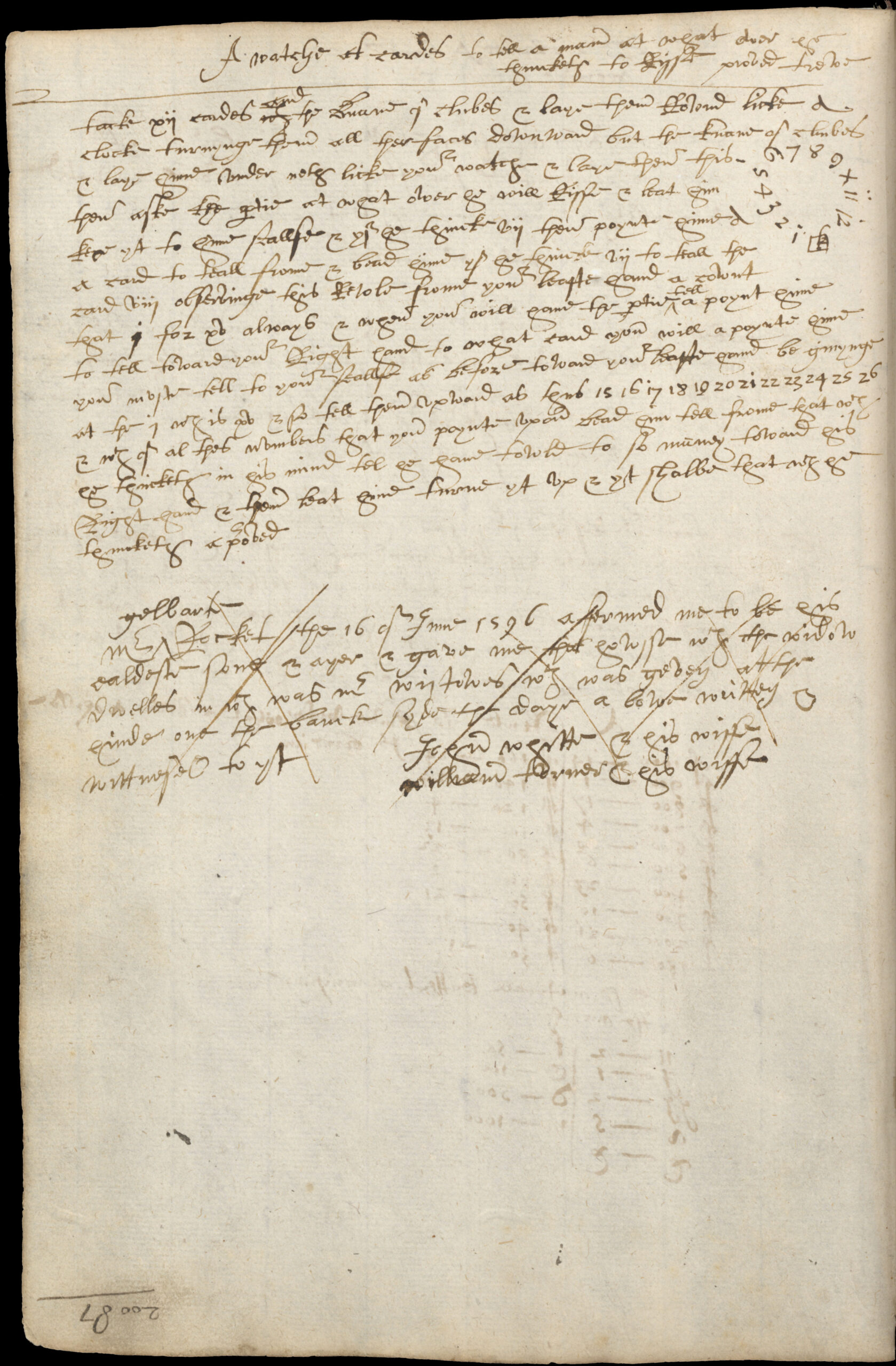
Henslowe, one of Elizabethan theatre’s most important figures, kept a diary. It’s mainly the accounts of the theatre and records of loans, but among the administrivia are some gems — including the following card trick:
Dulwich College Archive MS VII f18v — with kind permission of the Governors of Dulwich College
My dogged team of researchers is looking into it, but there are very few documented card tricks from this era — and most of them are sleight-of-hand or forces. Tiago says this might be related to something written by Pacioli in 1478, and I understand there are Italian deck-stacking tricks from the first half of the 16th century. While it’s relatively unremarkable now, it seems quite sophisticated for its time.
Luckily, the trick was transcribed by W. W. Greg barely 300 years after having been scrawled out by Henslowe:
Now, I don’t know about you, but I’m not fluent in shorthand-infused streams-of-consciousness written in Early Modern English. Maths communication has evidently come a long way in the last 400 years. Here’s the best I can do as a more-or-less faithful translation:
Take 12 cards and the jack of clubs and lay them in a circle like a clock, all face down except for the jack. Put the jack at the bottom like on your watch [ed: I have never owned a watch with the jack of clubs at the bottom of it, but let’s roll with it], laid out like [the picture]. Then ask the volunteer what time they will get up and to keep it to themself.
Tell them to pick a card to count from [ed: It’s unclear to me whether the trickster or the volunteer picks the card — it doesn’t make a difference, so I’d let the volunteer do it]. Starting from this card and moving clockwise, they should count from their card up to 15 — so if they picked 7, they should count on eight cards.
Going around the circle, you count aloud clockwise while pointing at the cards, saying “15” on the first card clockwise from the jack, “16” on the second and so on up to 26. Tell the volunteer that whichever number you said when you pointed at their current card, they should count anticlockwise from their secret number up to that number.
When they flip the card they land on, it will be the number they first thought of.
I presume “a proved” is Early Middle English for “and everyone said WOW! That’s amazing.”
But it doesn’t work.
If you follow the instructions — which, like a game of Telephone that started centuries before the telephone was invented, have been written down from Henslowe’s memory, transcribed by an expert from unclear manuscript, and then translated into modern-day English by someone unqualified to do so. Hi! — you’ll find your “tada!” falls flat, because it’s not their secret number.
Let’s try it: I get up when I want, except on Wednesdays when I’m rudely awakened by the dustmen at 6am. And, rolling a 13-sided die¹ to decide where to start, I get card #3. I need to count on 9 clockwise from there (to make it up to 15), so I end up on card #12. That’s been given the number 26, so I need to count counterclockwise from my number (6) up to 26 — that is, 20 cards backwards. That takes me to 5.
¹ Yes, I do own a 13-sided die. Why do you ask?
Close, but no not-yet-introduced-to-England cigar.
It turns out that, whatever card you start from, and whichever number you pick, you’ll end up on the card immediately before your secret number. This suggests an easy fix: start your counting-aloud from 14 at card #1.
In case you want to do the trick yourself correctly, here are instructions for my version:
Tell your volunteer to think of a secret number from 1 to 12 (don’t let me control your mind!).
Tell them to pick a card (any card! don’t tell me what it is) and count clockwise from their chosen card, starting from their secret number and ending at 15. Have them tell you the card they land on.
Now tell them the numbers attached to the card: whatever “time” their card is on the clock face, give them a number 13 higher.
They must now move anticlockwise from their chosen card, starting from their secret number, ending on the number attached to the card.
Turn over the card they ended up on and say “abracadabra!”.
My glamorous assistant Bill goes through the trick with me. Better magicians than me — which is pretty much everyone — will have ideas about improving the patter and performance.
NOW it works. But why?
You know what else, apart from the later Shakespeare plays, telephones, and cigars, hadn’t arrived in Elizabethan London? I’ll tell you: modular arithmetic. At least, modular arithmetic as we know it — working with remainders goes back to at least Sun Zi in the third century CE, but Euler and Gauss’s formalisations of it were still 150 years away.
I don’t know what Henslowe’s mathematical background was — he was certainly competent at regular arithmetic — so I don’t know whether he understood why the trick worked, whether he came up with it himself, or anything about the history of it. All the same, I’m certain he wouldn’t have used the modulo function.
(In case you’re one of today’s lucky 10,000: modular arithmetic uses the remainder left over when you divide by a given number, like on a clock: 16:00 is the same as 4pm, and we’d say we were working “modulo 12” or “mod 12”, because we are lazy and modulo is far too long a word. The numbers 4 and 16 have the same remainder when you divide them by 12. In this problem, we’ll be working modulo 13.)
Let’s say you’ve picked secret number \(s\) and you decide to start from card #\(c\). You’re going to count on \( 15-s \) cards from there, so you end up at card #\( (c + 15 – s ) \). (We can think of card 14 as the same as card 1 and so on.)
The number I assign to it is 13 more than the card number. Modulo 13, that’s just the card number — but doing it this way ensures we don’t have to deal with negative numbers. (Negative numbers had probably reached England by this point, but I don’t imagine they were the kind of thing you’d want to have in a card trick.)
In any case, the volunteer is currently at card #\( (c +15 – s ) \) and has been given the target # \( (c +28 – s )\) to count to, starting at their secret number \( s \). That means they’re going to move \( (c +28 – 2s) \) cards back the way they came, starting at card #\( (c + 15 -s ) \). Moving backwards makes it a subtraction, so we work out \( (c + 15 – s ) – (c +28 – 2s ) \) to see that we end up on card #\( (s – 13)\).
And, because there are 13 cards, that’s the same as card #\(s\), which has the volunteer’s secret number written on it.
Boom.
One more twist, though
When I talked to young Bill about it, he asked a tremendous mathematical question: “would it work with a number other than 15?” The kid is ten years old, and already making me mutter “good GRIEF, where did that come from?” about three times a month.
The answer is… you don’t need it to be 15. In fact, the first half of the trick is mathematically irrelevant². You could ask them to spell out their secret number in a language of their choice, you could ask them to add their age to their best Parkrun time in minutes, you could ask them to spin a coin and pick the card it lands closest to. It doesn’t matter in the slightest, as long as they pick a card.
² That doesn’t mean it’s not an important part of the trick! I think it’s helpful to demonstrate how you want the final bit counted, and it misdirects the volunteer/audience into thinking there must be something clever going on.
If that’s card #\( C \), then they subtract \( (C + 13) – s \) from it — which again leaves you on card #\( (s – 13) \), which is card #\( s \).
Even knowing the maths behind it, I think this is still a pretty impressive trick. To someone frequenting a smoky Elizabethan tavern, it must have looked like, well, magic.
Thanks to Rob Eastaway for sending me the trick. His book on the maths of Shakespeare, Much Ado About Numbers, is available wherever good books etc.Thanks also to Paul O’Malley and Tiago Hirth for historical help, and to Calista Lucy and the Governors of Dulwich College for permission to reproduce the manuscript page.

![Screenshot of a PDF of the transcription. Text reads: "A watche at cardes to tell a man at what ower he thincketh to Risse proved trewe"; then a horizontal line; then "tacke xij cardes [w^th (and)] the knaue of clubes & laye them Round licke a clocke turnynge them all ther faces downward but the knave of clubes & laye hime vnder neth licke you^r watche & laye them this- then aske the ptie at what ower he will Risse & leat him kepe yt to hime seallfe & yf he thincke vij then poynte hime a a card to teall frome & bead hime yf he thincke vij to teall the card viij observinge this Rewle frome your leafte hand a cownt; that j for xv always & when you will have the ptie ^tell a poynt hime to tell toward you^r Right hand to what card you will a poynte hime you muste tell to your sealfe as before toward you leafte hand be ginynge at the j wch is xv & so tell them vpward as thus 15 16 17 18 19 20 21 22 23 24 & w^ch of al thes nvmbers that you poynte vpon bead him tell frome that w^ch he thinketh in his mind tel he haue towld to so maney toward his Right hand & then leat hime turn yt vp & yt shalbe that w^ch he thincketh a proved." To the right is a diagram of the numbers 1-12 arranged in a circle, with an X in place of 10.](https://aperiodical.com/wp-content/uploads/2024/09/image-2.png)