If you find yourself at a loose end this month, want a break from focusing on work, or have younger mathematicians to entertain, here are some suggestions for online activities you can do/watch/attend. If you have any suggestions of your own, add them in the comments!
In this guest post, Greg Benedis-Grab shares the story of when he discovered Pick’s Theorem, and how he coded an interactive version to play with.
Have you ever been intoxicated by a mathematical theorem? Well that’s what happened to a class of 9th grade geometry students at my school. Their enthusiastic teacher showed them Pick’s theorem.
(Author Positionality: I want to start this post by stating I am writing this from my position and lived experience as a white, male-passing queer, non-binary person who has lived their whole life in the United States of America. I am employed full-time as the mathematics & statistics librarian at a large endowment public doctoral granting university in the USA. I do not have to go up for tenure. I am a highly privileged person. I have not been perfect and I have been a part of the problem. I believe anti-racism is the way to no longer be a part of the problem. I believe Black Lives Matter.)
Note: This post will focus on the mathematical sciences within the USA as that is where my lived experience and knowledge lies. Also, this is an evolving post and resources will be added/changed over time.
Systemic racism, empowered to a great extent by white supremacy, is a part of the society of the USA. The results of this systemic racism can be seen everyday and has most recently made itself crystal clear through the killings of George Floyd, Tony McDade, and Breonna Taylor (among many others), by police and Ahmaud Arbery by a former officer, as well as the differential impact race has on COVID-19 infection rates and outcomes. The mathematical sciences (under whose umbrella I include both Mathematics & Statistics) are a part of this society and not immune to this systemic racism as can be seen day in day out in many ways, including the lack of representation of Black people in the mathematical sciences. A lack of representation that is ongoing and historic with the first Ph.D granted in mathematics in the USA was in 1862 while it was not until 1924 Elbert Frank Cox became the first Black person granted a Ph.D. in mathematics in the USA and intersectionally that Euphemia Lofton Haynes had to wait 19 more years to become the first Black woman granted a Ph.D. in mathematics in the USA. Statistical and Mathematical organizations from around the country have all made statements which are worth reading to understand where the US mathematics and statistics community is collectively at this moment, but I would like to call attention in particular to the one by the National Association of Mathematicians
NAM was founded in 1969, one year after the assassination of Dr. Martin Luther King, Jr. sparked widespread protests throughout the nation, similar to the ones we are seeing today. Indeed, NAM’s founding was a direct result of the marginalization of Black people within the professional mathematics community, which then and now serves as a microcosm of the society in which we live. Over 50 years since NAM’s founding, despite the lessons of the civil rights movement, we still see systemic racial inequities in education, economic prosperity, criminal justice and public health. Today, it should be clear to us all that the consequence of ignoring these racial inequities is dire.
In my own journey toward removing things like false neutrality and color-blind ideology and incorporating anti-racism and social justice into my life and work I have put together a set of lists and resources which may be helpful for those who see a need to take anti-racist steps against this systemic racism. These resources are especially helpful to those with white privilege like I have, especially if you have never interrogated your privilege.
First let us define Anti-Racist:
There is no such thing as a “not-racist” policy, idea or person. Just an old-fashioned racist in a newfound denial. All policies, ideas and people are either being racist or antiracist. Racist policies yield racial inequity; antiracist policies yield racial equity. Racist ideas suggest racial hierarchy, antiracist ideas suggest racial equality. A racist is supporting racist policy or expressing a racist idea. An antiracist is supporting antiracist policy or expressing an antiracist idea. A racist or antiracist is not who we are, but what we are doing in the moment.
There are a lot of learning and actions happening and a lot more which need to happen. I know there is still so much left for me to do and so much left for me to learn. You can reach out to me if you want to discuss these topics more. If you are starting out and struggling with the concepts or you are looking for more ways to learn more about anti-racism and social justice or you are wondering what a next step could be I can not guarantee I will have an answer but I am happy to talk with you. I hope everyone has been able to find and access the support they need, and if there is a way I can provide needed support let me know and I will do what I can.
The next issue of the Carnival of Mathematics, rounding up blog posts from the month of May, is now online at ZoeLGriffiths.co.uk
The Carnival rounds up maths blog posts from all over the internet, including some from our own Aperiodical. See our Carnival of Mathematics page for more information.
I was recently asked for my advice for encouraging maths play with a young child. I should start by saying I’m not qualified to talk about this with authority – I teach mathematics, but to undergraduates. The closest thing I have to relevant experience is playing with my son who is nearly 5, so I can share a little about that.
So how do we encourage mathematical play with my son? I don’t mean to get all philosophical, but what is maths really? Many people think maths is numbers and counting, which is true of course. Maths is built on arithmetic like literature is built on spelling and handwriting, so it’s important but not the whole picture. Maths is also patterns and shapes, structure and order, classifying objects and their properties, … and it can be very playful.
Through nursery and his start at school, I’ve never been concerned with teaching my son things he will later learn at school, because he’s a bright boy and already knowing what the teachers are covering is a recipe for switching off his love of learning and making him misbehave in class. But I think there is a lot that can be done to strengthen his deep understanding in ways that won’t interfere when he comes to learn times tables, or whatever. (There are some caveats here: I’m not totally sure what is on the National Curriculum, and he sometimes plays his own way into curricular topics, as we’ll see with multiplication later.)
I have never done anything very structured. Mostly we played, often following his lead, somewhat inspired by things I’d seen on the #tmwyk hashtag on Twitter. Here I’ll waffle through a few suggestions.
First and foremost: watch Numberblocks on CBeebies. We weren’t big on TV or screens when he was young, and still aren’t really, but Numberblocks is amazing. You must start with episode 1, which introduces number 1, and go from there. Episodes are only 5 minutes long. It quickly introduces numbers 2-5 and then has adventures with them, then 6-10, and so on. It taught him loads about numbers and also gave him a context to understand arithmetic operations. Later episodes gave him a serious interest in big numbers. I suggest you don’t rush through, rewatch earlier episodes if needed before moving on, and definitely watch together and try to talk about the ideas. Look for the numbers around the house. When an episode introduces 3, ask how many groups of 3 things you can find around the house, etc.
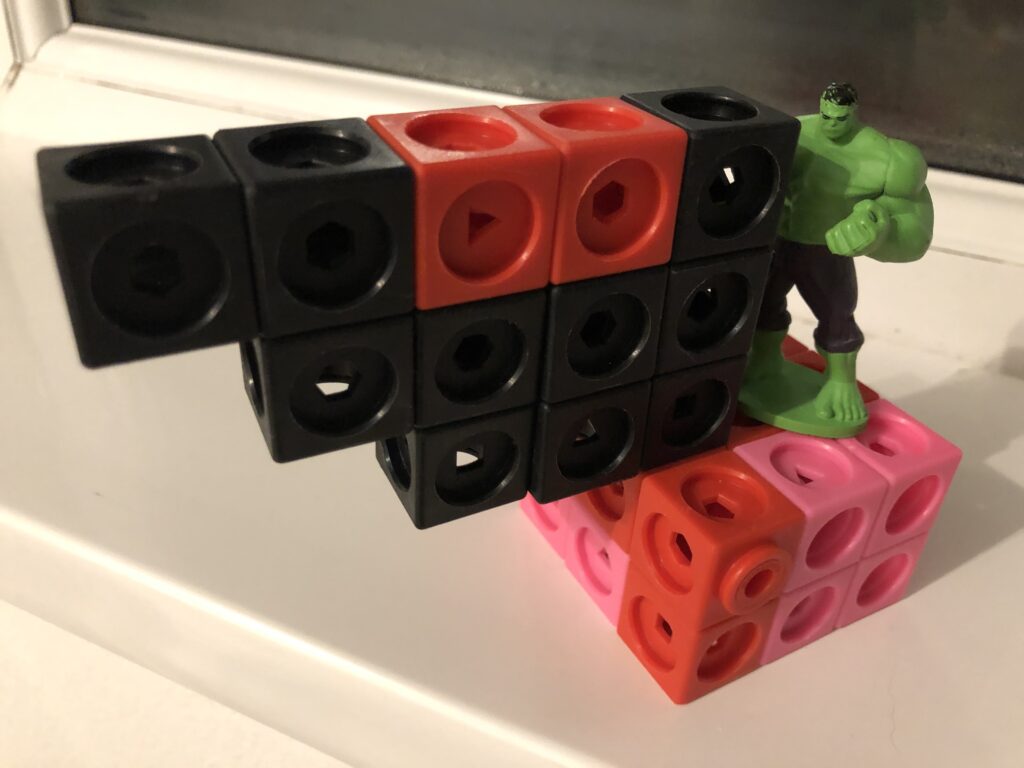
I think the best thing we did for him was buy a set of 100 Mathlink Cubes. These are coloured cubes which join together. He used to spend a lot of time playing with these on his own and with us, making the Numberblocks characters and taking them on adventures, counting them, making colour patterns with them, making shapes with them. Then Katie Steckles kindly bought us Kyle D. Evans’ book Here Come The Numbers, which goes into how to arrange numbers in squares and rectangles, and raises the issue of numbers that can’t be arranged like this, even naming these primes. This gave him a really effective way to understand how numbers work. I think it’s good he has developed his own understanding of how blocks can be arranged into squares and rectangles, even if he doesn’t know he’s multiplying. It also gave him marvellous insight into spacial awareness and symmetry by building shapes, copying shapes I’d built, etc. He still uses the blocks, mostly to build space ships for his other toys to have adventures in – always with a lovely pattern of colours and a symmetric shape. He also plays with magnetic tiles, pattern blocks and Cuisenaire rods, but the Mathlink cubes came first.
There’s a concept called number sense, which is an understanding of how numbers work, their order, magnitude, etc. which can be helped by counting objects, asking which pile of objects has more in it, counting things in groups, etc. Sometimes we’d count number blocks, or match other objects to number blocks, or just count objects directly. How many socks does he have? How many teddies are coming to the tea party? etc.
It’s good to practice counting by chanting numbers in order, using books (although books always stop at 10 and I’d always count to 12 because time uses 12 and I don’t want him to have an uncertainty about 11 and 12) or counting objects, and trying to learn that you tap the objects as you count them in 1-to-1 correspondence. He could tell the time to the nearest hour from an analogue clock when he was 2 by recognising which numbers the little hand was between. He went through a period where he loved doing dot-to-dot puzzles, which are about joining the numbered dots in the right numerical order. At one point nursery were keen that he learns he can count abstract things that aren’t physical objects as well, so we used to count processes. How many parts are there to the morning routine (brush teeth, wash face, put clothes on, …)? How many stages are there to cross the road (hold hands, stand at the edge, look one way, …)?
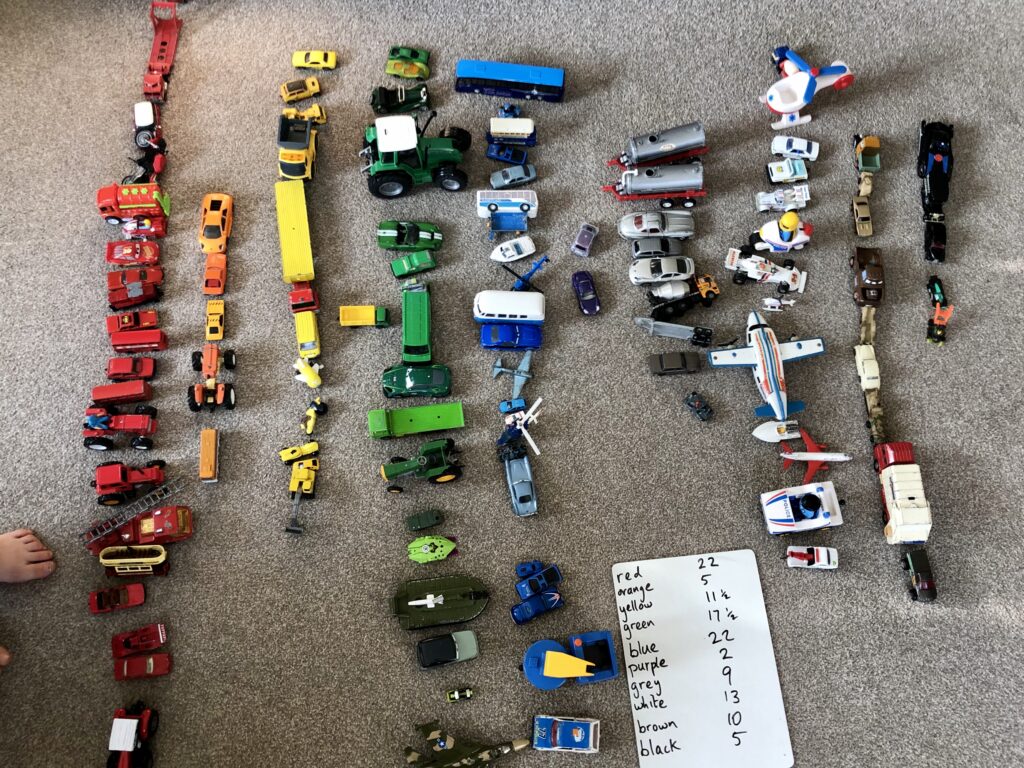
But while you’re counting, you can also talk about the properties of objects and the patterns they form. We have made ‘object graphs‘, which is where you classify things according to some attribute you decide on together and group the objects accordingly. For example, I grabbed a couple of handfuls of Lego and we arranged it by colour (so x axis colour, y axis frequency, though I didn’t use that language). This is exploring the properties of objects and classifying things. Then we counted each group to see which colour we had the most of. We’ve also done the same with different kinds of toys – Star Wars, dinosaurs, cars, etc. You can arrange the same objects using different classifications, which gets into how the same object can have multiple characteristics – this green dinosaur has two legs, but the other green dinosaur has four legs, etc. All this thinking about properties of objects is very mathematical. We used to play I-spy long before he could read by e.g. “I spy with my little eye something that’s red/round/tall/etc.” Again, classifying properties of objects. Just recently, we’ve played with #vehiclechat, which proved to be good fun thinking about definitions and classifications.
There’s a good pair of books called How Many? and Which One Doesn’t Belong? The latter in particular is amazing. The idea is that there are four objects and each has a plausible reason why it could be the odd one out, so there is no wrong answer but it’s just about talking properties and justifying your answer. My son really enjoys coming up with a reason for each of the four objects in a Which One Doesn’t Belong? Recently he has started making his own Which One Doesn’t Belong? puzzles from pattern blocks.
My son made these and asks “which one doesn’t belong? And how many times can you turn them?”
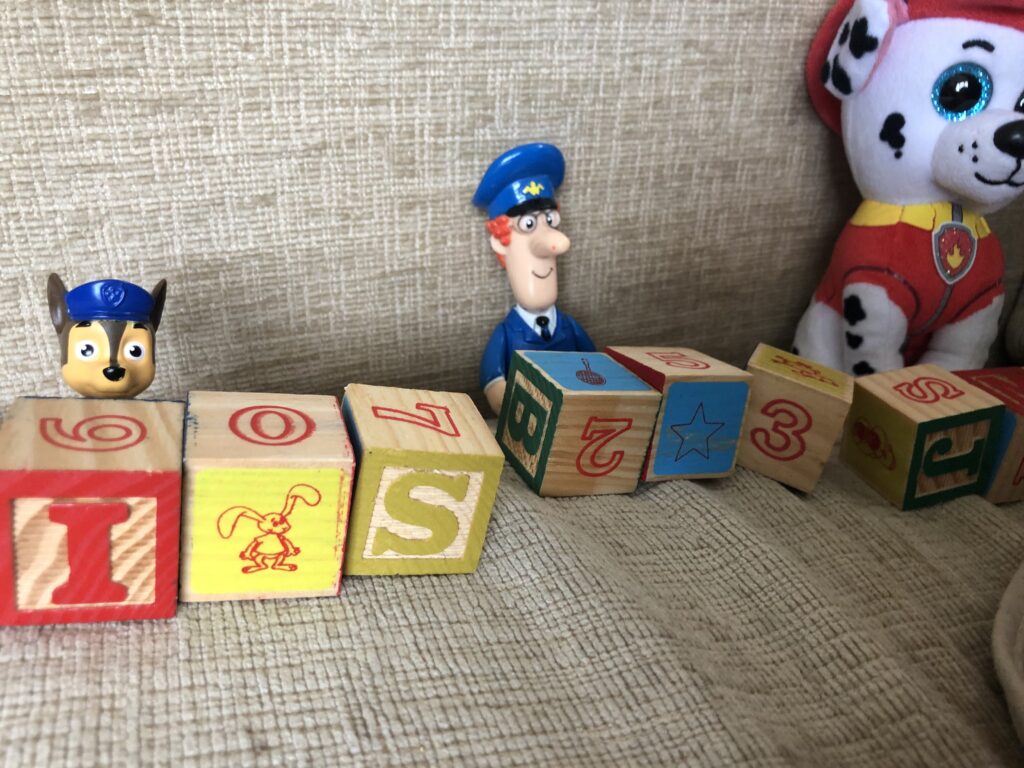
Apart from this, I am quite serious about maths being interlinked with other areas, especially at this age. We explored patterns by reading poems or story books and talking about words that rhyme, and making up nonsense words that rhyme with real words, etc. He asked what it is called when two words rhyme at the start, so he became a little boy with a good sense of alliteration. We’d play games on the walk to nursery where we’d take turns to say a word and the other would have to say a word that rhymed or alliterated with it. One day I told him about palindromes and he became obsessed, spotting them, inventing nonsense palindrome words, etc. This playing with language is good for his language, of course, but also it’s about patterns and properties, so it’s building that good foundation on which maths can grow.
This is just some rambly thoughts, but I hope it was interesting and helpful.