At work we’ve got a 3D printer. In this series of posts I’ll share some of the designs I’ve made.
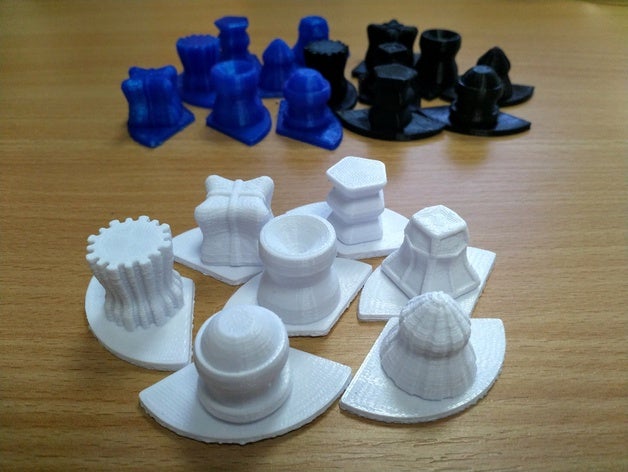
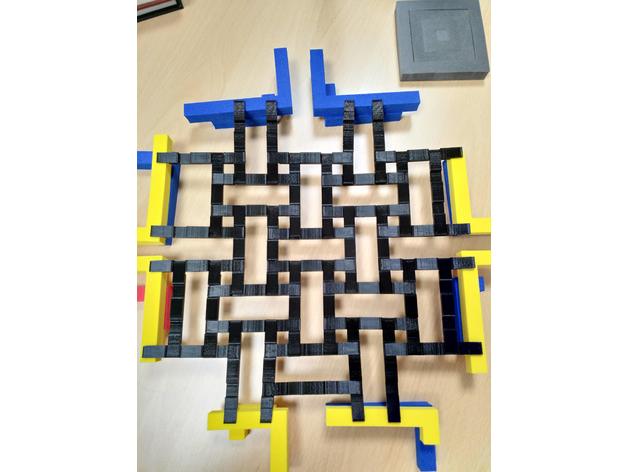
This is something I’ve wanted to make for a long time: a literal sieve of Eratosthenes.
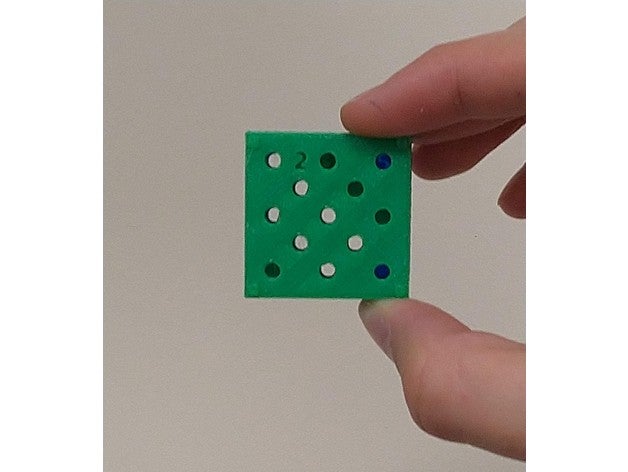
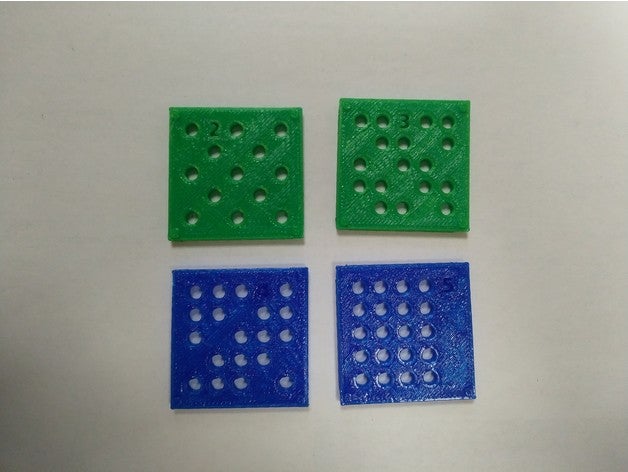
This is a collection of trays which stack on top of each other.
Each tray has a grid of holes, with some holes filled in. The tray with a “2” on it has every second hole filled in; the tray with a “3” has every third hole filled in; and so on.
When the trays are stacked together, the holes you can see through correspond to prime numbers: every other number is filled in on one of the trays.
I went through quite a few iterations of this design. The first version was a series of nesting trays. After printing it, I realised that you might want to put the trays in a different order. After that, I did a lot of fiddling with different ways of making the plates stack on top of each other. The final version has sticky-outy pegs at each corner, and corresponding holes on the other side. I had to add a fair bit of margin around the holes so the wall didn’t go wiggly when printed.
At work we’ve got a 3D printer. In this series of posts I’ll share some of the designs I’ve made.
At the start of the Summer we (I) bought a new 3D printer for the department, a FlashForge Dreamer. It’s got two extruder heads, so it can do two-colour prints.
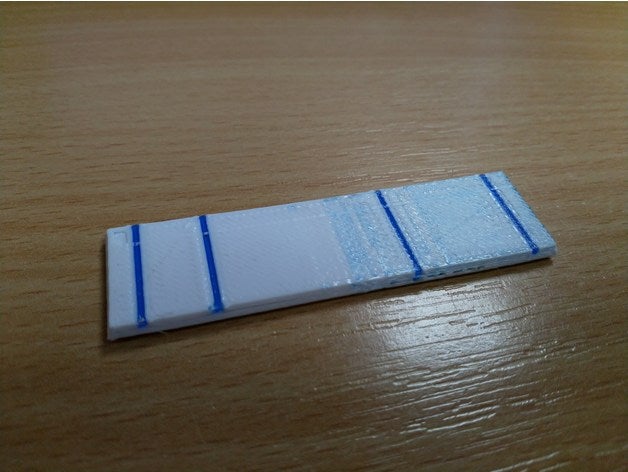
To test that out, I designed this Golomb ruler. It’s a straightedge with marks at 0, 1, 4 and 6 cm. The idea is that you can measure 1, 2, 3, 4, 5 or 6 cm by lining up against different pairs of marks. I recently did a silly Twitter thread on this subject.
As you can see from the photo, two-colour printing isn’t quite as straightforwared as it could be. Because both nozzles need to stay hot, while one colour was printing the other just oozed out and made a mess. There are some settings on the printer you can change to try to reduce this, but I haven’t got the hang of it yet.
At work we’ve got a 3D printer. In this series of posts I’ll share some of the designs I’ve made.
The roof of the Sheldonian theatre in Oxford, built from 1664 to 1669, is constructed from timber beams which are unsupported apart from at the walls, and held together only by gravity.
At work we’ve got a 3D printer. In this series of posts I’ll share some of the designs I’ve made.
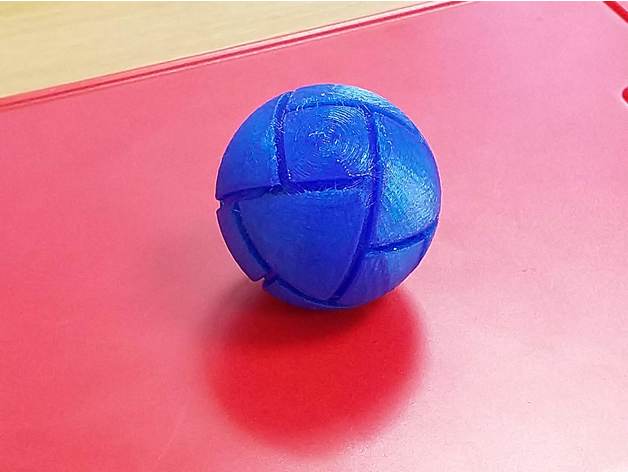
This shape is a “spherical pseudo-cuboctahedron”, prompted by a request from Jim Propp on the math-fun mailing list.
It has 24 vertices, 12 edges and 14 faces. That doesn’t satisfy Euler’s formula $V – E + F = 2$, so it can’t be a proper polyhedron – hence “pseudo-cuboctahedron”.
However, if you push all the vertices onto the surface of a sphere, all the edges are spherical arcs, it sort of works.
While designing this object, I got fed up with OpenSCAD‘s awkward control syntax, and switched to Python. I wrote Python code to produce the coordinates of points along the edges, which the SolidPython library turned into something that OpenSCAD can cut out of a sphere.
At work we’ve got a 3D printer. In this series of posts I’ll share some of the designs I’ve made.
This is one of the first ‘proper’ things I’ve designed – I wanted to have a go at making something based on an object I already had. A colleague asked if I could make some props to explain coordinate systems, and I was holding a whiteboard pen at the time, so I decided to make a set of orthogonal axes out of whiteboard pens.
The next issue of the Carnival of Mathematics, rounding up blog posts from the month of October, is now online at Woolly Thoughts and Mental Blocks.
The Carnival rounds up maths blog posts from all over the internet, including some from our own Aperiodical. See our Carnival of Mathematics page for more information.