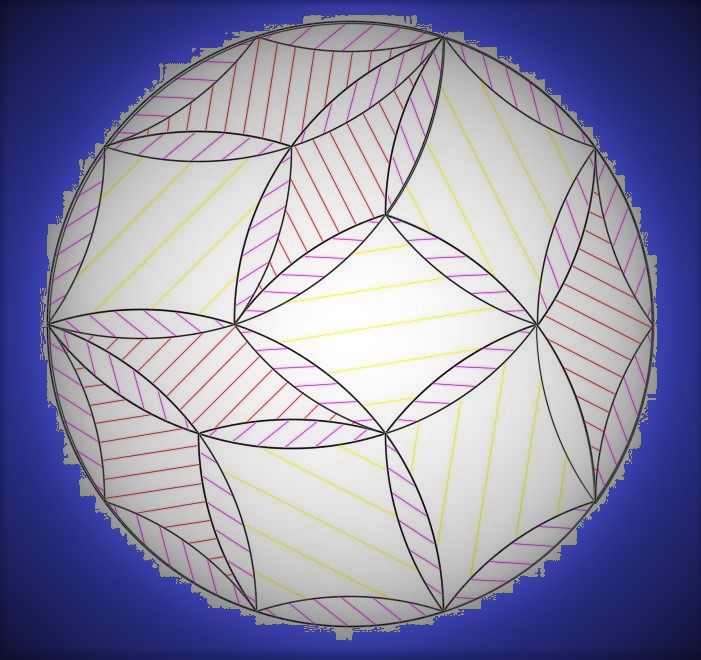
Tim has previously written guest posts here about tiling by tricurves, and is now looking at ways of tiling with other shapes.
In an earlier post elsewhere I covered some basic arc-sided shapes that tile by themselves. Lately I’ve been playing with groups of curved tiling shapes, asking a question common for me: how to get the most play value as an open-ended puzzle? This means getting the most interesting possibilities from the simplest set. “Interesting” includes variety, complexity, challenge and aesthetic appeal. “Simplest” covers not only size of set and the shapes, but also the least total information needed to describe or construct the shapes.
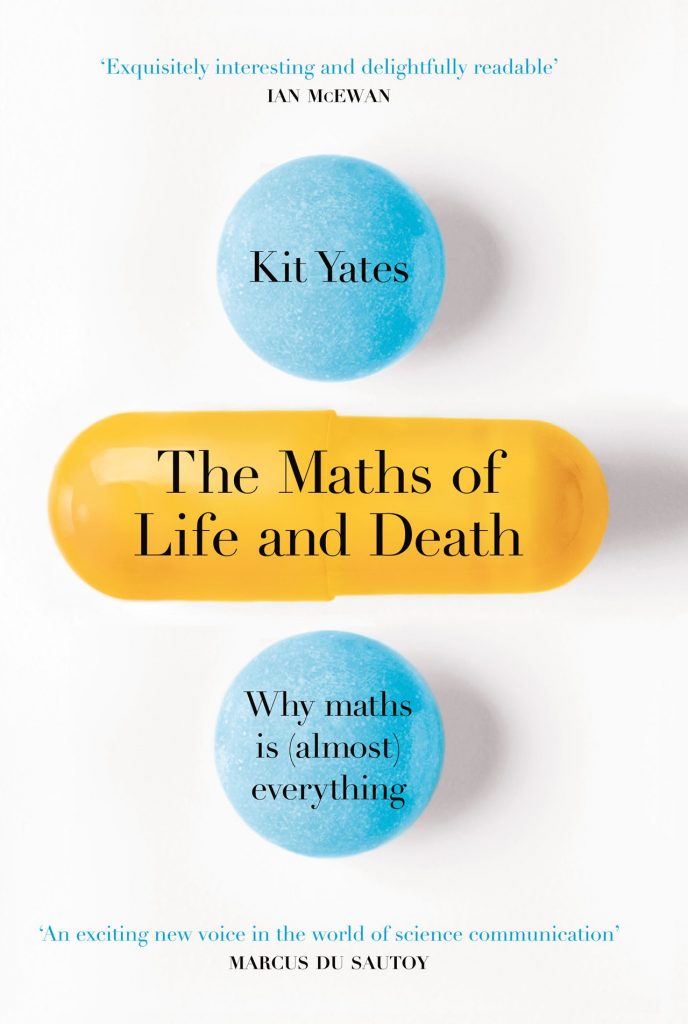
Aperiodicolleague Kit Yates has recently had a new book out: The Maths of Life and Death. He’s kindly agreed to share a sample chapter with us, explaining the God Equation: it’s used by NICE to decide whether to fund new drugs.
In my new book, The Maths of Life and Death, I explore the true stories of life-changing events in which the application (or misapplication) of mathematics has played a critical role: patients crippled by faulty genes and entrepreneurs bankrupt by faulty algorithms; innocent victims of miscarriages of justice and the unwitting victims of software glitches. I follow stories of investors who have lost fortunes and parents who have lost children, all because of mathematical misunderstanding. I wrestle with ethical dilemmas from screening to statistical subterfuge and examine pertinent societal issues such as political referenda, disease prevention, criminal justice and artificial intelligence. I aim to demonstrate that mathematics has something profound or significant to say on all of these subjects, and more.
We asked #bigmathoff competitor Lucy Rycroft-Smith to tell us a little about her latest project – CM Define It, an app aiming to collect and define mathematical vocabulary, which launches today.
When
you teach mathematical vocabulary, how do you define its meaning?
Are
you exact, choosing your words specifically?
Do you give a written definition?
Do you give multiple explanations?
Do you use diagrams? Metaphors?
Connect to previous vocabulary?
As part of our work at Cambridge, creating a Framework for mathematics learning, we are creating a network of semantic links across nodes in our mathematical layer – and we initially thought we could just import a mathematical glossary from somewhere else to populate this. But we found so many inconsistencies, technical errors, and definition loops in many existing glossaries that we decided to make an app to ask the mathematical community what they thought, with the aim of developing a crowdsourced, multi-layered collage which takes into account different layers of mathematical experience.
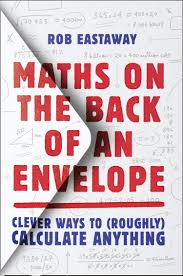
Aperiodipal and MathsJam regular Rob Eastaway organised an inter-MathsJam competition for last month’s events, challenging Jams to make Fermi estimates on the back of an envelope. The prize was a copy of his new book, Maths on the Back of an Envelope. Here Rob gives a summary of the entries he received, and shares his favourites.
Regular attendees of MathsJam will know that in September, Katie Steckles kindly allowed me to hijack the evening (in the nicest possible sense) by posing some envelope-related challenges, in celebration of the publication of my new book Maths On The Back Of An Envelope. In addition to some envelope-related puzzles, there was also an open challenge to Maths Jam groups to come up with their own back-of-an-envelope problems, with the chance to win the book as a prize.
This month’s Carnival of Mathematics is hosted here, at The Aperiodical. The Carnival rounds up maths blog posts from all over the internet, and this month we’ve reached the heady heights of number 174.
The next issue of the Carnival of Mathematics, rounding up blog posts from the month of August, is now online at PeterKrautzberger.org.
The Carnival rounds up maths blog posts from all over the internet, including some from our own Aperiodical. See our Carnival of Mathematics page for more information.
Euclid of Alexandria lived c. 300 BCE. He wrote The Elements, the most widely used mathematics and geometry textbook in history. The Elements consists of thirteen books. In all, it contains 465 theorems and proofs, described in a clear, logical and elegant style, and using only a compass and a straight edge. Euclid’s Elements has influenced all branches of science but none so much as mathematics and the exact sciences. No other book except the Bible has been so widely translated and circulated.
The first printed version of the Elements appeared in 1482 with the advent of the printing press. It was based on Campanus of Novara’s 1260 edition. On May 25, 1482 printer Erhard Ratdolt of Venice issued the first printed edition of Euclid’s Elements. It was the first substantial book to contain geometrical figures. From definitions and axioms, Euclid showed how to prove dozens of mathematical propositions, producing knowledge that was objective and undeniable.
Isaac Newton’s famous work Principia Mathematica clearly demonstrates Euclid’s influence. Newton called his famous laws of motion “axioms” and deduced his law of gravitation in the form of two mathematical theorems.
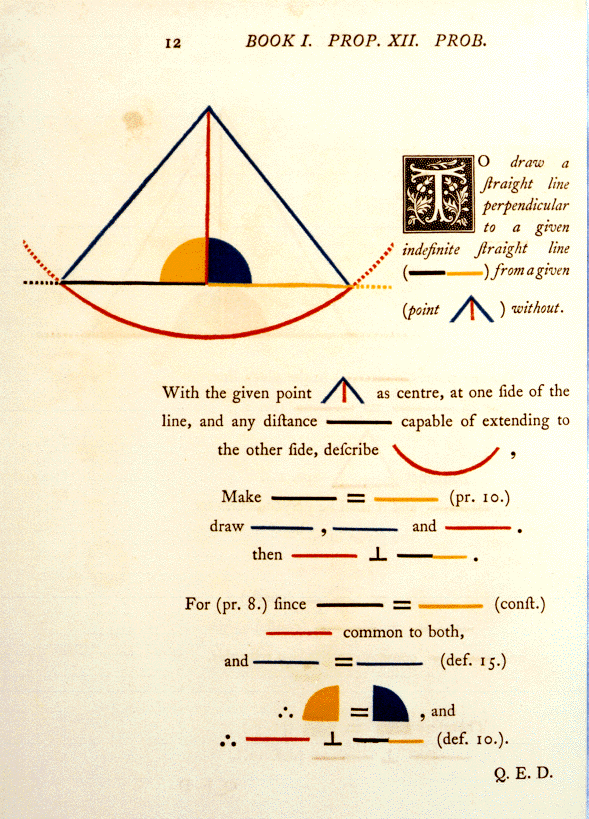
Page 12 from Book 1 of Oliver Byrne’s edition of The Elements
Who was Oliver Byrne, and what did he do?
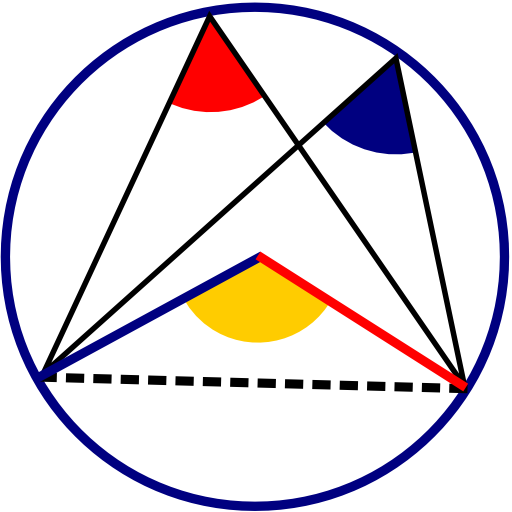
Irish-born Oliver Byrne (1810-1880) was an innovator in mathematics education, particularly in the teaching of geometry. His most well-known book was his colorful version of ‘Euclid’s Elements’, published in 1847. Oliver Byrne employed a red, yellow, and blue color scheme for the figures and diagrams in his most unusual 1847 edition of Euclid’s Elements.
“I do not introduce colours for the purpose of entertainment, or to amuse by certain combinations of tint and form, but to assist the mind in its researches after truth, to increase the facilities of instruction, and to diffuse permanent knowledge”.
Oliver Byrne
Byrne had experimented with colors in schools and he had evidently decided that the schoolteacher’s approach indicating lines, angles,… on the blackboard and then making deductions from them would be better described by his method than in the usual way.
Oliver Byrne’s 1847 Euclid was one of the first multicolor printed books. Many consider it the most attractive edition of Euclid’s Elements ever produced.Byrne’s Euclid was exhibited in London at the Great Exhibition of 1851. Praise was given for its beauty and the artistry of the printing, which may have influenced future publications and artwork.
You might have noticed we’re fans of Byrne’s diagrams here at the Aperiodical (see: our header images and branding). What drew you to Byrne’s work?
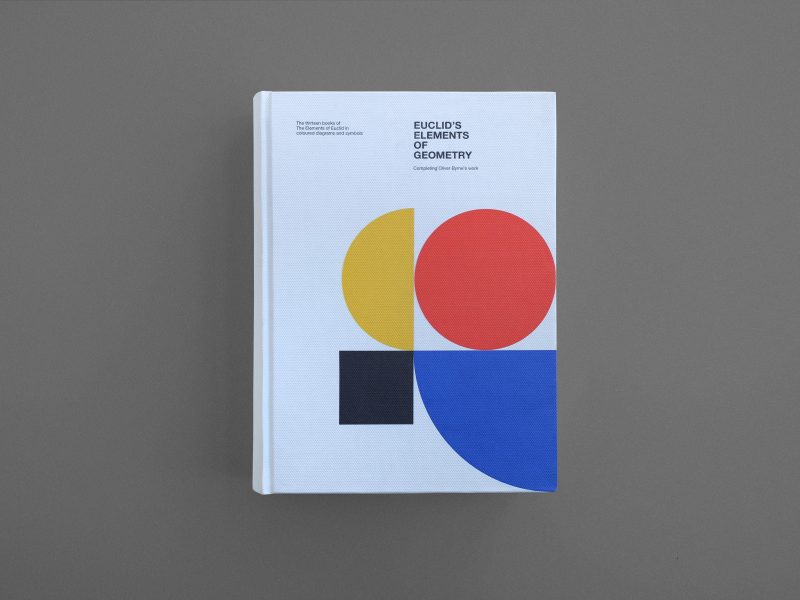
After printing Isaac Newton’s Principia, we were searching for another major book in science. We have been in love with Elements for a long time and as design enthusiasts, Byrne’s work held a special place in our minds. Those beautiful, minimalist, clean and didactical lines encouraged us to start a crazy adventure, to finish Byrne’s work. All 13 books. It simply could not be unfinished!
What’s different between your edition and Byrne’s original?
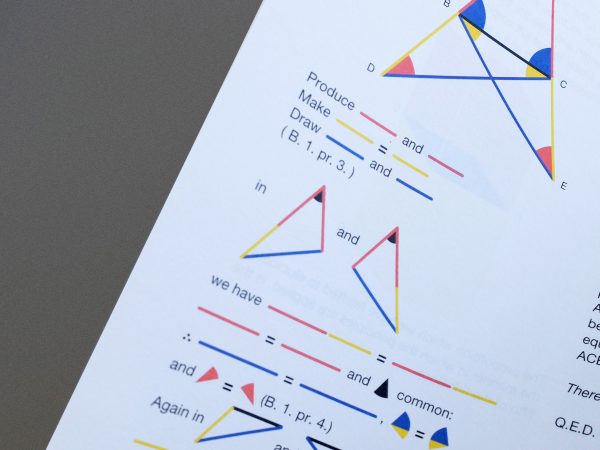
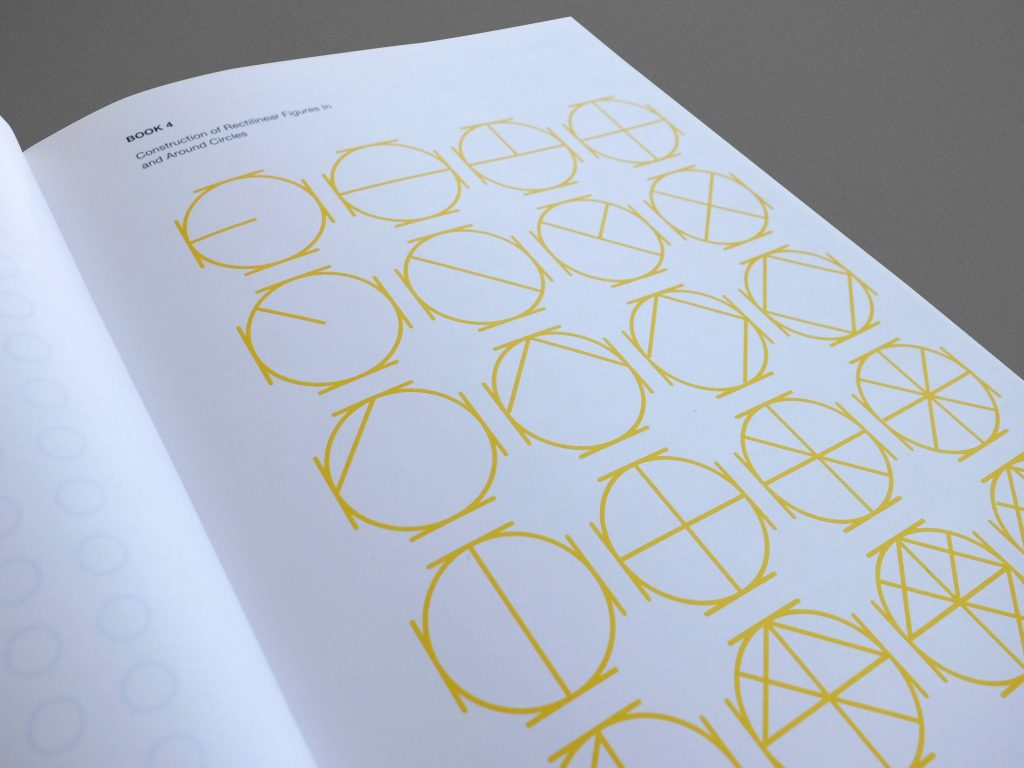
The first six books are identical. We only applied a modern vectorial design to graphs and a new typography, but the content is the same. Our hard work started when creating the visual interpretation of the rest of the books, from 7 to 13.
Who took on the challenge of reinterpreting Euclid’s work on books 7-13?
A team of 6 mathematicians worked almost a year and a half – thinking, drawing and writing every page of the books. The team not only have great mathematical skills, but also a deep knowledge of mathematics history and mathematics didactic.
Were there any challenges presented by content in the later books?
Absolutely. Almost all the later books were a challenge, especially the 10th. This book involved a very long journey for our mathematicians. Not only talking about maths – the entire project was a challenge because we needed to manage a large team of mathematicians, designers, editors… taking our small company nearly to its limits – it was hard and difficult to adapt a lot of non-geometrical propositions; lots of points-of-view, a lot of nights thinking how to solve a problem… but in the end we have achieved what we believe to be an outstanding end result.
How did you incorporate Byrne’s unique graphical style for the less visual content?
We were faithful to Byrne’s philosophy and before any designer started to work, we created a visual guide for internal use. With that guide, we worked together with mathematicians re-using graphical elements and creating some new ones – because books 7 – 13 needed a new color (some graphs needed more than Byrne’s three basic colors).But focusing on your question, for the less visual content, we followed Byrne’s color scheme and put it into the text as imaginary words.
What’s the target audience for your book? Why should we buy an expensive paper edition when free, interactive versions are available online?
We are intrinsically ‘digital’ and know that physical books nowadays can seem hard to manage and expensive….thats the reason we print books with high quality papers and with a love for design. We try to keep an eye on the details and quality. We have a high respect for our customers and want to create books that meet their expectations (when they are committed to not relying on the free digital versions) – it’s our priority. Obviously, our Elements is an expensive book because it was very expensive to produce. Much more than our other books.
We smiled when we found out that Byrne’s Euclid was extremely difficult and expensive to produce. Only one thousand copies (almost like our crowdfunding campaign) were originally published. It was sold at a price of 25 shillings, almost five times the typical book price at the time. Maybe we are also close to that ‘five times the amount’ with our book – compared to a typical book.
Our audience are science lovers. A lot of our customers send us ideas of new books, authors,… and they are science people. But also they love well-produced books and buy them as collectors because our books are books to own, not only to read. We do not know how to, nor do we want to, create a monotonous and characterless product. We want to create books to own and create the desire to touch unique books made by lovers of books and science. Not only for customers.
What have you learned from this project?
Patience! We published it with a few delays because we prioritized quality and good content versus speed. That meant, people had to have a lot of patience with us waiting for their books without asking. We love our customers and supporters, they are the most important motivation for us. Also, we learned how beautiful mathematics can be and the power of joining mathematics and design – to reach more people and understand math better.
As well as the book itself, are there any related products people can pick up? (I’m thinking posters. I want a poster.)
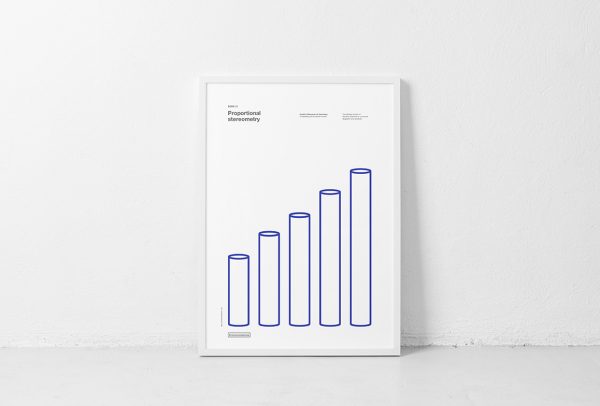
Yes! Posters – we created a poster of every book cover. The cover design is our creation, Byrne didn’t create them. They are truly beautiful.
At the other hand, our Newton’s Principia could be also a related product. Newton used Euclid’s Elements knowledge and language to introduce his theorems. Since last Tuesday we are trying to reprint it again.
What’s your next project? Is it also maths-related?
Now we are only focused on a 6-book Astronomy collection. We did a Kickstarter campaign earlier this year, and we are working hard now on translations. Another challenge for us!
We don’t know which will be our next big project. I’ll keep you posted!