Mathematician and ninja mathematical-thinking-prompter Alison Kiddle has been posting an image each day for the whole of August, each prompting some kind of mathematical question or discussion.
You're reading: News
- Caroline Series, Emeritus Professor of Mathematics, University of Warwick. Appointed CBE for services to Mathematics.
- Ceinwen Blake, Deputy Director, Corporate Information Technology and Services, Office for National Statistics. Appointed OBE for Public Service.
- Simon Lebus, Interim Chief Regulator, Ofqual and member of the Maths to 18 expert advisory group. Appointed CBE for services to Educational Assessment.
- Pat Ryan, Founder and Director, Cyber Girls First. Appointed OBE for services to STEM Education for Girls and to the Provision of IT Equipment for Children in Hospital.
Aperiodical News Roundup – July 2023
Here’s some mathematical news that didn’t make it on to the site otherwise this month.
Maths News
There’s been more abc conjecture drama: Peter Scholze and Jakob Stix are in line for a ¥140m (around £766k) prize for their paper pointing out the flaw in Mochizuki’s claimed abc proof – if they publish it in a journal.
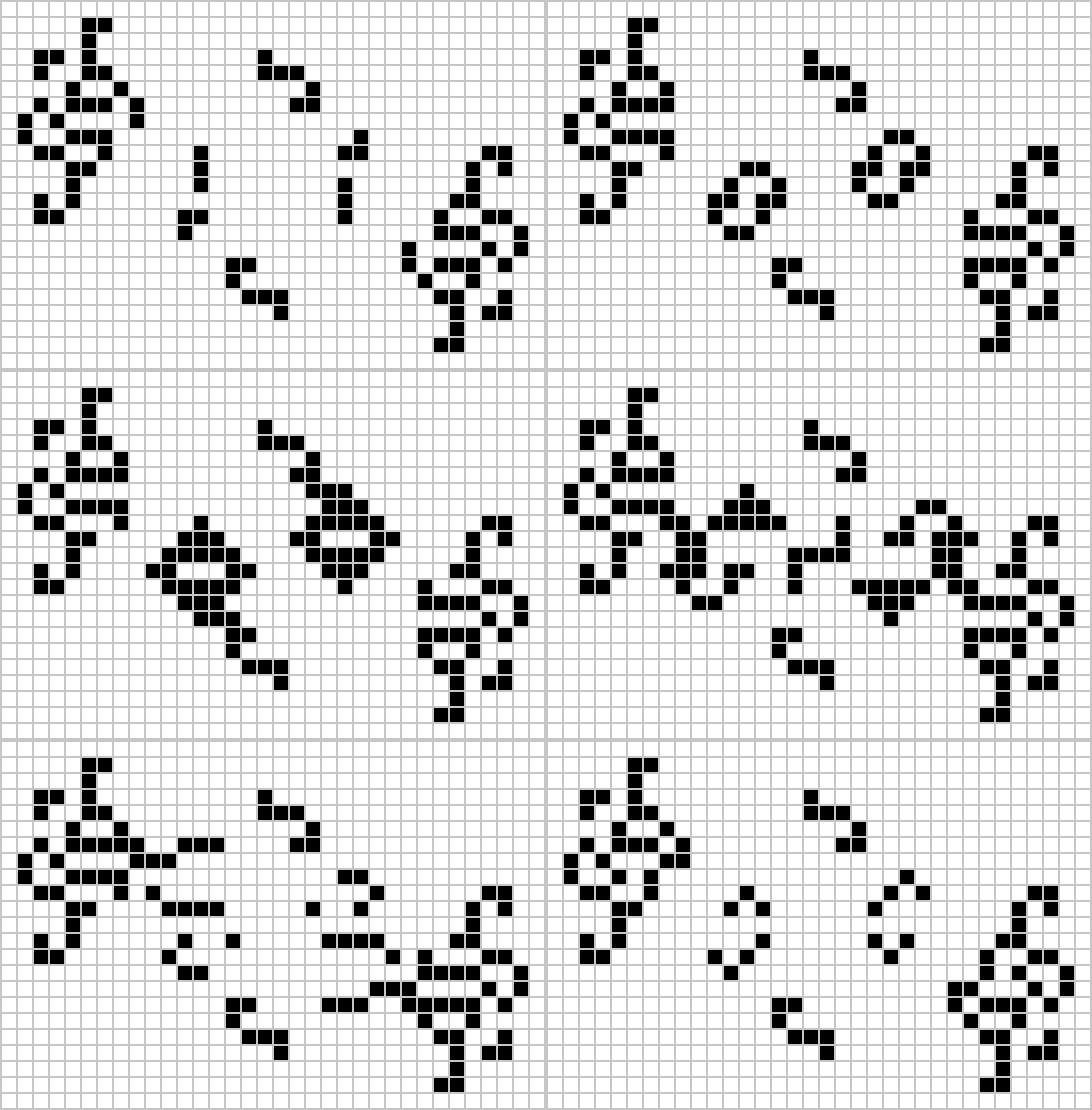
A period 19 oscillator has been found in Conway’s game of life – the discussion thread on ConwayLife just gives it as a series of coordinates, but it already has an entry on LifeWiki, where it’s called ‘Cribbage’. (via Isaac Grosof)
Then, a week later, the first ever period 41 oscillator was also found! Excitingly named 204P41 (consisting of 204 cells) it’s led to another discovery – it looks like we now know how to make oscillators with any period, meaning Game of Life is omniperiodic. Since 2013 we’ve known all periods above 43 were possible, and this fills a gap in this excellent table.
Lean’s mathlib has been completely ported to Lean4 – if you’re familiar with proof assistants, you may find this news exciting or significant. Here’s a video showing off what that looks like. Meanwhile, the Lean Focused Research Organization has been set up to “advance the formal mathematics revolution”. (via @leanprover@functional.cafe)
Events and Organisations
Inclusion/Exclusion, a justice and maths blog, has posted an open letter to the MAA about holding MathFest in Florida, requesting an option for online participation due to the state’s recent draconian law changes. It pulls ε punches:
Regardless of any in-person safeguards that MAA may put in place, this year’s MathFest will not be a safe event for trans people, for undocumented immigrants, or for many other members of our community, including disabled people. Therefore, our most urgent request is that you provide an online participation option.
Excerpt from the open letter
If π approximation day on 22/7 got you thinking about your plans for the next actual π day, you might find it useful to know that the International Day of Mathematics 2024 theme is Playing With Math. From their website, “In 2024 we want to celebrate mathematical games, puzzles and other entertaining activities, but also “playing” with mathematics itself, exploring, experimenting, and discovering.”
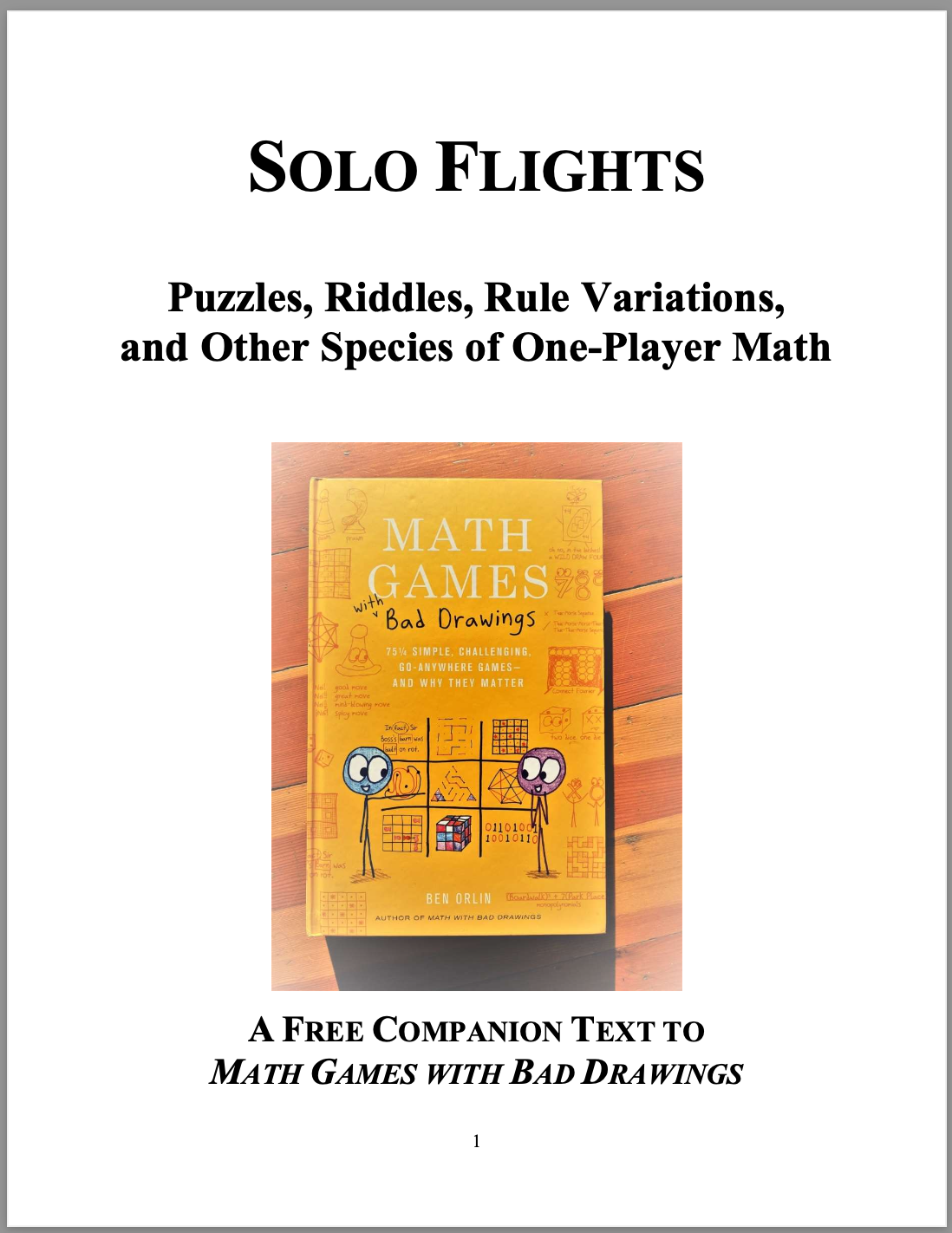
Speaking of mathematical games, Ben Orlin has released a book of solitaire games as a follow-up to his “Math Games with Bad Drawings”. It’s available for free on his website as a PDF, and therefore weighs infinity less than the actual book it’s a follow-up to, which is so huge it’s collapsed into a black hole under its own mass. (via Patrick Honner)
And finally: Tim Wall, the Australian group theorist, has died. According to his profile on the Australian Academy of Science website, Wall “has made highly significant and original contributions to the development of Algebra, in particular to the Theory of Groups. […] He has always instinctingly given of his ideas to his collaborators and younger colleagues.” Thanks Tim!
Interview: Kyle Evans on his 2023 Fringe show, Maths at the Museum
We spoke to friend of the site, award-winning maths communicator and past math-off competitor Kyle Evans about his Edinburgh Fringe show for 2023, which is about maths.
Aperiodical News Roundup – May & June 2023
Maths news didn’t stop coming this month, and if you missed it, here was our coverage of the new Spectre aperiodic monotile, an improvement on the previous monotile discovery. Here’s some other news that happened in May and June which we didn’t otherwise cover here.
Vladimir Drinfeld and Shing-Tung Yau have been awarded the 2023 Shaw Prize for their contributions related to mathematical physics, to arithmetic geometry, differential geometry and Kähler geometry. (via the European Mathematical Society)
According to provisional 2023 entry data, mathematics remains the most popular choice at A level in England and Wales this year.
Ticket sales continue apace for this year’s TMiP maths communication conference, and in the meantime it’s inspired a nascent equivalent network for math communicators in the US – sign up if you’re an American math communicator who WLTM others.
There’s been a moderation strike at Stack Overflow, which includes Math Overflow, in response to AI-generated content policy changes. “Striking community members will refrain from moderating and curating content, including casting flags, and critical community-driven anti-spam and quality control infrastructure will be shut down.” (via theHigherGeometer)
There’s a free online IMA event, including a talk called ‘How Maths Helped Me to Annoy My Insurance Company’ by Victoria Sánchez Muñoz taking place at 5pm on Thursday 13 July.
Obviously the most important news this month is the new Rubik’s cube world record – it’s now possible for a human to solve the cube in as little as 3.13 seconds (furious they’ve skipped π seconds) and the GIF included in the article shows just how impressive the feat was.
And finally, this Nature article outlines how deep reinforcement learning has discovered faster sorting algorithms. Algorithms such as sorting or hashing are everywhere – used trillions of times a day, according to the article. This means even small efficiency improvements can be huge because of the scale, but these algorithms are so well-studied that further efficiency was difficult to imagine. DeepMind trained a deep reinforcement agent, AlphaDev, to work from scratch using assembly code to attempt to find a better sorting routine. The researchers reverse engineered the algorithms found by AlphaDev to C++ and found these led to performance improvements of “up to 70% for sequences of a length of five and roughly 1.7% for sequences exceeding 250,000 elements”. The Nature paper has details of the algorithmic improvements. The improved algorithms have already been implemented into the LLVM libc++ standard sorting library.
Particularly mathematical Birthday Honours 2023
The UK Government have announced the first set of King’s Birthday Honours for King Charles III. Here’s our selection of particularly mathematical entries for this year. If you spot any more, let us know in the comments and we’ll add to the list.
Get the full list of honours on gov.uk.
Now that’s what I call an aperiodic monotile!

Surely you didn’t expect news about aperiodic tilings to appear at regular intervals? You know how it is – you wait ages for a new aperiodic monotile discovery to come along, then two come in quick succession.
In March, we covered the discovery of an aperiodic monotile. The team of authors behind that discovery have been continuing their work and this week have an even bigger announcement.
Aperiodical News Roundup – March, April & some of May 2023
It’s been a busy few months! As per our name, here’s an aperiodically-timed round up of things that have happened in the world of maths in the last few months.