If you were interested in Keith Devlin’s Massively Open Online Course (MOOC) Introduction to Mathematical Thinking in the autumn but heard about it too late, didn’t have time to take part, or signed up but couldn’t keep on top of the course, you may be pleased to hear that Keith has announced plans for the course to run again from 4th March 2013 for 10 weeks. This is longer than the seven week course which started in September.
You're reading: News
The nonsense math effect
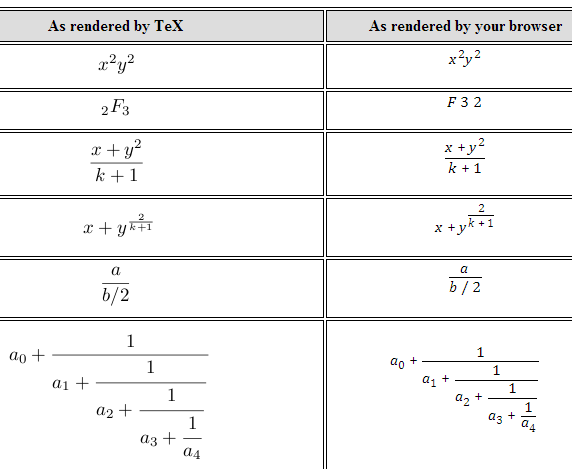
This week, the Freakonomics blog covered research by Stockholm University’s Kimmo Eriksson, which found that including a mathematical equation in the abstract of a research paper made scholars from different fields judge the research to be ‘of higher quality’, even though the equation is unrelated to the work and also complete nonsense. The study included 200 participants, although the amount by which the equation increased the perceived ‘quality’ of research varied between disciplines, and in fact caused a slight decrease for people working in mathematics or science subjects.
Math/Maths 127: Hiatus Begins
A new episode of the Math/Maths Podcast has been released.
A conversation about mathematics between the UK and USA from Pulse-Project.org. The podcast is going on hiatus for a few months, so Samuel and Peter give a short goodbye, with: mathematical Christmas presents; a list of back-episodes to listen to on special topics or with special guests; other podcasts to try; what they’re doing for the next six months; and a heartfelt thanks and goodbye.
Get this episode: Math/Maths 127: Hiatus Begins
2013: I can be the year of stuff too!
2013 will be the first year since 1987 in which all digits are different from one-another.
— The QI Elves (@qikipedia) December 31, 2012
In case you were bored of hearing that amazing ‘mathematical’ fact number coincidence, don’t worry – 2013 is mathematical for other reasons. Even though we’ve run out of Alan Turing Centenary year, and the slightly-under-mentioned Poincaré Centenary year, apparently 2013 is both The International Year of Statistics (Statistics2013) and the year of scientific collaboration project Mathematics of Planet Earth 2013. Watch out for upcoming events related to both!
Not mentioned on The Aperiodical last year
Here’s a quick round-up of some news stories from the tail end of 2012 that we characteristically failed to write up!
Math/Maths 126: Review of the year – 1712
A new episode of the Math/Maths Podcast has been released.
A conversation about mathematics between the UK and USA from Pulse-Project.org. In a traditional move for the end of December, we attempt a review of the year. In an untraditional move, we choose the year 1712. Catch up with the latest from Christian Goldbach, Sir Isaac Newton, Gottfried Leibniz, John Flamsteed, Brook Taylor, Giovanni Cassini and Abraham de Moivre.
Get this episode: Math/Maths 126: Review of the year – 1712
Let’s ture to the max!
A new study from Prof. Lawks A. Mercy and Dr. O. Goode-Griefe of the Institute of Blogging Studies indicates that we have published absolutely loads of posts about Alan Turing this year, the Alan Turing Year. We’ve posted about Alan Turing events, Alan Turing facts, Alan Turing competitions and O mercy me have we posted about Alan Turing petitions.
So this is the last Turing post of 2012. I’ve been saving this thing up so it can be the last Turing post this year and on Wednesday morning we can put the whole mad shebang behind us.
What I’d like to bring your attention to is nothing so demanding of your attention as a petition or a campaign, but a little suggestion for a simple way to commemorate Alan Turing: Donald A. Knuth has posted on his website that it would be a nice idea to define a meaning for the verb ‘to ture‘.