University of Chicago grad student Kathryn Mann spotted this possibly-sexist flyer handed out by the AMS at a recent event:
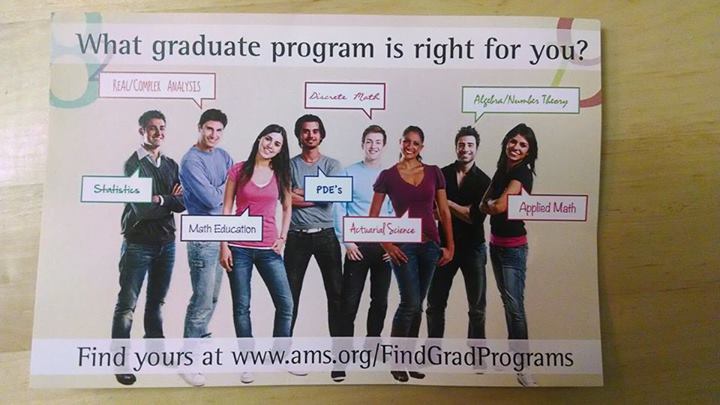
The beautiful stock photo men are all doing pure maths, and the beautiful stock photo women are all doing applied! Heinous!
University of Chicago grad student Kathryn Mann spotted this possibly-sexist flyer handed out by the AMS at a recent event:
The beautiful stock photo men are all doing pure maths, and the beautiful stock photo women are all doing applied! Heinous!
Media math-man Alex Bellos has made another programme for BBC Radio 4, this time about How to Teach Maths.
Alex Bellos takes you on a mathematical learning journey from the first stages of number recognition through to an understanding of how children solve sums and calculate answers. On the way he will look at the neuroscience of maths and how our mathematical brain develops. He investigates the scientific evidence behind teaching maths and he’ll compare how modern methods of teaching children differ from those taught to their parents, helping kids today go beyond basic numeracy to develop a passion for numbers.
By the way, Radio 4 have also been repeating Marcus du Sautoy’s enjoyable A Brief History of Mathematics at a quarter to two each afternoon. That’s also available to listen to on the Radio 4 website.
Listen: How to Teach Maths on BBC Radio 4.
21 October 2014 is the centenary of the birth of Martin Gardner, the supreme populariser of mathematics (amongst much else) who sadly passed in 2010. Those behind the Martin Gardner Centennial website and associated Twitter account @MGardner100th are collecting testimonials from people inspired by his work.
What does his extensive written legacy mean to you? Are you one of the many who can say things like “I only read Scientific American for Martin’s column” or “The reason I became a [insert profession/hobby here] is because of Martin”?
We’d love you to submit your comments here please. Feel free to say a little about yourself; if you taught physics for 27 years, tell us. If you are an artist or puzzle maker, or a student of computer science or psychology or linguistics, let us know. If you were lucky enough to correspond with or meet the great man, share your story. If you’ve already written elsewhere about Martin’s influence on you, please don’t be shy about giving details (web links, etc). If you’re a well-known author yourself, who knew Martin, please chime in too. Martin didn’t care if his sources or correspondents were amateurs or professionals, and we’re equally broadminded. We actively seek a good cross-section of comments, but we don’t mind repetition either. So many people have similar stories to tell, and we want them all.
Currently testimonials include Keith Devlin (testimonial #29), Cliff Pickover (#24), George Hart (#9), Max Maven (#3), John Allen Paulos (#30) and Colm Mulcahy (#7).
The website says all submissions will be posted following review. Testimonials can be submitted via the website or by email to gardnercentennial@gmail.com.
For more about Martin Gardner, listen to the All Squared interview with Colm Mulcahy.
Via John Read on Twitter, who submitted testimonial #38.
Here’s a nice idea: a journal for people to write about open problems, with the aim of inspiring someone to have a go at solving them. Open Problems in Mathematics is a new open-access journal set up by Krzysztof Burdzy and a few others, and it’s online now.
Many of you who are aware of the internet will have noticed that some mild controversy has surrounded a recent Numberphile video, posted last week:
[youtube url=http://www.youtube.com/watch?v=w-I6XTVZXww]
Anticapitalists, please note: This post is categorised “not-directly-paid-for friendertisement”. We’re plugging a thing our friends do because we think it’s good, but alas, they make money off it. Please read with caution.
 Fans of mathematics and science in general will be pleased to hear that they no longer have to travel long distances to see comedy show Festival of the Spoken Nerd – as it’s on tour! The show features Stand-up Mathematician and friend of the Aperiodical Matt Parker, as well as some-time mathematician Steve Mould, and singer of science and maths songs Helen Arney. The comedy trio are visiting over 30 locations around the UK and performing their new show, Full Frontal Nerdity, which I’m assured ‘contains strong language and spreadsheets’, and is guaranteed to ‘feed your brain, tickle your ribs and light your Bunsen burner’. It’s a longer version of the show they performed at last year’s Edinburgh Fringe, and would make a great group night out for a maths department or other gathering of scientifically-minded humans (just saying).
Full details of the show, and a list of dates, can be found at the Festival of the Spoken Nerd website.
 TV maths advocate and certified old person Johnny Ball is hoping to stage what will be a record-breaking World’s Largest Maths Lesson, by filling a stadium with kids and talking to them all about maths at the same time. The event will take place on March 19th, during National Science and Engineering week, and will be aimed at 9-13 year olds.
The current world record is 2,981, set in Nigeria in July 2013, and they’re hoping to smash that using Leeds United’s Elland Road stadium (capacity: 39,460) – Johnny Ball himself has stated he’d be happy with “5, 6, 7 or 8,000 kids” (7 kids probably isn’t enough – better shoot for 8,000). The event is being sponsored by Yorkshire-based boiler maintenance company (?!) Help-Link, and is supported by Leeds City Council.
If you’re a maths teacher in Yorkshire, or know anyone who is, tickets are free and you can apply by emailing the organisers. Details are below.
TV legend hosts bid to stage the world’s biggest maths lesson at stadium, at the Yorkshire Evening Post.
Help-Link to break a Guinness World record in 2014, on the Help-Link website.
Help-Link UK’s Giant Maths Lesson with Johnny Ball, on YouTube.
Event flyer (PDF)
National Science and Engineering week.
via Alex Bellos on Twitter