There is an article in the Wall Street Journal about journals that publish negative results. There is a problem with scientific research that positive results are more likely to get published than negative ones. This can lead to spurious statistical results and researchers wasting their time because a procedure or technique might appear more successful than it really is.
You're reading: Main
Math52: A Fresh Way to Teach?
‘Math52: A Fresh Way to Teach’ is a Kickstarter project currently seeking funding. The organisers offer the following promise: “Every week for a year we’ll create a short video exploring a unique application of math in everyday life.” The emphasis is on providing teachers with material to enrich their teaching. You can find out more by watching the video below and visiting the Math52 Kickstarter page.
Flat tori in three-dimensional space and convex integration
French researchers Vincent Borrelli, Saïd Jabrane, Francis Lazarus and Boris Thibert have described an isometric embedding of the flat torus in 3D space, using the convex integration theory developed by Gromov in the 1970s. That means they’ve produced a surface which is topologically a torus – it has a single hole — which preserves distances between points in the 4D flat torus. Interestingly, the tangent plane is defined everywhere — the surface is in a sense smooth — but the normal vector is not defined, so it’s also a fractal. This is impossible in higher dimensions
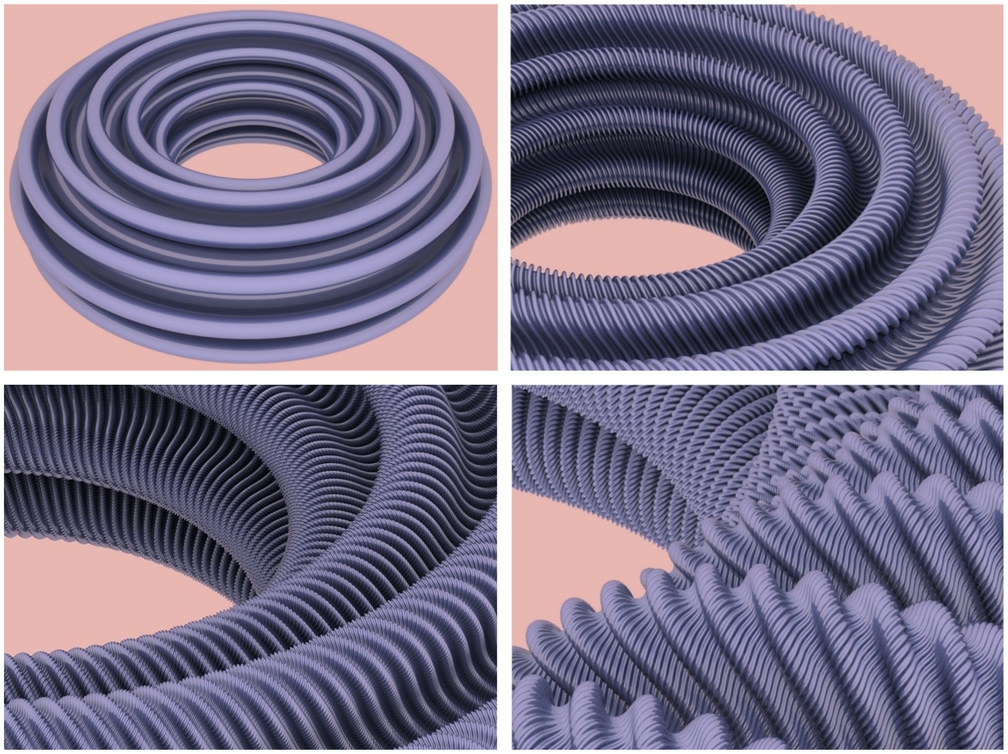
I’ve recorded a short video explaining in a handwavey fashion, with a few props made from things I had lying around, just what has been done.
Aperiodcast – 13/5/2012
In true Aperiodical fashion, we left 13 days before recording another Aperiodcast, so here’s what we think about the last almost-two-weeks on the site.
We talked about:


Podcast: Play in new window | Download
Subscribe: RSS | List of episodes
Math/Maths 96: Permeated by Robot Noise
A new episode of the Math/Maths Podcast has been released.
A conversation about mathematics between the UK and USA from Pulse-Project.org. This week Samuel and Peter spoke about: Math paper retracted because it ‘contains no scientific content’; Top Majors of 2022; New Journals of Negative Results; New UK law obliges publishing of public data in open formats; Frozen primes; Follow the timeline of Alan Turing’s life; TU Munich Cancels Elsevier; Help get Octave developed for Android! (like MATLAB, but free); Open Textbook Catalog; Tony’s Maths Blog; Tika Taka Analysis; Fractal Pancakes; and more. The recording is clear but, though Samuel could hear Peter, although with a time lag, during the episode Peter increasingly couldn’t hear Samuel. Makes for fun times!
Get this episode: Math/Maths 96: Permeated by Robot Noise
Life imitates Life
A while ago somebody created a simulation of Conway’s Game of Life inside a bigger version of the Game of Life. Now, YouTube user Phillip Bradbury has created a very simple — and aurally pleasing ((the Shepard tone is used to create the illusion of a sound constantly increasing in pitch)) — video showing it in action.
[youtube url=http://www.youtube.com/watch?v=xP5-iIeKXE8]
Apparently this is made possible by the Outer Totalistic Cellular Automata Meta-Pixel (OTCAMP), a “two state programmable unit cell which allows Conway’s Life to simulate any outer totalistic rule. OTCAMP is a meta-cell which is also a meta-pixel. OTCAMP meta-pixels display evolving meta-patterns on-screen in meta-realtime.”
An outer totalistic rule is a rule for a cellular automaton which defines the transitions between cell states based on the total number of switched-on surrounding cells surrounding them. The Game of Life is one such rule.
Source: Richard Elwes on Google+.
Parallel postulate not proven after all – paper retracted as having “no scientific content”
A paper published in the January 2010 issue of Computers & Mathematics with Applications which, according to Times Higher Education, “used unspecified computer ‘magnification technology’ to provide the first proof of a Euclidean axiom called the ‘parallel postulate'”, has been withdrawn by the publisher.