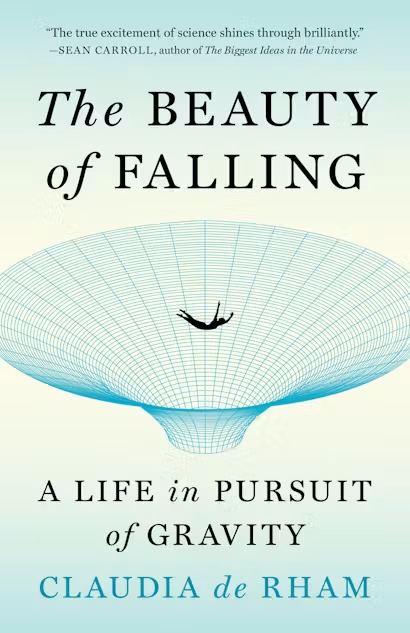
We were kindly sent a copy of Claudia de Rham’s new book ‘The Beauty of Falling’, and asked irregular contributor Elinor Flavell to write this review.
You're reading: Main
- Professor Dwight Barkley FRS (University of Warwick)
- Professor Francis Brown FRS (University of Oxford)
- Professor Frank Calegari FRS (University of Chicago, USA)
- Professor Mark Chaplain FRSE FRS (University of St Andrews and President, LMS)
- Professor Charlotte Deane MBE FRS (University of Oxford and Executive Chair, Engineering and Physical Sciences Research Council)
- Edited April 28th to correct \( BB(6) \) to \( BB(16) \). Apologies.
Aperiodical News Roundup – April/May 2026
Here’s a short round-up of maths news stories from the last two months that we didn’t otherwise cover on the site.
Thomas Dieterrich, a representative of the arXiv, has clarified the site’s AI policy – in a Twitter thread (non-Twitter mirror link) he explains that their Code of Conduct states that the an author of a paper posted on the arXiv “takes full responsibility for all its contents, irrespective of how the contents were generated” – meaning that “if generative AI tools generate inappropriate language, plagiarized content, biased content, errors, mistakes, incorrect references, or misleading content, and that output is included in scientific works, it is the responsibility of the author(s)”.
The implications of this are serious – “If a submission contains incontrovertible evidence that the authors did not check the results of LLM generation, this means we can’t trust anything in the paper.
The penalty is a 1-year ban from arXiv followed by the requirement that subsequent arXiv submissions must first be accepted at a reputable peer-reviewed venue”. The responses in the thread include some interesting discussion!
Relatedly, the Leiden Declaration on AI and Mathematics calls on researchers to implement AI use responsibly – including full disclosure when AI tools are used, taking responsibility for AI-generated content published in their name, and ensuring credit is given to sources (which is often difficult if AI surfaces something from its training data without credit). They also have some thoughts about the dangers of publishing results via informal channels like blog posts and social media, rather than through existing journals. You can add your name to the list of signatories if you agree! (via Dave Richeson on Bluesky)
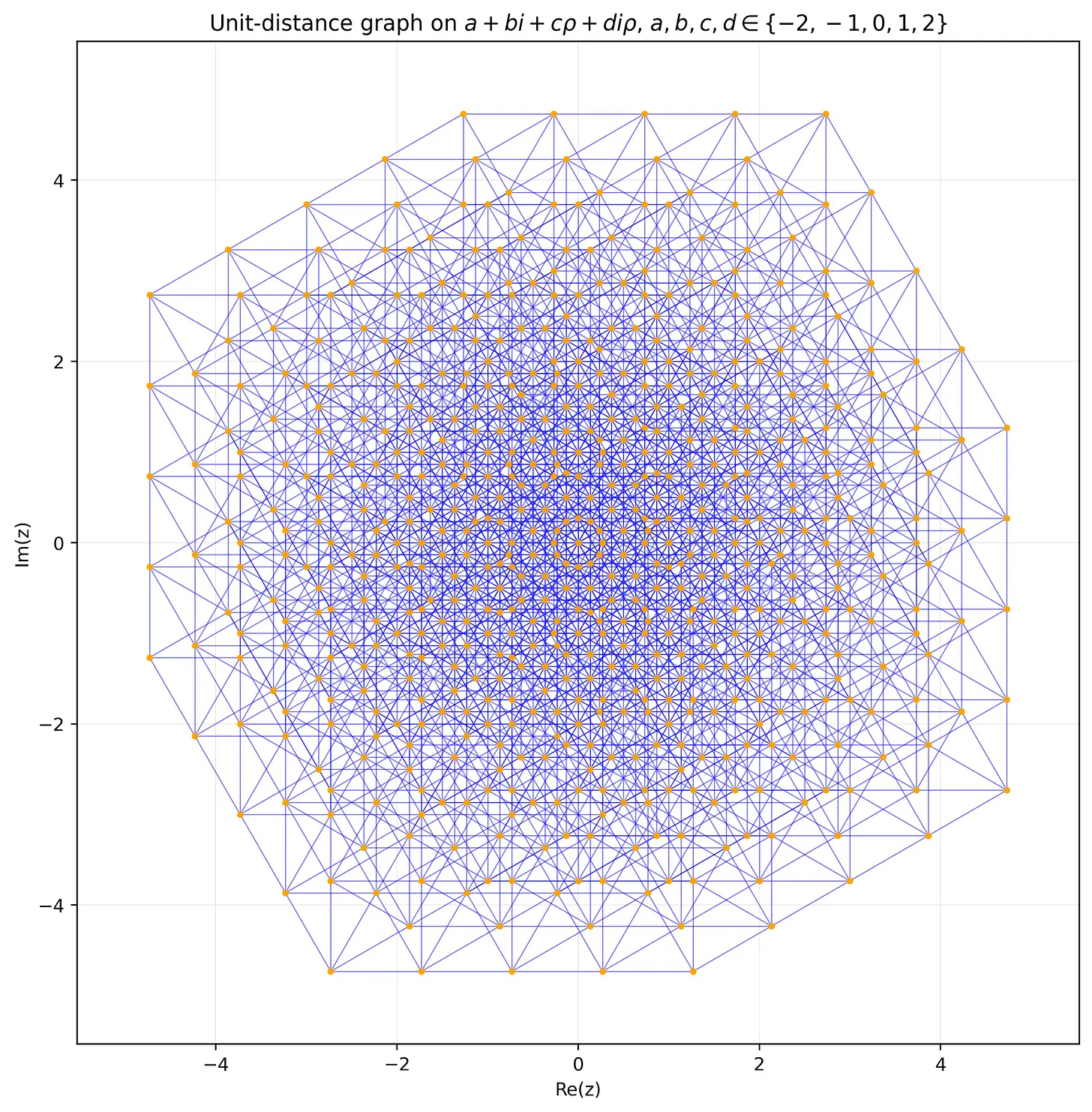
Meanwhile, OpenAI says their model has disproved the planar unit distance conjecture, originally stated by Paul Erdős, which asks “If you place \(n\) points in the plane, how many pairs of points can be exactly distance \(1\) apart?”
Fields medallist Tim Gowers is impressed, saying “This will I think be looked back on as the first time that AI solved a major mathematics problem”. As always, Gil Kalai has blogged about it, including links to several other in-depth writeups – including this interesting take from Eric Hoel.
This year’s intake of new Royal Society Fellows contains a number of mathematicians and maths-adjacent researchers, including:
And finally, Michael Rabin, of the Miller-Rabin primality test (among many other achievements in cryptography and automata theory), has died at the age of 94.
Book review – A Guide to Infinity: Ten Mathematical Journeys by Edward R. Scheinerman
We were sent a free copy of this book by the publisher, and invited irregular contributor Elinor Flavell to read and review it.
Been feeling finite recently? Bounded by life? Those larger numbers feeling out of reach? Then you need “A Guide to Infinity: Ten Mathematical Journeys” by Edward R. Scheinerman. Over ten chapters, Scheinerman takes the reader through the infinity at the end of the number line, that other infinity between zero and one, the other other infinity found in shapes, and many other other other infinities.
The book reads like a set of lecture notes – and like lecture notes, has its pros and cons. This is not the book to give your friend to convince them that maths is amazing. However, if it’s been a while since you studied infinity, or you are looking for something to fill your time before you start university in the autumn, or maybe you are currently studying topics around infinity, you may find this book helpful.
Like lecture notes, there are lots of definitions, which can be useful when building up your knowledge about infinity. However, like lecture notes there is also assumed knowledge, and use of words before formal definitions! Those who are more familiar with mathematical jargon may find it easier to peruse.
At the end of each chapter there are several questions to the reader – which I think are great! They clearly follow from the material in the chapter, but are quite open questions, and more than one question made me stop to properly think about it.
For me, “A Guide to Infinity” does not quite contain enough information on the wider context and history of infinity. Scheinerman does make a few mentions of names, but I wanted more! Of course, as a historian of maths I am biased towards including historical material in books, but I think it would have complemented the book well – without this, it reads, as I keep saying, like a set of lecture notes.
As anyone who has taken a lecture series can tell you, not all lecture notes are created equal – and as lecture notes go, “A Guide to Infinity” is good. However, it does not quite match its claim of being “An accessible Introduction to Mathematical Infinity for the Endlessly Curious”. Infinity is a hard topic to start with – and for me, “A Guide to Infinity” does not quite hit the spot.
A Guide To Infinity at Yale Books
A Guide To Infinity on Bookshop.org
A Guide To Infinity on Waterstones.com
Review: Huge Numbers by Richard Elwes
There’s a story about a child mathematician talking to an older mathematician and saying “I think the biggest number is a TRILLION.”
The grown-up says “OK, but what about a trillion and one?”
The child mathematician looks crestfallen, but only for a moment. “Oh. At least I was close!”
If you’ve ever interacted with mathematically-inclined children, you’ll have experienced at least the occasional obsession with big numbers, if only so they can say “I hate you RAYO’S NUMBER times, no backsies”. For the more ancient mathematician, the fascination tends to wear off: as Sam Hartburn notes, “infinity’s pretty big” – no matter how enormous the number you can imagine or write down, most numbers (in some sense) tower over it. A trillion is effectively zero compared to a googolplex, \( 10^{10^{100}} \). A googolplex is tiny compared to Graham’s number. \( BB(16) \) scrapes Graham’s number off of its shoe with a look of mild distaste.
As a consequence, Richard Elwes‘s Huge Numbers initially struck me as an unpromising idea for a book. What is there to say, other than “here’s a big number. Oh look! Here’s a bigger one!”? Like the child mathematician, I had severely underestimated. Elwes is infectiously bouncy, with dashes of light-touch humour mixed in with the explanations of how we get from numbers we can count without trying to numbers that presumably required several long and furious email chains with the typesetters.
The book is in three parts: in Giants Of The Ancient World, we explore big numbers discovered long ago and how they pushed the limits of the notational systems used to communicate them, culminating in a Jain thought experiment a millennium ago that requires Knuth up-arrow notation to get close to. We then crash back to reality with The Numbers Of The Universe, in which space, time and combinations get the treatment, before winding up with Beyond The Human Horizon, where we get to what my kids would consider “the good stuff” – numbers that require new types of maths just to be considered worth thinking about.
I confess to getting a bit lost in this part – perhaps unsurprisingly, the process of reaching mind-bogglingly large numbers left my mind a bit boggled, and I found myself struggling with a heady mixture of Turing machines, mathematical cookbooks and a “who can write the bigger number” challenge that I had a hard time keeping up with the first time through; it’s a section that rewards reading more slowly than the rest of the book.
For all that, it’s a lot of fun – Elwes clearly cares about googology, understands that it’s a slightly silly thing to care about, but also that by caring about silly things, you can reach some very serious mathematics.
+1 to that.
Huge Numbers is published in the UK by Basic Books and is available wherever good books are sold.
For disclosure, the circle of maths communicators is pretty small, so I know Richard via Talking Maths in Public and consider him a friend. He considers me “someone with a cunning ruse for getting free books.”
Aperiodical News Roundup – March 2026
Here’s a quick round-up of maths internet news this month!
Progress has been made on the Lonely Runner problem, which concerns when runners of different speeds going round a track will meet up, and has connections to higher-dimensional geometry.
A workshop for queer and trans people in category theory, which has an excellent logo, will take place in Hamburg, 12-14 August 2026. (via tessa on mastodon)
The board of the journal Communications in Algebra have resigned in protest at policies imposed by the publisher, Taylor and Francis – including doubling the number of reviewers needed on each paper, which the board consider to be unsustainable. (via Michael Kinyon)
The arXiv is becoming independent from Cornell University, and is looking to hire a $300k/year CEO.
April sees the start of the Month of Math – 5 weeks of puzzles shared every two days, organised by the Joy of Thinking Foundation.
And finally: weird symbol news! The mystery of the Unicode symbol ⍼ has been solved: it represents azimuth. (via Oscar Cunningham)
Aperiodical News Roundup – February 2026
Here’s a short round-up of mathematical and maths-adjacent news from this month.
The LMS are seeking Outreach Lecturers, who must work in UK HE mathematics, and will receive a two-year post during which they’re expected to deliver talks to a minimum of 4 schools around the UK each year. The talks should be free to the schools, targeted at a minimum 75% schools with a high proportion of pupils from disadvantaged backgrounds. The post comes with a small honorarium to cover travel and ‘associated costs’, and the deadline for applications is 9th March.
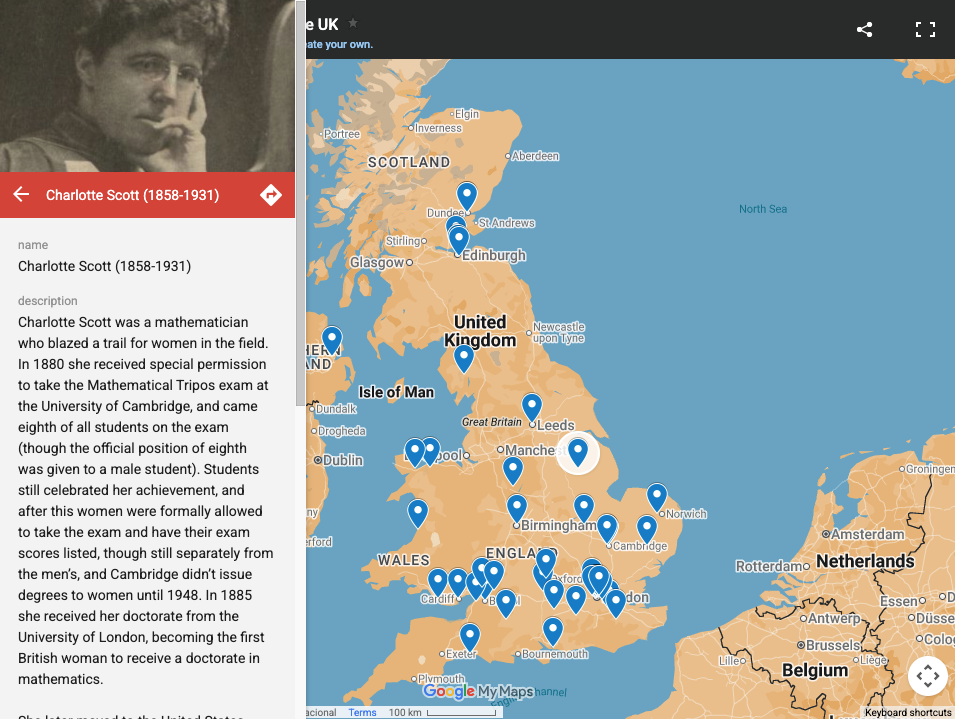
The Royal Society has launched a Women in STEM History Map. They acknowledge there isn’t much on it yet, and have issued a call for help filling it in. (via Noel-Ann Bradshaw on LinkedIn)

Computer scientist Joe Halpern, known for his research on reasoning about knowledge and uncertainty, has died at 72. His book Reasoning about Knowledge is available as a PDF. (via Lance Fortnow on Mastodon)
In a recent issue of DMFT posted here, Colin investigated the connection between Jeffrey Epstein and the Gathering 4 Gardner recreational maths events. (It turns out, he was on their mailing list but never registered to attend).
Mathematical Objects: A Norbert Wiener Story

A conversation about mathematics inspired by a piece of folklore. Presented by Katie Steckles and Peter Rowlett.

Podcast: Play in new window | Download
Subscribe: RSS | List of episodes