 I have two simple rules for deciding whether a popular maths book is Any Good. Firstly: does it teach me something I didn’t know? And secondly: does it entertain me when treading ground I’m familiar with?
You're reading: Main
- Developing the top-top set project to maximise its impact and cost-effectiveness.
- Supporting and visiting the schools currently
- Helping schools implement the top-top set model to full effect.
- Recruiting more schools to start in September 2020.
- Working with potential and existing funders.
- Teaching top-top sets or potential top-top set students.
- Developing resources for and managing the online Parallel Project.
The Maths of Life and Death – The God Equation
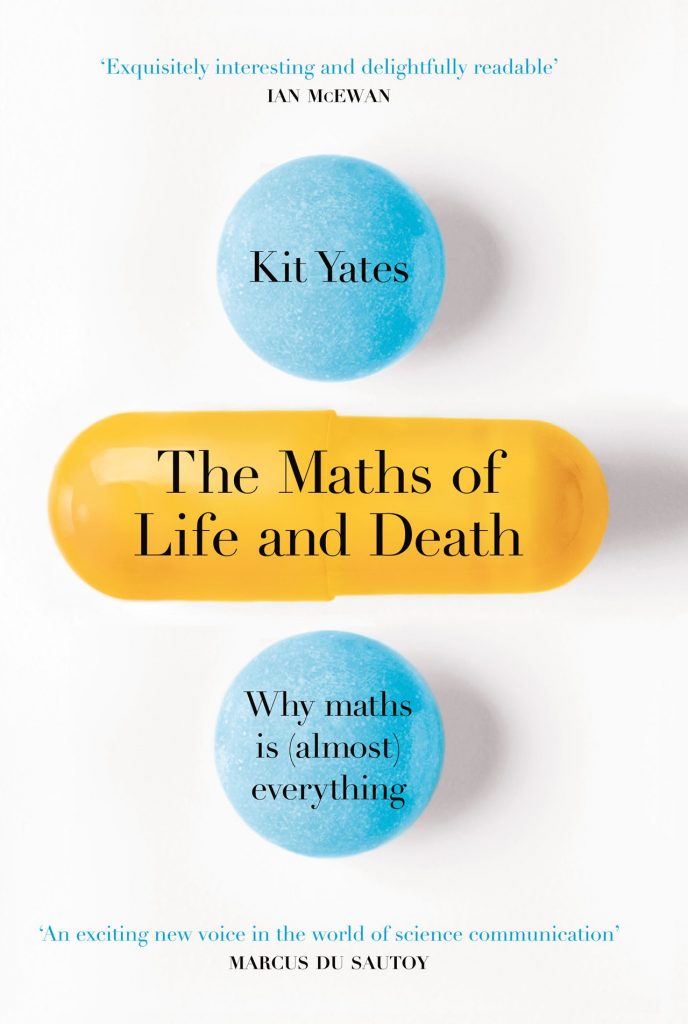
Aperiodicolleague Kit Yates has recently had a new book out: The Maths of Life and Death. He’s kindly agreed to share a sample chapter with us, explaining the God Equation: it’s used by NICE to decide whether to fund new drugs.
In my new book, The Maths of Life and Death, I explore the true stories of life-changing events in which the application (or misapplication) of mathematics has played a critical role: patients crippled by faulty genes and entrepreneurs bankrupt by faulty algorithms; innocent victims of miscarriages of justice and the unwitting victims of software glitches. I follow stories of investors who have lost fortunes and parents who have lost children, all because of mathematical misunderstanding. I wrestle with ethical dilemmas from screening to statistical subterfuge and examine pertinent societal issues such as political referenda, disease prevention, criminal justice and artificial intelligence. I aim to demonstrate that mathematics has something profound or significant to say on all of these subjects, and more.
International Day of Mathematics
The UNESCO Executive Board decided in October 2018 to endorse a recommendation, coordinated by the International Mathematical Union, to proclaim an International Day of Mathematics on 14th March each year. This recommendation is on the agenda for the UNESCO General Conference in November 2019 an, if adopted, will have its first official celebration on 14th March 2020, where the proposed theme is ‘Mathematics is Everywhere‘.
Preparations in anticipation for the adoption seem to be heating up, with a publicity drive underway. The IDM website says it will share free materials, projects, ideas and software, as well as a map of worldwide events and gatherings, all in multiple languages and under open licenses. You can sign up for a “one or two emails per month at most” mailing list to keep informed.
More information: The IMU wants to make π Day the International Day of Mathematics (October 2018).
Wikithon for diversity in mathematics
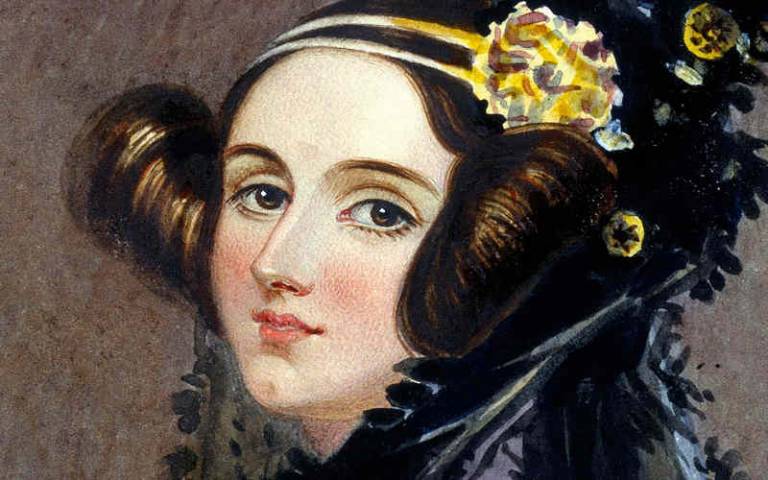
Next Tuesday, October 8th, UCL Mathematics is hosting a Wikithon in celebration of Ada Lovelace Day from 5-7pm. The theme is Diversity in Mathematics, and the aim is to write Wikipedia articles about mathematicians from under-represented groups. The session will be led by Dr Jess Wade BEM (Imperial College, Physics) and Dr Alice White (Wellcome Trust).
Jess Wade was appointed BEM earlier this year for services to Gender Diversity in Science.
If you want to participate, you are asked to bring a laptop – pizza will be provided. You are asked to register (for free) for catering reasons.
42 is the answer to the question “what is (-80538738812075974)³ + 80435758145817515³ + 12602123297335631³?”
We now know that the number 42 can be written as the sum of three cubes:
\[ 42 = (-80538738812075974)^3 + 80435758145817515^3 + 12602123297335631^3 \]
This computational breakthrough was achieved in a collaboration between Andrew Sutherland (MIT) and Andrew Booker (Bristol). They announced the result by both replacing their homepages with the expression – with the page title Life, the Universe and Everything.
Simon Singh wants someone to help with Top Top Set
Simon Singh, author of Fermat’s Last Theorem and The Code Book, among others, has for the last three years been running a project called Top-Top Set. It’s an enrichment project to stretch kids at non-selective state schools in the UK.
Now, Simon is looking for an experienced maths teacher to help him grow the project even further.
Responsibilities for the Top-Top Set Project Co-ordinator include:
If that sounds like something you’d like to do, find more information about how to apply at the Good Thinking Society website.
If that doesn’t sound like something you’d like to do, or just while you’re waiting to hear if you’ve got the job, check out Parallel, a set of free weekly maths challenges developed to support Top-Top Set, but available to everyone.
Cédric Villani is running for mayor of Paris
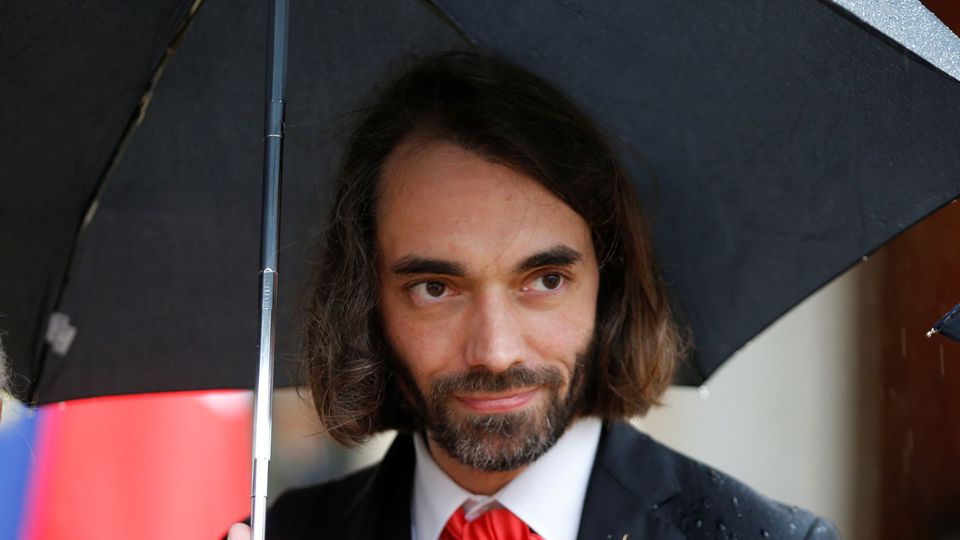
Fields medallist Cédric Villani has announced he’s running to be mayor of Paris.
Villani is already a deputé for Emmanuel Macron’s La République en Marche! party, but his ambition doesn’t seem to be bounded above, so now he wants to be mayor of Paris.
France has already had a mathematician President, Paul Painlevé, so I’m surprised to see Villani revisiting a solved problem. Maybe he’s going for an induction…
How far will Cédric Villani go to achieve his goal? Well, here’s a piece in Le Parisien featuring a photo of him in an open-necked shirt and without his signature spider brooch. Watch out, world!
A press release on Villani’s website also mentions that he’s got a book out in February, Immersion, de la science à la politique, reflecting on his experiences campaigning and in parliament.