Someone called James Davis has found a counterexample to John H. Conway’s “Climb to a Prime” conjecture, for which Conway was offering \$1,000 for a solution.
The conjecture goes like this, as stated in Conway’s list of \$1,000 problems:
Let $n$ be a positive integer. Write the prime factorization in the usual way, e.g. $60 = 2^2 \cdot 3 \cdot 5$, in which the primes are written in increasing order, and exponents of $1$ are omitted. Then bring exponents down to the line and omit all multiplication signs, obtaining a number $f(n)$. Now repeat.
So, for example, $f(60) = f(2^2 \cdot 3 \cdot 5) = 2235$. Next, because $2235 = 3 \cdot 5 \cdot 149$, it maps, under $f$, to $35149$, and since $35149$ is prime, we stop there forever.
The conjecture, in which I seem to be the only believer, is that every number eventually climbs to a prime. The number 20 has not been verified to do so. Observe that $20 \to 225 \to 3252 \to 223271 \to \ldots$, eventually getting to more than one hundred digits without reaching a prime!
Well, James, who says he is “not a mathematician by any stretch”, had a hunch that a counterexample would be of the form $n = x \cdot p = f(x) \cdot 10^y+p$, where $p$ is the largest prime factor of $n$, which in turn motivates looking for $x$ of the form $x=m \cdot 10^y + 1$, and $m=1407$, $y=5$, $p=96179$ “fell out immediately”. It’s not at all obvious to me where that hunch came from, or why it worked.
The number James found was $13\,532\,385\,396\,179 = 13 \cdot 53^2 \cdot 3853 \cdot 96179$, which maps onto itself under Conway’s function $f$ – it’s a fixed point of the function. So, $f$ will never map this composite number onto a prime, disproving the conjecture. Finding such a simple counterexample against such stratospherically poor odds is like deciding to look for Lord Lucan and bumping into him on your doorstep as you leave the house.
A lovely bit of speculative maths spelunking!
via Hans Havermann, whom James originally contacted with his discovery.

 Welcome to the 145th Carnival of Mathematics, hosted here at The Aperiodical.
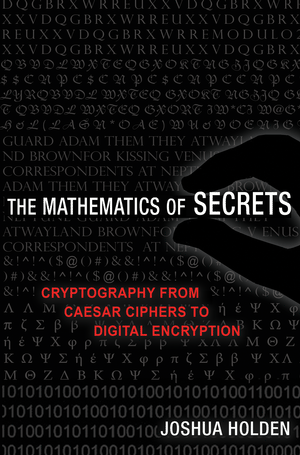 Any book on cryptography written for a more-or-less lay audience must inevitably face comparisons to The Code Book, written in 1999 by Simon Singh, the king of distilling complex subjects to a few hundred pages of understandable writing. While Singh’s book is a pretty thorough history of codes and codebreaking ((