I’ve done another maths video! If you missed it earlier this week, here’s a nice mathematical card trick I learned recently on a trip to Finland. Enjoy!
You're reading: Main
Cutting an oval pizza – video
As if there wasn’t enough maths/pizza news lately, the story has hit the red-tops recently that UK supermarkets are scamming consumers by offering them oval-shaped pizzas – marketed in the high-end/’Extra Special’ ranges, with more expensive (sounding) ingredients like mozzarella di bufala, roquito peppers and merguez sausage, and a distinctive pair of artisanally different radii. These pizzas apparently cost more per gram, because their elliptical shape means they’re actually smaller than a circle with the same diameter. Cue plenty of ‘costing you dough’ and ‘cheesed off’ puns.
While we’re not massively bothered by the pricing, the articles do raise, and then completely fail to address, an interesting point: an oval pizza is harder to cut into equally sized pieces! Luckily, maths is here to save the day. I found a nice method and made a video explaining how it works:
Take a look and improve your future pizza cutting technique!
Review: Hidden Figures
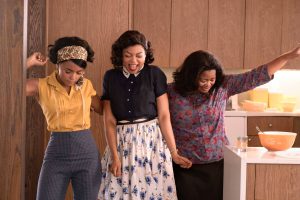 Mega-late to the party, I’ve now arrived back from a week lecturing in Indonesia and have found time to go and see the incredibly well-received and widely talked-about NASA women maths film, Hidden Figures. I’ve heard an incredible number of wildly positive responses to the film, from as long ago as January, and have been looking forward to it greatly.
The film is a painstaking and at times brutally realistic depiction of the struggles faced by African-Americans, and by women, during the era of the early space missions.
“I own more maths books by Martin Gardner than by women, is that bad?”
Today is International Women’s Day, so we’ve taken a moment to think about the woman mathematicians in our lives.
We each have fairly sizeable collections of maths books, which prompted CLP to wonder how many of them are by female authors. A quick scan of our respective bookshelves later, here’s what we found.
The 12th Polymath project has started: resolve Rota’s basis conjecture
Timothy Chow of MIT has proposed a new Polymath project: resolve Rota’s basis conjecture.
What’s that? It’s this:
… if $B_1$, $B_2$, $\ldots$, $B_n$ are $n$ bases of an $n$-dimensional vector space $V$ (not necessarily distinct or disjoint), then there exists an $n \times n$ grid of vectors ($v_{ij}$) such that
1. the $n$ vectors in row $i$ are the members of the $i$th basis $B_i$ (in some order), and
2. in each column of the matrix, the $n$ vectors in that column form a basis of $V$.
Easy to state, but apparently hard to prove!
George Boole statue to be erected in Lincoln
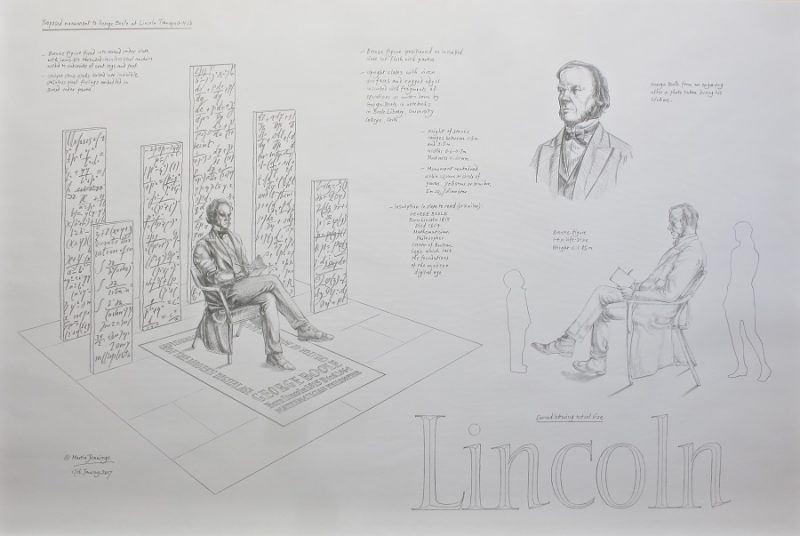
It was George Boole’s bicentenary in 2015, so the Heslam Trust is a bit slow to reveal its plans to erect a statue of the great man in his home town of Lincoln.
The sculptors, Martin Jennings and Antony Dufort, have come up with a few designs for the statue, and they’d like the public to vote for their favourite.
There’s already a bust of Boole in University College, Cork, installed in plenty of time for the bicentenary. Here’s a picture of me and HRH Poppy Dog standing next to it, last Summer.

More information
Lincoln maths genius to get statue in city – and here are the designs at LincolnshireLive
Proposals for George Boole monument on the City of Lincoln council website
Hans Rosling and Raymond Smullyan have died
Why should I worry about dying? It’s not going to happen in my lifetime!
Raymond Smullyan, This Book Needs No Title (1986)
This week, the mathematical community has lost not one but two of its most beloved practitioners. Earlier this week, Swedish statistician Hans Rosling passed away aged 68, and today it’s been announced that author and logician Raymond Smullyan has also died, aged 97.