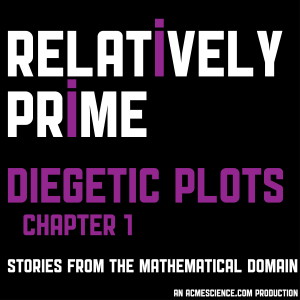
For about 40 minutes of this week’s episode of Relatively Prime (Number 5 of 8, already? Good heavens!), Samuel Hansen looks like he’s managed to escape from his shameful, borderline criminal, past in Las Vegas. But he’s pulled back in for one last job, which is a debacle, of course.
You're reading: Main
Relatively Prime Recap: Season 2, Episode 4: Diegetic Plots, Chapter 1
On top of the usual disclosures, I should add that Dave Gale and I interviewed Samuel Hansen this week for our Wrong, But Useful podcast, which you might like to listen to for a deeper insight into Samuel’s brain.
During the conversation, he warned me I wouldn’t like Episode 4 of the new Relatively Prime, “Diegetic Plots, Chapter 1”. I don’t know if that was expectation management or an elaborate double bluff, but the joke’s on you, Hansen: I jolly well did like it, so there!
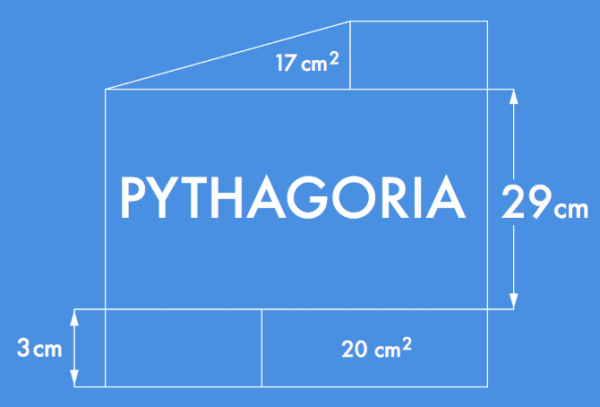
Review: Pythagoria

Pythagoria is a puzzle game for PCs. It’s the same idea as Naoki Inaba’s Area Maze: you’re shown a geometric construction, not drawn to scale, and you have to work out a missing length or an area.
Each puzzle is constructed so that it can be solved without ever dealing with fractions, though what exactly that means is up for debate. Whatever it means, it keeps you from breaking out pen and paper to solve a problem algebraically, when you know there should be a way of doing it in your head.
Learning to play Go: computer edition

In a remarkable example of us being psychic (or, what’s also known as ‘a coincidence’), our recently posted introduction to the game of Go has been made more topical by actual Go-related news.
The game of Go has long been considered a difficult game for artificial intelligences to play – much more so than chess, which has plenty of computer players. A Wired article from 2014 describes Go as ‘the ancient game that computers still can’t win’. As well as having a much larger set of possible games ($10^{761}$, as opposed to $10^{120}$ in chess), Go also has highly complicated strategy, compared to its simple rules, and moves made early on in the game can result in important changes to the state of the board further down the line.
The Aperiodical’s Actual Snowflake Competition – Results
Before Christmas, we launched a winter-themed maths competition – to design a sensible hexagonal snowflake, using a square grid, which could be used to knit a wintery jumper and not a) look terrible or b) have non-hexagonal symmetry. We had a deluge of entries, some valid and others less so – in fact, we may have had at least one entry break each of the rules we set. Below is a round-up of all the entries we received.
New Mersenne prime discovered, and promptly printed out
Breaking news! On 19th January 2016, the Great Internet Mersenne Prime Search discovered a new largest prime number – we know 49 Mersenne primes, the largest of which is now $2^{74207281}-1$, a number containing over 22 million digits and full of primey goodness.
Internet Maths Person Matt Parker has responded to the news in spectacular style, by issuing a 14-minute long video explaining the discovery and its implications, as well as somehow scoring an interview with the actual discoverer of the new prime, Curtis Cooper.
Our top 10 posts from 2015

In 2015 The Aperiodical went from strength to strength again, with 179 posts published by 18 authors. I’ve collected our ten most popular posts from 2015, in case you missed them.