[youtube url=https://www.youtube.com/watch?v=85LJh4sFi_M] Erik Åberg is selling a short documentary about these lovely foldy cubes on his website. via Will Davies on Twitter
Babbage’s difference engine is really, really pretty
Hands up if you knew there was a working replica of Babbage’s difference engine in California. (My hand is not up.) This glorious machine lives in the Computer History Museum in Mountain View, California. A company called xRez Studio, which specialises in taking extremely high resolution gigapixel photos of things, has taken some extremely high…
You have completed level 8. Game over. Insert coin.
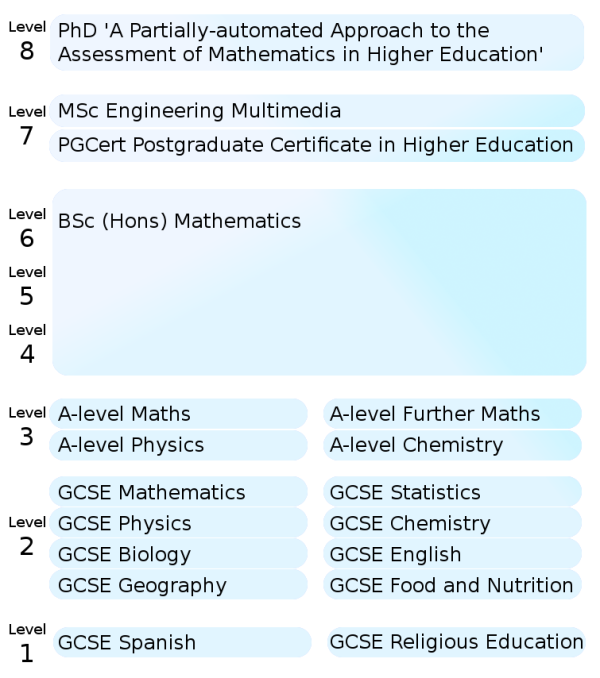
(See QCF.) That is to say, the university have sent me a degree certificate, and I’ve shown it to the bank. So that’s pretty darn official.
The neuroscience of mathematical beauty, or, Equation beauty contest!
Neuroscientists Semir Zeki and John Paul Romaya have put mathematicians in an MRI scanner and shown them equations, in an attempt to discover whether mathematical beauty is comparable to the experience derived from great art. They’ve detailed the results in a paper titled “The experience of mathematical beauty and its neural correlates”. Here’s a bit…
Tie, tie, tie a tie / Fly, fly, fly as you might
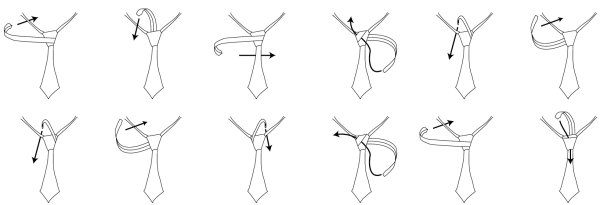
Novel knot news now! You might already be aware that there are 85 ways to tie a tie. Well, cast that preconception aside because there are actually loads.
What kind of mathematics is right for you? Maybe applied sarcasm?
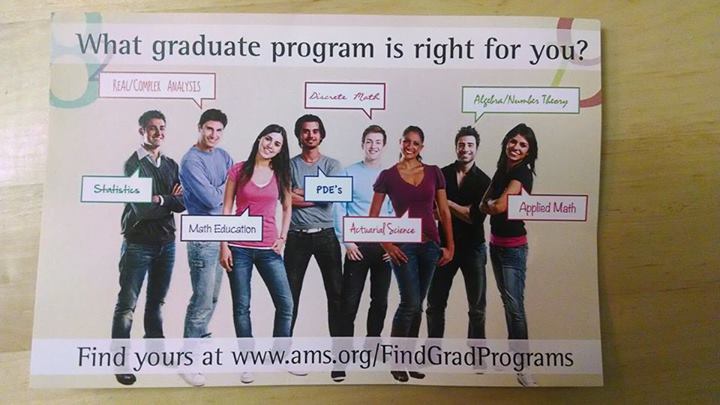
University of Chicago grad student Kathryn Mann spotted this possibly-sexist flyer handed out by the AMS at a recent event: The beautiful stock photo men are all doing pure maths, and the beautiful stock photo women are all doing applied! Heinous!
How to Teach Maths by Alex Bellos on Radio 4
Media math-man Alex Bellos has made another programme for BBC Radio 4, this time about How to Teach Maths. Alex Bellos takes you on a mathematical learning journey from the first stages of number recognition through to an understanding of how children solve sums and calculate answers. On the way he will look at the…