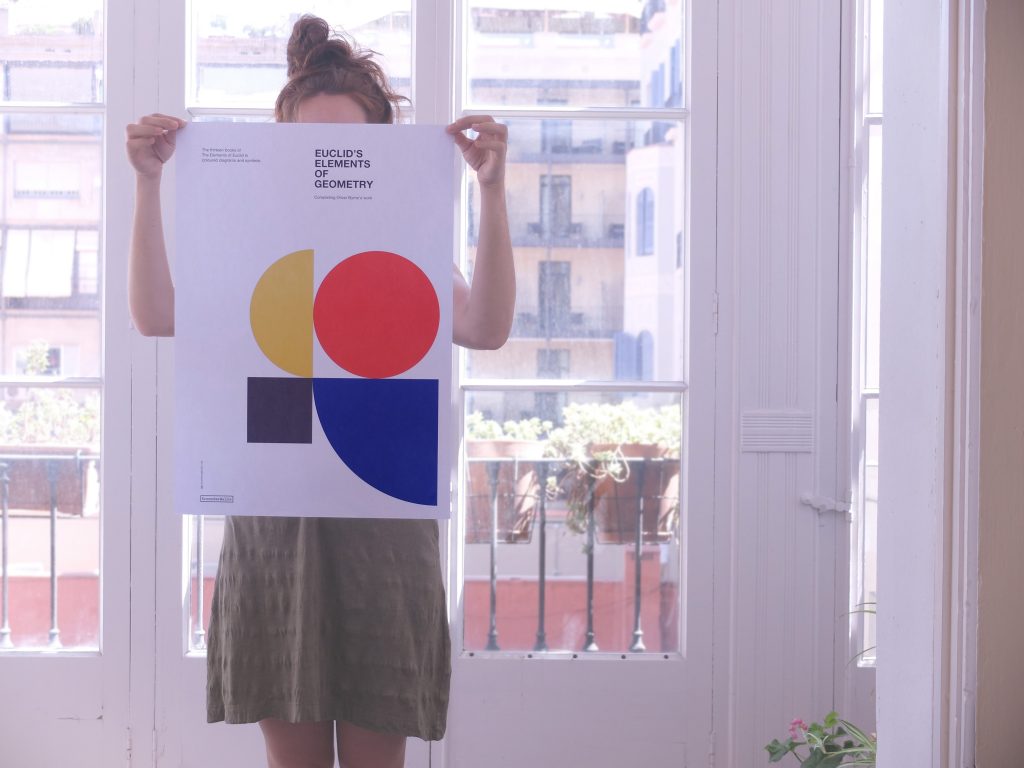
Barcelona-based publishing company Kronecker Wallis have produced a new updated edition of Byrne’s Euclid. We asked founder and editor Jordi Anton to tell us all about it – and their related Principia reprint, which is still looking for funding on Kickstarter. Tell us about Euclid’s Elements. Euclid of Alexandria lived c. 300 BCE. He wrote…
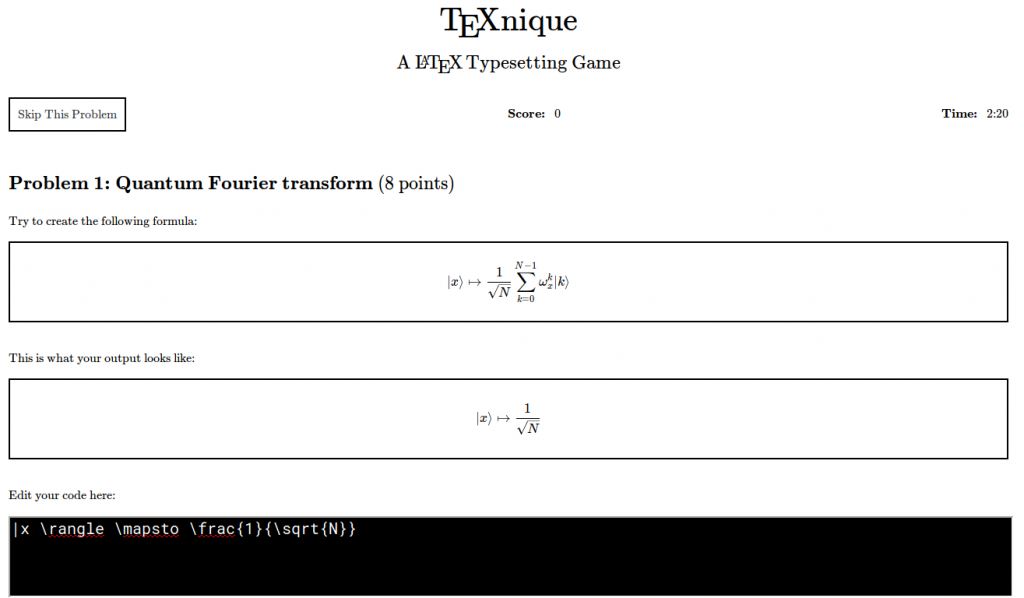
You know what’s fun? Typesetting mathematics! Glad you agree, because here’s a game that puts the fun in ‘underfilled hbox’. In TeXnique, you’re shown a typeset bit of mathematical notation, and have to frantically type LaTeX to reproduce it. You get three minutes, and you’re awarded points when you produce something that’s a pixel-perfect replica…
Karen Uhlenbeck has made a donation to the EDGE (Enhancing Diversity in Graduate Education) Foundation which is to establish The Karen EDGE Fellowship Program. This aims “to support and enhance the research programs and collaborations of mid-career mathematicians who are U.S. citizens and members of a minority group that is underrepresented in the field of mathematics”.
The award consists of $8,000 per year for three years including funding for visits to the Institute for Advanced Study in Princeton. Further details and how to apply are available via the EDGE website. Applications are due by 1st February 2020, with three awardees announced by 1 May 2020.
There are a collection of 23 maths-based puzzles appearing at a rate of one-per-weekday through August over at the Isaac Newton Institute. Their website explains “They won’t require sophisticated maths to solve, but equally they won’t be easy. Discussing your ideas might help.”
They each start with an unlimited number of coins of denominations: 1p, 5p, 10p, 20p, 50p and 100p.
They take it in turns putting coins into a pot one at a time.
The winner is the person who places the final coin into the pot reaching the target total of £8.19.
A player automatically loses if they exceed the target total.
Given that they are both perfect logicians and strategists, who wins?
Answers will be revealed at the end of the month, and you are invited to submit your answers for a chance to be named as a person or group who submitted one of the first few correct answers.
At the time of writing, there are 6 puzzles still to be revealed, and 17 puzzles are live. Check out the Summer Maths Puzzles website, or search Twitter, Facebook or Instagram for #SummerMathsPuzzles.
Tricurves were introduced to the Aperiodical audience via Tim Lexen‘s posts Bending the Law of Sines, Combining Tricurves, Phantom Tiling, and (joint with Katie Steckles) Making Tricurves. Like Tim and Katie in that last post, when introduced to a new concept I like to play around with it to see it from different perspectives. Tiling…
Regular readers of The Aperiodical will not be surprised to hear that Hannah Fry is up to something exciting, but you will likely still be surprised by the sheer number of exciting things which Hannah Fry is currently doing. But this is why we are here after all, so here is your breaking FryDay news,…
The next issue of the Carnival of Mathematics, rounding up blog posts from the month of July, is now online at Cassandra Lee Yieng’s blog. The Carnival rounds up maths blog posts from all over the internet, including some from our own Aperiodical. See our Carnival of Mathematics page for more information.