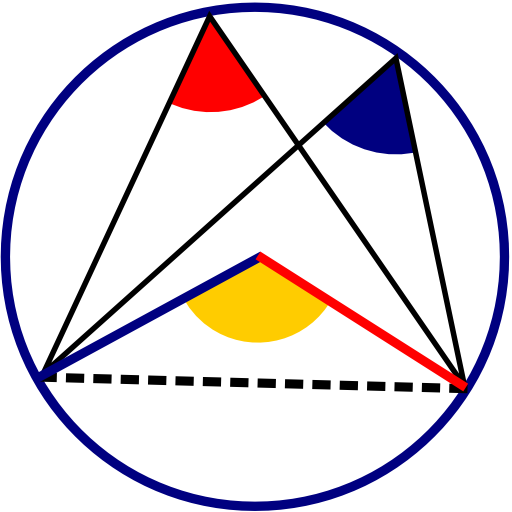
Enjoy a wonderful 11 minutes of @FryRSquared talking about the probability problems associated with assigning Secret Santa presents by drawing names from a hat: This post is part of the Aperiodical’s 2018 Aperiodvent Calendar.
Aperiodvent, Day 7: Parabolic Sewing
By stitching carefully between a set of points, you can create a parabola – these Christmas cards have taken this idea and given it a festive twist.
Aperiodvent, Day 6: Hexagonal Snowflakes
Six is the number of sides on a hexagon, and hexagonal symmetry is one of the most wintry symmetries – due to the bond angle of water when frozen into ice, all snowflakes (with some minor exceptions) have hexagonal symmetry.
Aperiodvent, Day 5: Dodecorations
If you’re thinking about decorating your house for the festive season, we recommend the Twelve Pentagons of Christmas – dodecahedrons. Here’s a few ways to get more regular twelve-sided polyhedra into your life.
LaTeX/TikZ to draw a star graph $K_{1,n}$
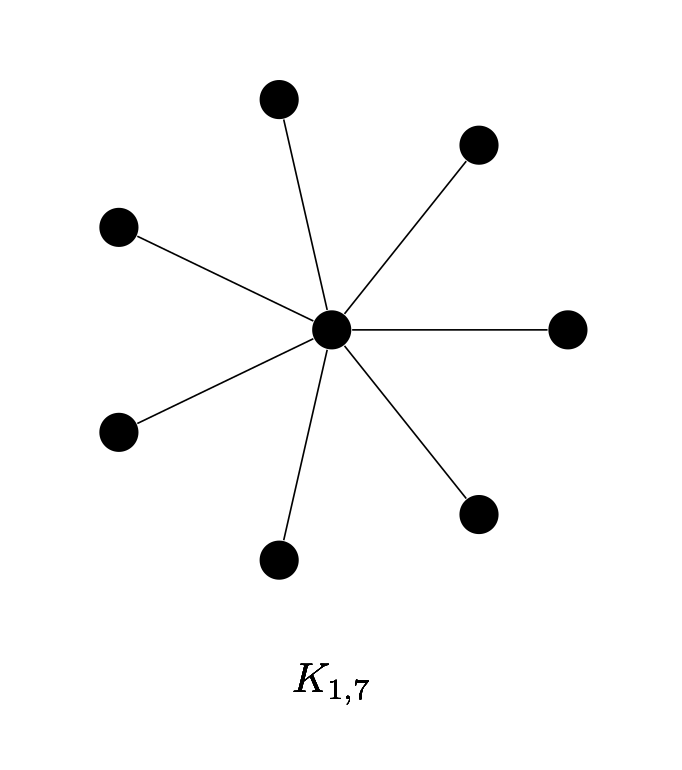
For a diagram for a class this week, I’ve written a LaTeX command to draw star graphs using TikZ. A star graph $K_{1,n}$ is a graph with a single central node, $n$ radial nodes, and $n$ edges connecting the central node to each radial node. I am sharing this here in case it is useful…
Aperiodvent, Day 4: Möbius Paper Chains
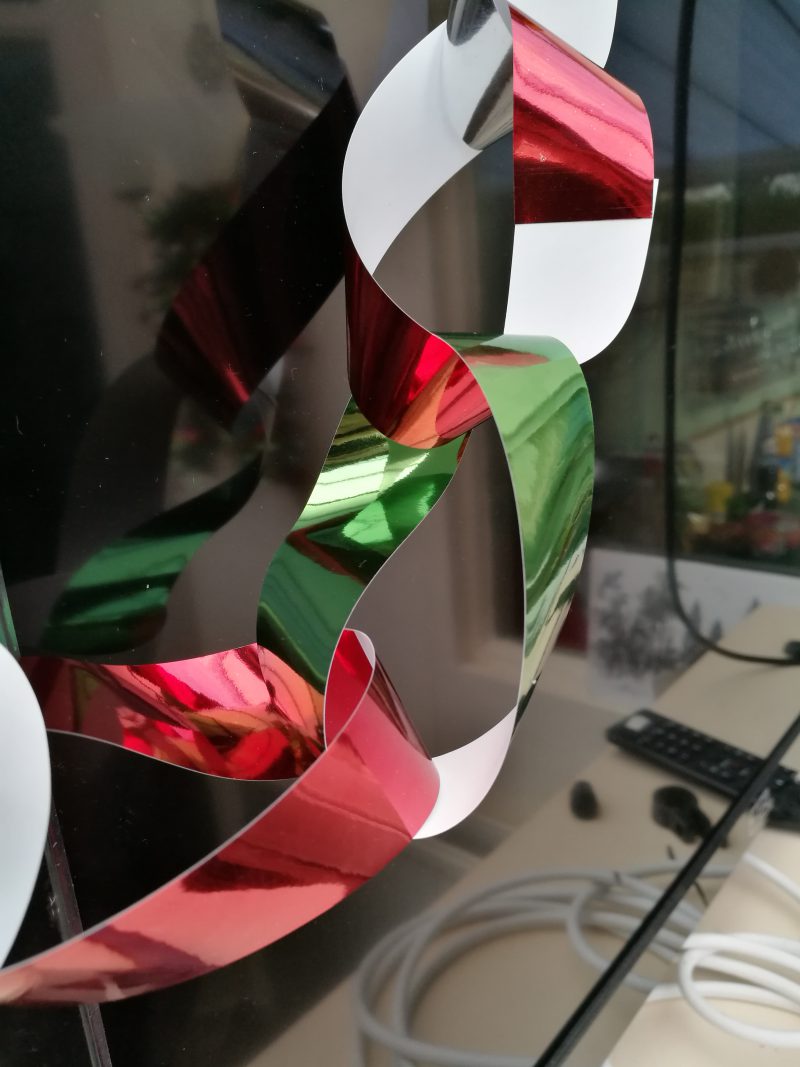
If you’re trying to think of ways to decorate your home, office or classroom, look no further than mathematically non-trivial paper chains, made from Möbius bands. All you need is some double-sided coloured paper (ideally the same colour on both sides, but if you want to show off the twist, you can go two-tone) cut…
Aperiodvent Day 3: Mince Pi Pendulum

Today’s contribution is from friend of the site, Festival of the Spoken Nerd’s Matt Parker, who’s found a way to approximate π using a mince pie (or any type of pie, or indeed any small object with non-zero mass, but the mince pie is the most festive option). The trick is to use it as…