Here’s a round-up of some news from the last couple of months.
You're reading: Posts Tagged: Alex Bellos
- Alex Bellos’s Think Twice
- Rob Eastaway’s Much Ado About Numbers
- Pippa Goldschmidt’s Schrödinger’s Wife
- Matt Parker’s Love Triangle
- Ernő Rubik’s Cubed
- Olivia Waite’s The Lady’s Guide To Celestial Mechanics
Maths events at Cheltenham Science Festival 2025
This is a guest post by Martin Whitworth.
I am the organiser of Cheltenham MathsJam, and I am a fan of our local Cheltenham Festivals. In addition to successful Jazz, Music and Literature Festivals, they have an annual Science Festival with high profile presenters, this year from 3-8 June. The Science Festival always includes some maths content, and that’s particularly strong this year.
Double Maths First Thing: Issue 9
Double Maths First Thing is like a diet MathsJam, some of the flavour but only a hint of the joy.
Hello! My name is Colin and I am a mathematician on a mission to spread delight in my beloved subject.
I spent the weekend at Big MathsJam in Staffordshire and gorged myself full of puzzles, surprises and fascination — my personal highlights were Mats Vermeeren’s talk about why the start lines on athletics tracks are curved the way they are, Vincent van Pelt’s MathsJam Jam song (Mnemonic to the tune of Blondie’s Atomic) and the colouring-in in the quiet room. Now I’m sad that I don’t get to do it for another year.
From around the internet
It’s always cool to see ancient technology in action. Slide rules may not be ancient ancient, but they were no longer in common use by the time I was at school. (I remember we had some Napier’s bones, but nobody knew how to use them. I wish they had, I’d have lapped it up.)
As everyone knows, the Mathematical Villain goes through your spreadsheets turning data into dates. Here are some more times that Excel users failed to, well, excel. (Aside: it’s all so avoidable! A halfway-competent programmer can set up a script that checks for this sort of thing. And if you need one of those, you should let me know.)
In “everything is interesting if you look at it closely enough” news, the horrors of implementing daylight saving rules around the world are fascinating.
I also loved this bit of code golf for finding Fibonacci numbers. The explanation is much more interesting than the code.
I couldn’t explain why, but I’m averse to calculator notebooks. Not my cup of tea. Don’t like Jupyter. I may have had a bad experience with Maple as a student. That doesn’t mean you can’t experiment and enjoy, though!
Lastly, to file under “ridiculous but brilliant projects”, several generators of the Finite Group are challenging humankind to say the new record Mersenne Prime before the next one is discovered. Join the race!
Books!
Apparently some people celebrate Actual Christmas rather than (or as well as!) MathsJam. That’s OK, all are welcome. If you’re looking for maths-related books to buy someone so they can add them to the unread pile on the floor, here is a selection of books I’ve either read and enjoyed or have had recommended to me:
(Note: these links don’t necessarily go to the cheapest place to order from. I recommend asking your local independent bookshop — if you don’t have one of those, Gulliver’s in Wimborne deliver across the UK and are lovely people too.)
In the meantime, if you have friends and/or colleagues who would enjoy Double Maths First Thing, do send them the link to sign up — they’ll be very welcome here.
If you’ve missed the previous issues of DMFT or — somehow — this one, you can find the archive courtesy of my dear friends at the Aperiodical.
That’s all for this week! If there’s something I should know about, you can find me on Mathstodon as @icecolbeveridge, or at my personal website. You can also just reply to this email if there’s something I should be aware of.
Until next time,
C
Alex Bellos – The Language Lover’s Puzzle Book
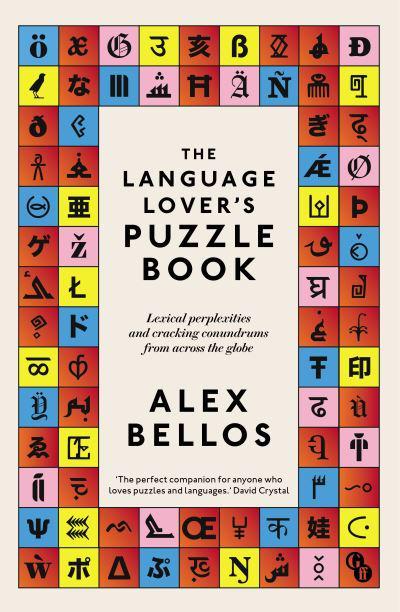
If you’re a fan of maths (which we assume you are, if you’re reading a maths blog), you might be familiar with Alex Bellos from his excellent popular maths books, including Alex’s Adventures in Numberland and the follow-up Alex Through The Looking Glass; you might also enjoy his more recent forays into puzzle books, including Can You Solve My Problems, and Japanese logic puzzle collection Puzzle Ninja, as well as his regular Monday puzzle column in The Guardian.
For his latest book, The Language Lover’s Puzzle Book, Alex has focused on language puzzles, largely drawn from the linguistic equivalent of Maths Olympiads (which he’s gotten really into lately). It’s a hefty volume split into cleverly collected sections on different aspects of language – including how languages are constructed, how words are pronounced, and as you might expect, the origins of how language is used to communicate numbers.
Christmas images using parabolic curves and TikZ
Katie is running an Aperiodical advent calendar (Aperiodvent 2018), with fun maths Christmas treats every day. Behind the door for 7th December was Parabolic Sewing.
This is not unrelated to what I submitted as my entry to The Big Internet Math-Off last summer. I have been revisiting this idea ready for a class next week in my second year programming module.
Alex Bellos’ The Supercalculators on BBC R4
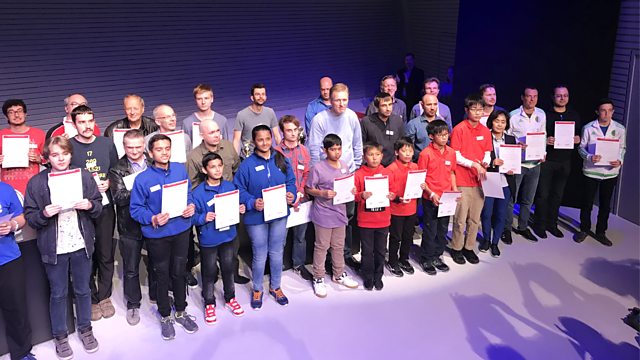
Maths perpetrator Alex Bellos has been on Radio 4 again, this time meeting some of the competitors in the Mental Calculation World Cup, which is held annually in Germany. It went out on Radio 4 last night, and will be repeated again next Monday at 9pm, plus you can listen online.
Carnival of Mathematics 145
 Welcome to the 145th Carnival of Mathematics, hosted here at The Aperiodical.
If you’re not familiar with the Carnival of Mathematics, it’s a monthly blog post, hosted on some kind volunteer’s maths blog, rounding up their favourite mathematical blog posts (and submissions they’ve received through our form) from the past month, ish. If you think you’d like to host one on your blog, simply drop an email to katie@aperiodical.com and we can find an upcoming month you can do. On to the Carnival!