Here’s a round-up of some news from the last couple of months.
You're reading: Posts Tagged: aperiodic monotile
Double Maths First Thing: Issue 6C
Double Maths First Thing is fair drawing in.
Hello! My name is Colin and I am a mathematician on a mission to spread the joy and delight in doing and talking (and singing) about maths.
This week I’m in the undelightful state of “writing up maths I’ve already done”, which is preventing me from doing new maths. I don’t like it.
Links
Fractal Kitty is responsible for the Mathober prompts.
Maths Week England is barely six weeks away, and starts on my birthday. This year, they’re running a prize competition for maths in libraries (which there should be more of).
My favourite paper of the week: An Abundance Of Katherines: The Game Theory of Baby Naming, by Katy Blumer, Kate Donahue, Katie Fritz, Kate Ivanovich, Katherine Lee, Katie Luo, Cathy Meng, and Katie Van Koevering.
Katie Steckles is not an author, but she has pointed me at a daily game called Trace, which I refuse to engage with on “already having too many daily games” grounds. Ben Cornish points me a Wikipedia exploration game which I also have too little time for.
While DMFT’s official position is “in this household, we don’t care about AI”, we’ve got a paper by Chaim Goodman-Strauss explaining the maths of a recently-discovered three-dimensional monotile, Chair44. @Danpiker has animated the tessellation. I’ve not tried to follow it, because of the aforementioned position. Sometimes it makes things much easier if you decide not to care.
Currently
If you’ve got Carnival links for Ben Leis, the deadline is fast approaching. Send ’em in here. Next month’s host is Sam Hartburn…
… Who (among many other things, such as being a fabulous human) runs the TMiP animation collaboration, the September edition of which is drawing to a close – if you’ve got an animation about PROOFS WITHOUT WORDS, you’ve only got a few days. October’s prompt is FRACTALS.
Next week: Dr Volker Remmert is speaking about “What do you need a mathematician for? as the BSHM Gresham Lecture in central London from 5:30pm on October 7th.
Richard Elwes is talking big numbers at the Wells Literary Festival on Sunday October 18th at 4:15pm. Tickets are £12.50.
If you’re an aspiring STEM writer, you should probably apply to ScienceWrite before the deadline on November 9th.
That’s all I’ve got for this week. If you have friends and/or colleagues who would enjoy Double Maths First Thing, do send them the link to sign up – they’ll be very welcome here.
If you’ve missed the previous issues of DMFT or – somehow – this one, you can find the archive courtesy of my dear friends at the Aperiodical.
Meanwhile, if there’s something I should know about, you can find me on Mathstodon as @icecolbeveridge, or at my personal website. You can also just reply to this email if there’s something you want to tell me.
Until next time,
C
Let’s go to the beach and make an aperiodic tiling!
Somehow, I’ve been awarded the MEGA grant, from Matt Parker and Talking Maths in Public, for a ridiculous public maths project. I’d better get on that, then!
My plan is to go to the beach and use great big cookie cutters in the shape of the spectre aperiodic monotile to cover as much space as possible.
Exciting new maths of 2024
Over at the Finite Group, members (including me and Katie) have been discussing what in maths news has excited us this year. Here’s a summary.
Brayden Casella and fellow authors claimed that there exists a non-terminating game of Beggar-My-Neighbour, solving one of John H. Conway’s anti-Hilbert problems. Beggar-My-Neighbour is a card game similar to War in which two players deal cards onto a shared pile, aiming to win all the cards into their hand. Matthew Scroggs made a bot: Beggar-my-neighbour forever. In other game theory news, Othello is solved.
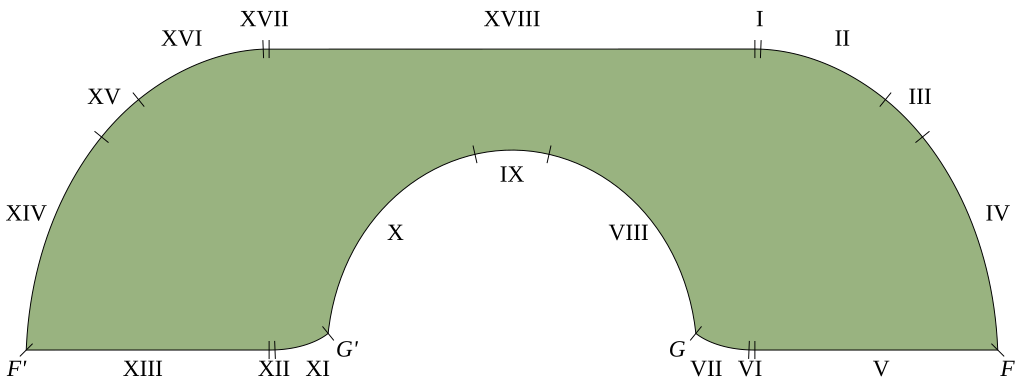
Jineon Baek claims a resolution to the moving sofa problem. This considers a 2D version of turning a sofa around an L-shaped corner, attempting to find a shape of largest area. (There are some nice animations at Wolfram MathWorld.) Baek offers a proof that the shape above, created by Joseph L. Gerver in 1992, is optimal.
The Great Internet Mersenne Prime Search (GIMPS) announced a new Mersenne prime: \(2^{136,279,841}-1\). You can get maximum excitement about this news from Ayliean on TikTok, and join in the fun by signing up to record yourself saying a chunk of the prime for the Say The Prime project.
One thing that’s new, apart from the prime itself, is that the work was done on a network of GPUs, ending “the 28-year reign of ordinary personal computers finding these huge prime numbers”. Also this was the first GIMPS prime discovered using a probable prime test, so the project chose to use the date the prime was verified by the Lucas-Lehmer primality test as the discovery date. In other computation news, the fifth Busy Beaver number has been found, as well as 202 trillion digits of pi.
A new elliptic curve was discovered, breaking a record set in 2006 and pushing at the limits of current methods for finding them. Here’s some background on the curves and some of the characters involved.
This year also saw a proof of the geometric Langlands conjecture, and this article explains why this is such a big deal.
We’re all still excited about the discovery of the aperiodic monotiles, and the result passed peer review and was published this year.
And finally, it may not be top research news, but 2024 was also the year that Colin Beveridge started his Double Maths First Thing newsletter. Subscribe to the newsletter here, and check out the archive of past issues here at The Aperiodical.
Finite Group is a friendly online mathematical discussion group which is free to join, and members can also pay to access monthly livestreams (next one Friday 20th December 2024 at 8pm GMT and recorded for viewing later). The content isn’t at the level of the research mathematics in this post, but we try to have a fun time chatting about interesting maths. Join us!
Aperiodical News Roundup – October 2023
Here’s a round-up of a few things that happened this month that we didn’t otherwise cover here.
The Salem Prize for 2023, given annually to young mathematicians judged to have done outstanding work on harmonic analysis and related topics, has been awarded to Sarah Peluse and Julian Sahasrabudhe. (via Terence Tao)
According to this recent arXiv paper, data from 350,757 coin flips supports Persi Diaconis’ model of coin tossing, which estimates the probability of a coin landing on the same side it started at a surprising 51%. (via Alex Corner, Sheffield Hallam University)
Statistician C. R. Rao, who pioneered powerful statistical methods that underpin modern scientific data analyses, has died. (via Raul Jimenez)
And finally, the newly* discovered aperiodic monotile, which we won’t stop going on about ever, has been chosen as one of Time’s 200 Best Inventions of 2023 (via the European Mathematical Society).
Mathematical Objects: Aperiodic monotile with Chaim Goodman-Strauss
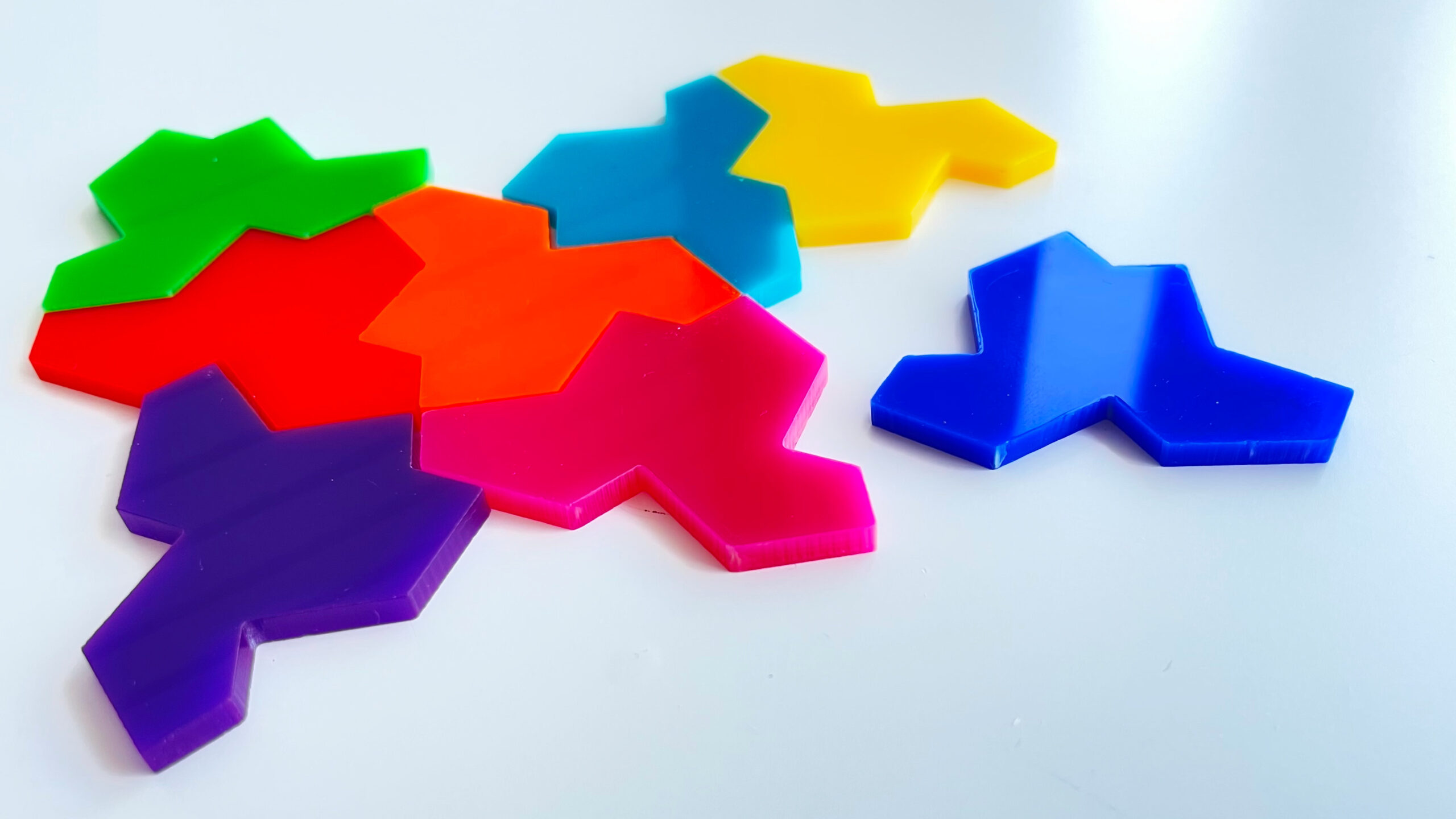
A conversation about mathematics inspired by the new aperiodic monotile. Presented by Katie Steckles and Peter Rowlett, with special guest Chaim Goodman-Strauss.
The paper announcing the discovery is An aperiodic monotile by David Smith, Joseph Samuel Myers, Craig S. Kaplan and Chaim Goodman-Strauss.
Chaim was recording from MoMath in New York, which will be running a creative artwork competition based on the monotile with UKMT. Chaim also mentioned a meeting in Oxford: Hatfest: celebrating the discovery of an Aperiodic Monotile.
Note: This podcast was recorded after the discovery of the ‘hat’ and ‘turtle’ monotiles but before the announcement of the ‘spectre’ monotile. Confused? Don’t worry, we explain in the episode!

Podcast: Play in new window | Download
Subscribe: RSS | List of episodes
Aperiodical News Roundup – March, April & some of May 2023
It’s been a busy few months! As per our name, here’s an aperiodically-timed round up of things that have happened in the world of maths in the last few months.