
It’s shaping up to be a busy month for education reform in England. Here’s some news in brief.
You're reading: Posts Tagged: education
Two years in: getstats
Yesterday the Royal Statistical Society/Nuffield Foundation collaboration getstats celebrated its second birthday.
Those of us with long enough memories might recall that getstats, a 10-year statistical literacy campaign, was launched with great fanfare at 8:10pm on World Statistics Day, 20th October 2010 (20:10 20.10.2010). Then-President David Hand was quoted at the time saying
Numbers are everywhere in our lives, and statistics is about turning these numbers into useful information on which we can take action. People need to appreciate the power of statistics as it can be the key to the important choices we make in our lives.
NRICH Site has had a facelift
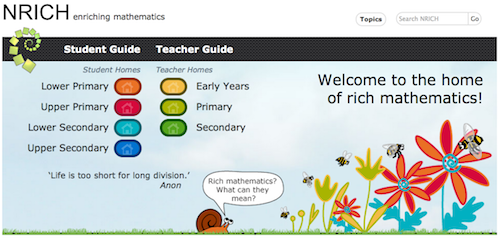
Everyone’s favourite source of excellent maths activities for all ages, NRICH, has been inspired by our change of font and has redesigned their site. It is still full of excellent ideas and teaching resources, as well as puzzles and games. Fans of rounded rectangles will especially like the slick new design and easy-to-use sections for different age groups.
What do you think of the redesign? Do you already use the NRICH site? Will you from now on? Comments below.
#MTT2K: Teachers critique Khan Academy
Pretty much everyone has an opinion about learning, and the teaching that causes, impedes or just precedes it. Sal Khan famously just started making videos with the aim of helping people learn, without paying much attention to the hows and whys of pedagogy. That means that pretty much everyone has an opinion about Sal’s site, Khan Academy. Recently some teachers and educationalists held a competition for “the best video commentary on a Khan Academy video” to “encourage math educators to create videos that help their peers bring a critical eye to the Khan series”.
(So this post has been in our news queue since June, when the #mtt2k competition started. The winners were announced a fortnight ago. I let it sit there for so long because we make a point of not being about education here. We didn’t cover the whole “Is Algebra Necessary” thing because of the sheer inanity and tendentiousness of it all. The videos produced for #mtt2k are interesting, though, so here’s the post I should’ve written at least two weeks ago.)
A trailer for Keith Devlin’s Intro to Mathematical Thinking MOOC
Keith Devlin has recorded a 3-minute video advertising his Introduction to Mathematical Thinking MOOC on Coursera.
In this, Keith explains the aims of the course, which includes elements seen previously on his MOOC Talk blog, and discusses the structure of the course and a little about the MOOC concept.
http://www.youtube.com/watch?v=YFs06zgBfMI
According to a tweet from Keith on 27 August, over 33,600 students have registered for the course since registration opened in July. The course starts on the 17th of September.
More info: Introduction to Mathematical Thinking on Coursera
Keith Devlin’s Mathematical Thinking MOOC opens for registrations
Prof Keith Devlin of Stanford University is running a Massively Open Online Course (MOOC) on Coursera, titled “Introduction to Mathematical Thinking“, with a stated goal to “help you develop a valuable mental ability – a powerful way of thinking that our ancestors have developed over three thousand years.”
MOOCs are big news, lately, with a popular AI course offered for free online by Sebastian Thrun from Stanford last year. Of course, distance learning and the ability to put course materials online are not new. “So”, asks Devlin in his May 2012 MAA column, “what has changed now?”
Understanding maths ‘more important than learning by rote’ shocker
A study by Oxford University’s Department of Education and reported in the Telegraph claims that “those who were good at maths reasoning aged eight tended to do better at the subject in future years than classmates who simply knew their numbers”.
This is pitched as a challenge to the current Government move towards rote learning of arithmetic in order to develop “fluency” ahead of studying algebra.
Study author Peter Bryant is quoted by the Times Educational Supplement saying,
Both arithmetic and maths reasoning are important and necessary, but we think there is a danger of maths reasoning moving out. I am not trying to say don’t teach times tables or procedures; it is important to have them. But it is possible to leave out maths reasoning and teach calculation, while you can’t teach reasoning without children being able to calculate.
Sources:
Telegraph: Understanding maths ‘more important than learning by rote’.
TES: Rote learning equals maths confusion.
Report: The relative importance of two different mathematical abilities to mathematical achievement in the British Journal of Psychology.