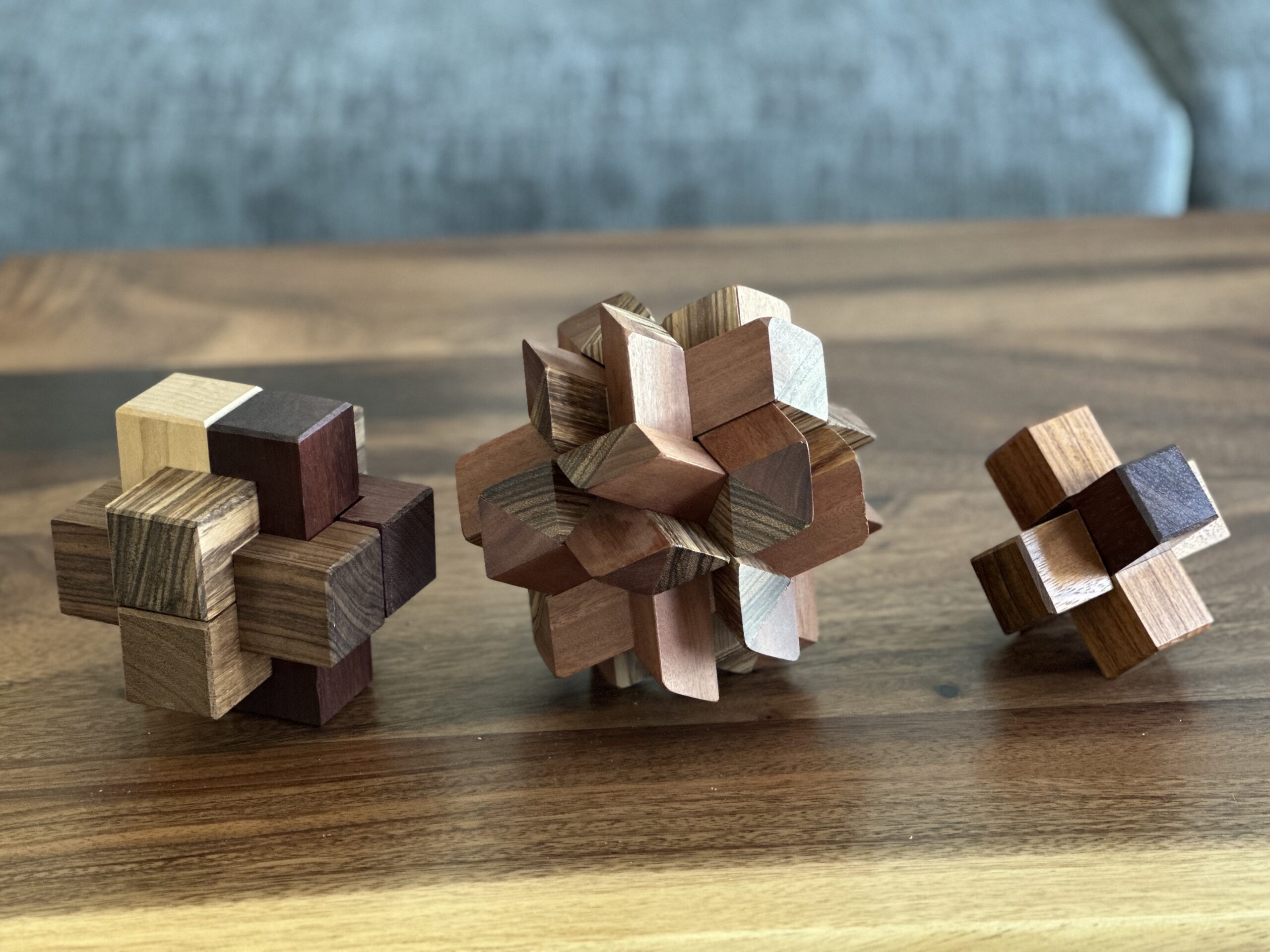
A conversation about mathematics inspired by a 3D wooden puzzle. Presented by Katie Steckles and Peter Rowlett, with special guest Grant Sanderson.

Podcast: Play in new window | Download
Subscribe: RSS | List of episodes
A conversation about mathematics inspired by a 3D wooden puzzle. Presented by Katie Steckles and Peter Rowlett, with special guest Grant Sanderson.
Podcast: Play in new window | Download
Subscribe: RSS | List of episodes
Double Maths First Thing is to maths news what the noticeboard outside the coffee shop is to theorems
Hello! My name is Colin and I am a mathematician on a mission to spread delight and joy while making people think.
I almost forgot (so strongly do I dislike the academic publishing process) that I had a paper published recently about Heron’s formula. One of the reasons I dislike it is that T&F want to charge you £45 of those sterling pounds to read a four-page paper, which is patently ridiculous. I can send you a copy if you want one. You definitely shouldn’t paste the DOI reference, 10.1080/0025570X.2024.2376510, into SciHub, or else the whole publishing system might collapse! (In fact, you can read the proof and the story behind it here).
I’ve also done my stint volunteering for Dorset Coding Day at a couple of local schools. The best questions I was asked were “how many pages were in your books?” and “what’s your favourite Netflix movie?”. Not a single more-of-a-comment, ten-year-olds are brilliant.
And in an email that made me grin from ear, a Tudor living historian emailed me to say he’d read my piece about Henslowe’s trick and is now performing it at events. How amazing is that?
Sometimes, people use the word “intuitive” for something that doesn’t line up with my intuition at all — but that’s ok, it’s good to see how other people’s minds work. For example, Gregory Gundersen’s piece on the Black-Scholes equation doesn’t match with how I’d explain it, but it’s still a lovely piece!
I haven’t yet got around to reading this article on the Kelly Criterion, but it’s a topic that always makes me prick up my ears. From my recollection, it turns out that “maximising expected returns” means roughly “small chance of an enormous jackpot, otherwise ruin”, but it’s a fascinating thing to play with.
Another item on my to-read list is this guide to transforming colours with matrices. This feels all sorts of wrong, but at first glance, it seems to work nicely!
Lastly, from memory lane, one of my favourite pieces of mathematical writing: Tim Gowers on deducing the cubic formula. A Fields Medallist explaining how to think about something? Clearly and lucidly? Sign me right up.
I’m also midway through Grant Sanderson explaining Manim to Ben Sparks and now I want to make videos just so I have an excuse to play with it.
In a move closely aligned with my key themes, the Finite Group have opened up their Discord to free-tier members. Among other things, it’s a great source of memes and somewhere you can suffer an endless stream of bad jokes, not all of which are from me. (The amazing live-streams — the next of which is on Wednesday 23rd October at 2pm UK time — are paid content, and worth every penny.)
Gathering4Gardner, best-known for their biennial gatherings that inspired Big MathsJam, but who do all sorts of amazing work, have a fundraising auction starting next week. I refuse to look at it because I have to dispose my income on fixing my laptop, but there might be something there that tickles your fancy!
Speaking of Big MathsJam, Tuesday coming is Little MathsJam Day — find your local Jam here or, failing that, start your own! It’s simple enough that I can do it. Instructions are on that page.
In the meantime, if you have friends and/or colleagues who would enjoy Double Maths First Thing, do send them the link to sign up — they’ll be very welcome here.
If you’ve missed the previous issues of DMFT or — somehow — this one, you can find the archive courtesy of my dear friends at the Aperiodical.
That’s all for this week! If there’s something I should know about, you can find me on Mathstodon as @icecolbeveridge, or at my personal website. You can also just reply to this email if there’s something I should be aware of.
Until next time,
C
Double Maths First Thing is, fundamentally, somewhere for Colin to dump all his open tabs.
Hello! My name is Colin and I am a mathematician on a mission to spread mathematical mirth, geometric joy, and delight in the beauty of whatever this is. Let’s boogie.
Since I’m applying for a job that involves Monte Carlo methods — which I’ve seen described as “integration by darts” — I’ve been looking at computer-generated “randomness” this week.
Matt Parker, with a contribution from Grant Sanderson, has a video making sense of why taking the square root of a uniform random number gives the same distribution as taking the larger of two.
I’ve also stumbled on a way to make your random number generator faster, and a way to turn biased coins into fair ones — although I’m not aware that it’s possible to create an unfair one.
Recent adventures in 3D printing had me thinking about how it’s possible to throw different shadows from different directions. Only tangentially related, you can use moiré effects to create weird (but useful) effects, such as signs for ships. There’s more about it in Chalkdust, which is a magazine for the mathematically curious. Issue 20 will be out at some point in the next month!
I never know quite what to make of Quanta magazine — sometimes it feels great, and sometimes it feels a bit patronising. It took quite a lot of reading to get to the point of this article, about multiple imputation in stats, but I still found it interesting.
If you’re interested in solving a Millennium Prize problem, you might start by reading up on what P vs NP is actually about. You lose a maths point if you say “P=NP iff N=1 or P=0.”
Lastly, I thought this piece about ‘mathiness’ — dressing nonsense up in mathematical clothes to fool people into thinking it’s sense — was excellent; not just describing the problem, but offering solutions too.
Lastly lastly, there is one Latin square of order 1, two of order 2, twelve of order 3… but it’s really hard to prove that it’s an increasing sequence. I thought that was interesting.
In the meantime, if you have friends and/or colleagues who would enjoy Double Maths First Thing, do send them the link to sign up — they’ll be very welcome here.
If you’ve missed the previous issues of DMFT or — somehow — this one, you can find right here at the Aperiodical.
That’s all for this week! If there’s something I should know about, you can find me on Mathstodon as @icecolbeveridge, or at my personal website. You can also just reply to this email if there’s something I should be aware of.
Until next time,
C
In this series of posts, we’ll be featuring mathematical video and streaming channels from all over the internet, by speaking to the creators of the channel and asking them about what they do.
We spoke to Grant Sanderson, author of the 3Blue1Brown channel, which now has over 5 million subscribers and has been posting videos since about 2016.
It’s been a busy few months! As per our name, here’s an aperiodically-timed round up of things that have happened in the world of maths in the last few months.
This is the fifth match in our group stage: from Group 1, it’s Grant Sanderson up against Alaric Stephen. The pitches are below, and at the end of this post there’s a poll where you can vote for your favourite bit of maths.
Take a look at both pitches, vote for the bit of maths that made you do the loudest “Aha!”, and if you know any more cool facts about either of the topics presented here, please write a comment below!
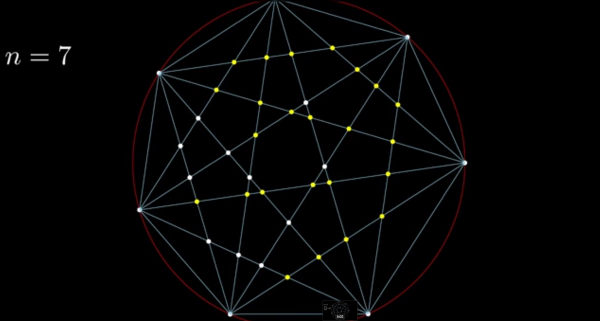
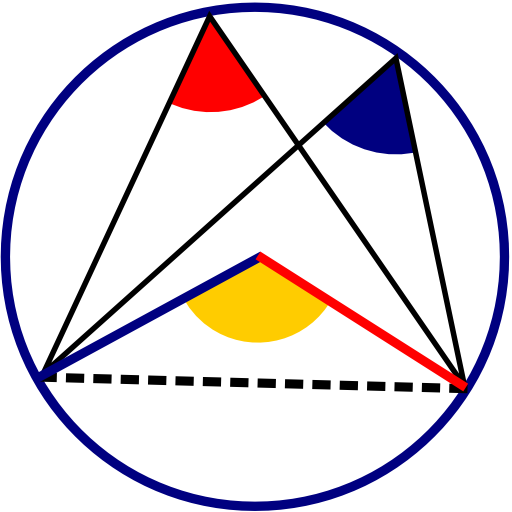
3Blue1Brown is Grant Sanderson, who’s writing software to help make videos explaining maths. So far, it’s going pretty well!