Hello! My name is Colin and I am a mathematician on a mission to share the joy, love and creativity of doing exactly the right maths for you.
This week, I have mainly been cursing the name of Scroggs and his cursed Chalkdust crossnumber. (It’s traditional, when someone mentions Chalkdust magazine, for you to say “what’s that?” and the response to be “it’s a magazine for the mathematically curious”.)
Links
If you’re anything like me, you will find the following pair of links to be personal catnip: three-dimensional maps of stations in Europe and the Americas, as well as specifically on the London Underground. I’ve certainly been more lost in Elephant & Castle than the map makes it look possible to be.
I’m shocked – shocked – to discover that there is fraud going on in scientific publishing and some academics are gaming the system, a fine example of Cunningham’s law. (Tee hee). The paper outlines some approaches to limit this, and reminds me of some reasons I don’t play academia any more.
The kids, when they do what I always called ‘carries’ and ‘borrows’ in arithmetic, use the word ‘exchanges’, which is a much more reasonable word. I also liked this explanation of ‘fat numbers’, which make the exchanges explicit.
And lastly, certainly winning the prize for “most provocative title”, a 2000 paper by Adler and Tanton demonstrates that π is the minimum value for pi.
Currently
Yesterday was the antepenultimate Tuesday of the month, which means Little MathsJam is almost upon us. In most of the world, that’ll be on Tuesday September 23rd, but check the website for your local details.
That’s all I’ve got for this week. If you have friends and/or colleagues who would enjoy Double Maths First Thing, do send them the link to sign up – they’ll be very welcome here.
Meanwhile, if there’s something I should know about, you can find me on Mathstodon as @icecolbeveridge, or at my personal website. You can also just reply to this email if there’s something you want to tell me.
We do these things, not because they are difficult, but because they are ridiculous – Matt Parker, probably
Matt Parker is going to the moon. I mean, not literally. Everyone’s favourite Stand-Up Mathematician is the sort of person who’s more likely to go to hyperspace than to space. However, when Matt was approached to do “something ridiculous” with spare computing power on a lunar rover, there was only ever going to be one outcome: an attempt to calculate \( \pi \) on the moon.
But… why?
That is an excellent question, beautifully presented. I compliment you for asking it. Next!
Moon-te Carlo
Because it’s important to do ridiculous things properly — there’s no point in going to the moon and doing calculations you could do on Earth — Matt made the decision to approximate \( \pi \) using the readings from the rover as a source of randomness for a Monte Carlo calculation.
Monte Carlo methods are typically used to work things out when it’s too difficult or too boring to do them analytically. While there were some earlier randomised calculation methods — Buffon’s needle, for example — the first real Monte Carlo experiment was done by Stanisław Ulam while recovering from an illness. Ulam wondered how likely it was that a game of solitaire would come out successfully and, rather than calculate it properly, decided to play a hundred games and count how many they won. It was a short step from there to the atomic bomb.
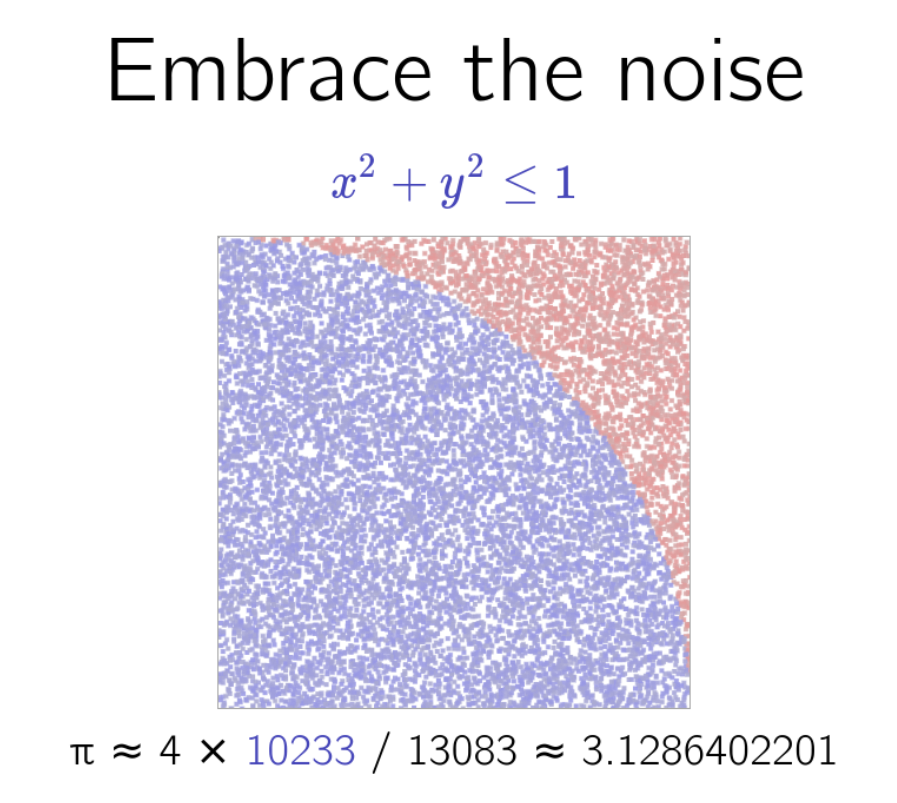
Matt showed the standard Monte Carlo approach to calculating \( \pi \) in the video announcing the moon \( \pi \) project — it’s often used as a simple example when introducing the idea. If you put a circular dartboard in a square box that just fits it, and threw darts at the box, assuming you were equally likely to hit any point in the box, each dart would have a probability of \( \frac{\pi}{4} \) of hitting the dartboard. If you threw 100 darts and 80 of them hit the board, you would conclude that \( \frac{\pi}{4} \approx 0.8 \) and that \( \pi \approx 3.2 \). Throwing more darts should get you a better estimate — although rather slowly. If you throw \( N \) darts, the standard error of your probability is proportional to \( N^{-\frac{1}{2}} \), which means becoming half as inaccurate requires four times as many darts.
An image from Christian’s Pi Day simulation, which does exactly this experiment. 10,233 out of 13,083 “darts”, coloured blue, have landed in the quadrant while the remainder landed outside, coloured red. That gives an estimate for \( pi \) of 3.129 or so, off by about 0.013. To improve that to “off by about 0.0065”, we’d need four times as many darts — 52,000.
Holding out for a Hero
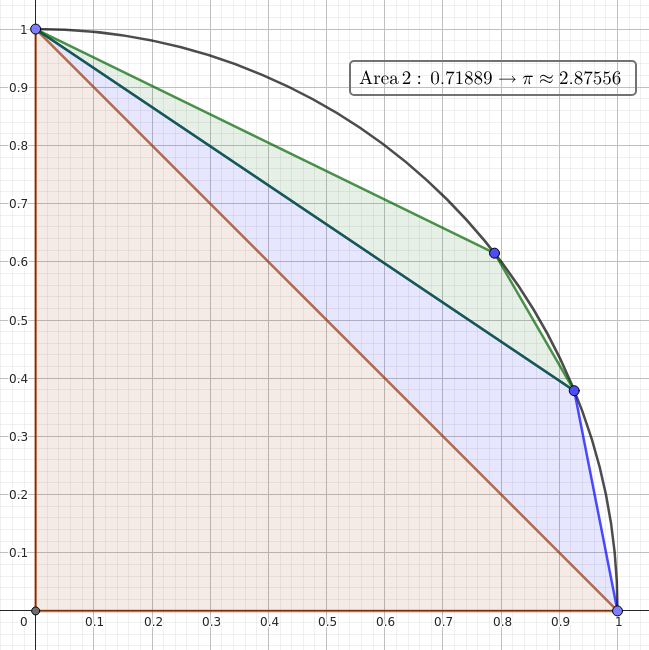
Matt famously thinks Heron’s formula is one of trigonometry’s most remarkable results. It’s been known to make Matt extremely emotional. So, naturally, my first thought was “I bet an approach based on Heron’s formula could converge more quickly.”
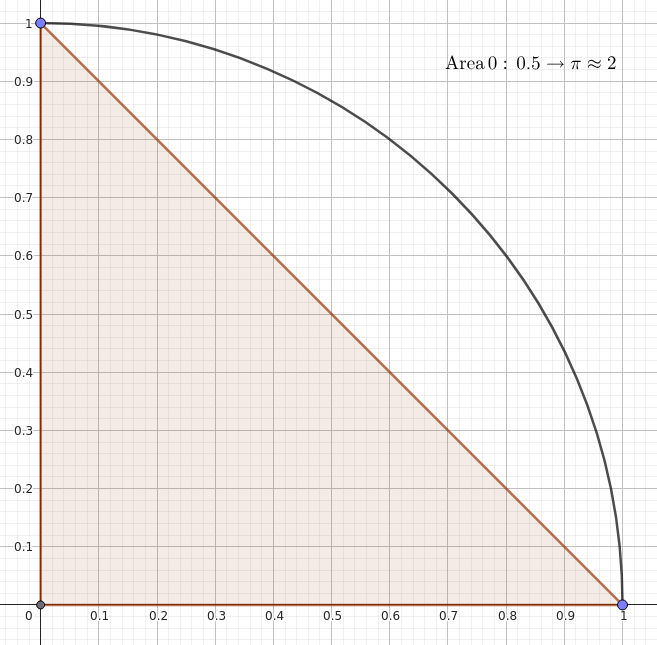
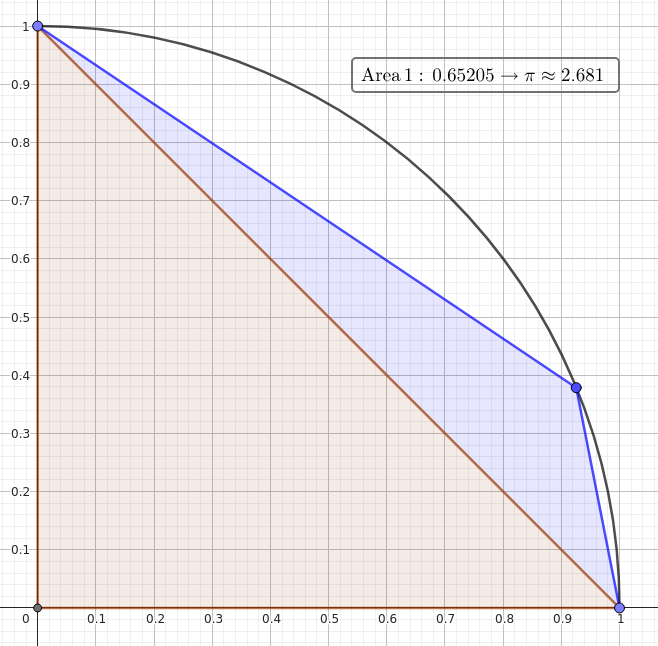
And it could! The approach entailed starting with a right-angled triangle with legs of length one inside a unit circle in the first quadrant. It would then pick a random x-coordinate between 0 and 1, figure out the corresponding point on the arc, and add a triangle based on the two adjacent points. Here’s the code. It converges to several decimal places within 10,000 iterations.
But that’s not really Monte Carlo, now, is it?
That is an excellent question, beautifully presented. I complime… what do you mean, I need to answer it? Who’s writing… OK. Fine. Sheesh.
You’re right, this isn’t a traditional Monte Carlo method. While it uses random points, it doesn’t use them to generate a probability. I do still maintain that it’s technically a Monte Carlo method, using a very involved adaptive weighting function, but I take the point.
What about proper Monte Carlo methods?
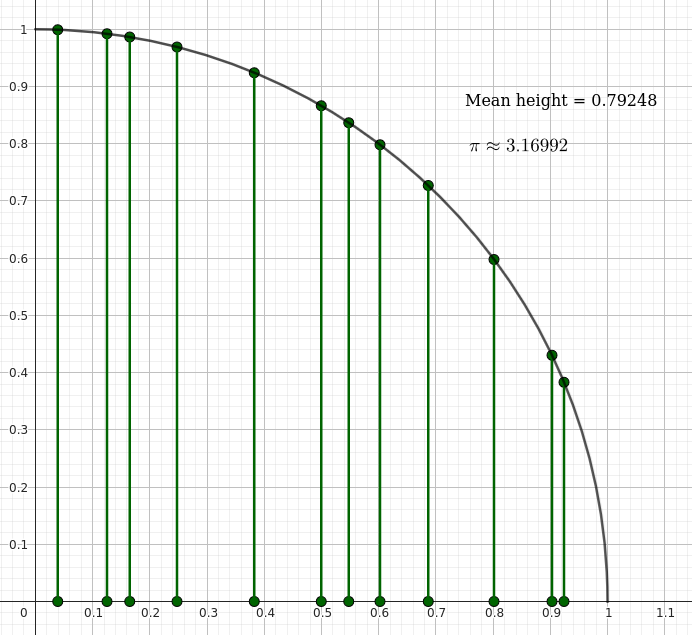
A less sophisticated (but still significantly more efficient than the integration-by-darts method) approach is to use the fact that \( x^2 + y^2 = 1 \) on the unit circle. If you pick an \( x \) value at random, you can immediately calculate the probability of a random \( y \) value giving a point inside the circle — it’s \( \sqrt{1- x^2} \). Rather than sample and add 1 or 0 to your total to approximate the probability, why not just add the probability? This converges very nicely.
The mean distance of a point on the circle from the axis is \( \frac{\pi}{4} \) — a fact we’ll (likely) be using for the actual experiment on the moon.
I’m not officially allowed to reveal that the reason for my interest in calculating \( \pi \) on the moon is that I’m helping to design Matt’s experiment, or that my codename is FizzBuzz Aldrin. (Is that lede sufficiently buried? Excellent.) And I’m definitely not officially allowed to say what we’re actually doing, because I imagine Matt will want to do a video about it.
However, I can say that the method above is equivalent to the fact that the expected distance between a point on the unit circle and an axis — any axis — is \( \frac{\pi}{4} \). By extension, using the magical incantation “SYMMETRY!” and a magisterial wave of the hand, it turns out that any point on a unit sphere is — on average — \( \frac{\pi}{4} \) from any axis of the sphere. That’s a fact that could be exploited, just to pick a random example, by a simulated rover making random moves on the surface in a sort of random moonwalk.
It would take small steps for a rover, and giant LOOPs for Matt-kind.
You can donate to Matt’s kickstarter here, if you’re so inclined. At the time of writing, they’ve raised well over a quarter of a million pounds towards their £75k target, so I’m looking forward to them launching their own space mission before long.
If you’re a teacher who wants to be involved, you can sign up here. Get the kiddos to estimate \( \pi \) by hand and they’ll get (I understand) a certificate, possibly their own value of lunar \( \pi \), and their name in a text file that goes to the moon. [Edited 2025-06-26 for formatting and to clarify that the personal \( \pi \) value is not guaranteed.]
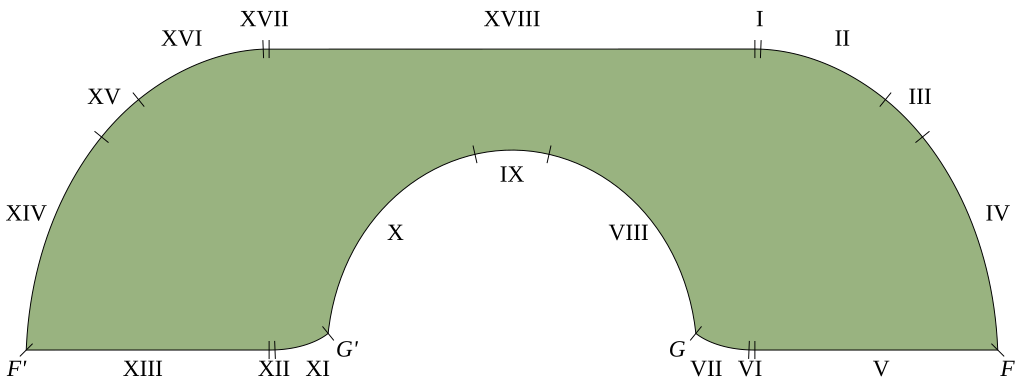
Jineon Baek claims a resolution to the moving sofa problem. This considers a 2D version of turning a sofa around an L-shaped corner, attempting to find a shape of largest area. (There are some nice animations at Wolfram MathWorld.) Baek offers a proof that the shape above, created by Joseph L. Gerver in 1992, is optimal.
One thing that’s new, apart from the prime itself, is that the work was done on a network of GPUs, ending “the 28-year reign of ordinary personal computers finding these huge prime numbers”. Also this was the first GIMPS prime discovered using a probable prime test, so the project chose to use the date the prime was verified by the Lucas-Lehmer primality test as the discovery date. In other computation news, the fifth Busy Beaver number has been found, as well as 202 trillion digits of pi.
Finite Group is a friendly online mathematical discussion group which is free to join, and members can also pay to access monthly livestreams (next one Friday 20th December 2024 at 8pm GMT and recorded for viewing later). The content isn’t at the level of the research mathematics in this post, but we try to have a fun time chatting about interesting maths. Join us!
Hello! My name is Colin and I am a mathematician. Welcome to issue 0 of Double Maths First Thing, in which I highlight some of the mathematical things that have caught my eye this week.
Let’s talk about \( \pi \) and powers
First up, a nod to physicists Arnab Priya Saha and Aninda Sinha for doing something with no real application: they “accidentally discovered a new formula for pi”. There’s a bit about it in Scientific American, a Numberphile video, and a paper in Physical Review Letters (open access). I’ve not worked through it in detail, but it’s got a Pochhammer symbol in it, so it must be good.
I promise this isn’t always going to be about pi, but I also stumbled on a proof that pi is irrational — again, I’ve not worked through the details, but it looks like it would be accessible to a good A-level class with a bit of hand-holding.
Via reddit, a surprisingly tricky problem with a lovely twist in the tail: show that \( 3^k + 5^k = n^3 \) has no solutions for \( k > 1 \). (There’s a hint and a spoiler over on mathstodon.)
Somewhere to visit: W5, Belfast
I’ve recently been on holiday in Northern Ireland. We visited W5 in Belfast, which is a pretty cool science museum — lots of hands-on stuff, including a build-your-own Scalextric-style car, bottle rockets and a green-screen bit where you can present the news about the alien invasion. On the minus side… there are lots of missed opportunities for highlighting the maths that underpins it all. Still, it’s a fun half-day if you’re all Titanic-ed out.
Maths in the news
In the proper news, the Guardian had a long read about Field’s Medallist Alexander Grothendieck; although it too is a bit maths-light, it’s understandable given quite how heavy Grothendieck’s maths is. Katie Steckles also pointed me at the devastating news that UK railcard discounts are dropping from 34% to 33.4%, which strikes me as the sort of thing that probably costs more to implement than it could possibly save the train operators.
This is a guest post by Storm Reinbolt, outlining a historical mathematical incident which almost caused a misdefinition!
π is an irrational number that is equal to 3.1415926535 (to 10 digits). Things could have been different, however, if Dr. Edward J. Goodwin succeeded in passing Indiana Bill No. 246. This bill would have completely changed π and mathematics as a whole.
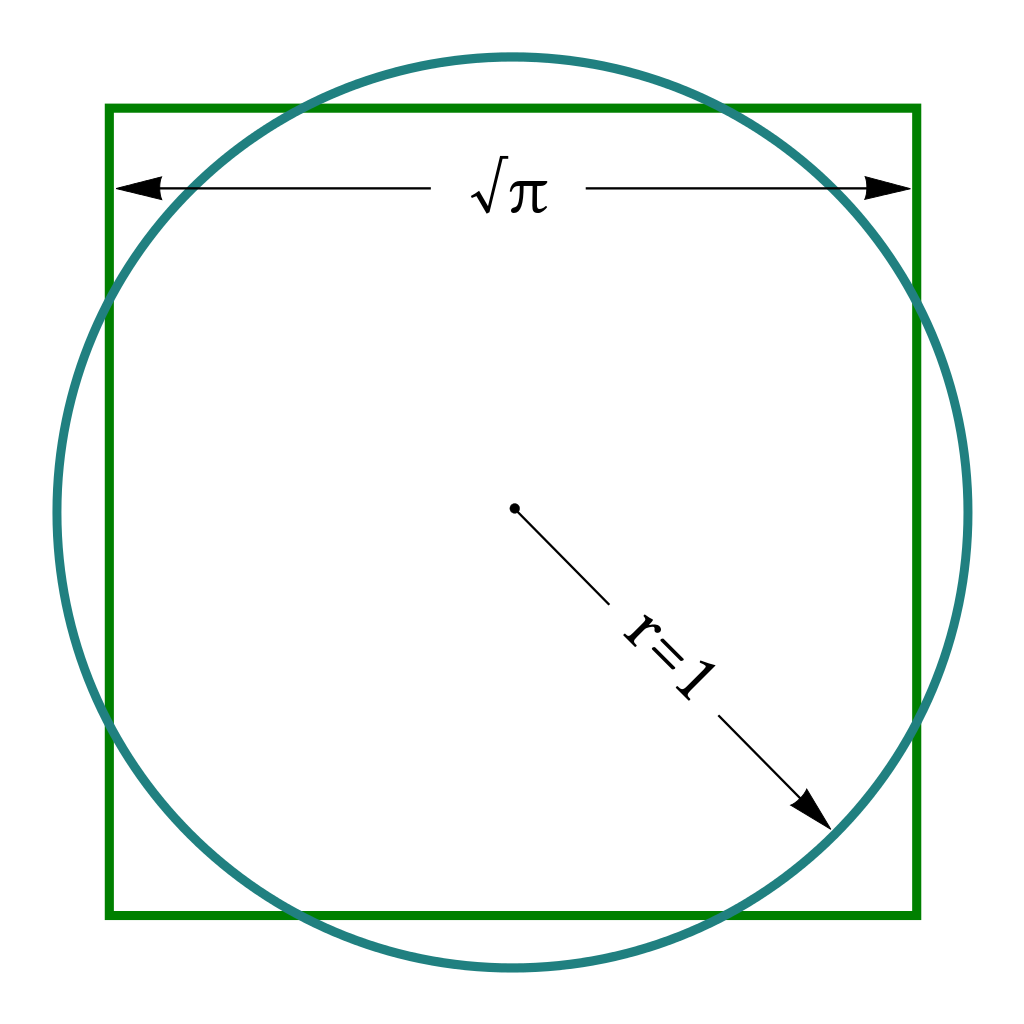
In 1894, Dr. Goodwin, a physician who dabbled in mathematics, claimed to have solved some of the most complex problems in math. Among these was the problem of squaring the circle, which was proposed to be impossible by the French Academy in 1775. This is impossible due to the fact the area of a circle is $\pi \cdot r^2$, where $r$ is the radius, and the area of a square is $s^2$, where $s$ is the length of each side.
This was proven by Ferdinand von Lindemann in 1882, and is what makes squaring a circle impossible.
In order to square a circle, $\pi \cdot r^2$ must be equal to $s^2$. For example, if $r=1$, we would have $\pi \cdot 1^2 = s^2$, or $\pi = s^2$. This would mean that each side of the square is equal to the square root of π, and since π is transcendental, there’s no algebraic expression that could describe π.
Regardless, Goodwin claimed to have done it, and published his paper to American Mathematical Monthly in 1894. It was gibberish, and no amount of understanding in mathematics would make his work comprehensible. He claimed nine different values of π across his many works, with one claim going as far as $9.2376\ldots$, “the biggest overestimate of π in the history of mathematics” (A History of Pi). When his theories weren’t becoming popular, he decided to take them to the Indiana State Legislature on January 18, 1897.
The Indiana Pi Legislature took place here, in the Indiana Statehouse. Photo CC BY-SA 3.0 Massimo Catarinella, from Wikipedia
Goodwin had convinced his state representative, Taylor I. Record, to introduce House Bill 246 (Indiana Bill No. 246). House Bill 246 would make Goodwin’s method of squaring the circle a part of Indiana law. However, those in the legislature either didn’t understand or didn’t even glance at the bill – and the House Committee on Canals decided to pass it. Dr. Goodwin’s ridiculous bill was now headed to the senate.
At the statehouse where the senate took up the bill was Professor Clarence Abiathar Waldo, a mathematics professor from New York. When Waldo heard what the bill was about, he was shocked to discover he was in the middle of a debate on a fundamental principle of mathematics. He decided to intervene and talk to the senators about the repercussions the bill would have on everything mathematics, and was able to stop the bill from passing the second chamber.
After Waldo’s intervention, it was clear to everyone that the people involved in the attempted passing of the bill, including Dr. Goodwin, were all wrong, and it was ridiculous to define mathematical truth by law.