“What’s that, boss?”
“I said, look at this article on a conference about how maths is applied and write something full of puns.”
“Cheesy puns?”
“Attaboy.”
“What’s that, boss?”
“I said, look at this article on a conference about how maths is applied and write something full of puns.”
“Cheesy puns?”
“Attaboy.”
The London Mathematical Society has announced that this year’s Women In Mathematics Day will take place on April the 18th and 19th at the Isaac Newton Institute in Cambridge. It’s free for students and £5 on the door for everyone else.
The event provides an opportunity to meet and talk with women who are active and successful in mathematics. While this is an occasion particularly for women active in mathematics to get together, men are certainly not excluded from this event.
The deadline for poster and talk submissions is March 15th 2013 (contact Beatrice Pelloni); if you’d like to register as a delegate, get in touch with Katy Henderson by April 1st 2013.
Women in Mathematics Day event page at the LMS
I have an article in the current issue of the Journal of Humanistic Mathematics (Vol 3, Issue 1). The title is Developing a Healthy Scepticism About Technology in Mathematics Teaching. This will be a chapter of my PhD thesis and provides some background context. I am following a model in which teaching draws on a body of theory which is based on scholarship as well as reflective evaluation of previous experience. So as well as a literature survey, I present a reflective account of experiences which have taken place alongside, but outside of, my PhD research that have shaped my thinking.
This journal is an online-only, diamond open-access ((Diamond open access means that you don’t have to pay to read it and I haven’t had to pay to publish it. It’s a kind of magic.)), peer-reviewed journal with an emphasis on “the aesthetic, cultural, historical, literary, pedagogical, philosophical, psychological, and sociological aspects as we look at mathematics as a human endeavor”. They publish “articles that focus mainly on the doing of mathematics, the teaching of mathematics, and the living of mathematics”. (Quotes from the Journal’s About page.)
My article’s synopsis is:
A reflective account is presented of experiences which took place alongside a research project and caused a change in approach to be more sceptical about implementation of learning technology. A critical evaluation is given of a previous e-assessment research project, undertaken from a position of naive enthusiasm for learning technology. Experiences of teaching classes and designing assessment tasks lead to doubts regarding the extent to which the previous project encouraged deep learning and contributed to graduate skills development. Investigations of the benefits of another technology—in-class response systems—lead to revelations about learning technology: its enthusiastic introduction in isolation cannot be expected to produce educational benefit; instead it must address some pedagogic need and should be evaluated against this. Overall, these experiences contribute to a shift away from a naive enthusiasm to an approach based on careful consideration of educational need before technology implementation.
Download the PDF of this article here.
P.S. Sorry the blog has become rather infrequent and quite education-focused. I am currently splitting my time between teaching and writing my thesis, so I have little time for anything else. My employment contract is only to teach until May and my thesis is due in July.
Gradually, gradually, the mathematicians are taking over the world. Having already conquered (by which I mean ‘colonised pubs once a month’) in places as far-flung as Melbourne, Houston, Bombay and Edinburgh, MathsJam will be making its debut in Cape Town, South Africa on Tuesday February 19th.
Science and maths are all about finding things out. Mathematics in particular is about making statements, and then determining their truth (or falsity). Finding a proof, or disproof, of a mathematical theory can be as simple as finding a counterexample, or it can take hundreds of authors tens of thousands of pages.
In this short series of articles, I’m going to write about some mathematical questions we don’t know the answer to – which haven’t yet been proven or disproven. Hopefully you will find it interesting, and maybe someone will even be inspired to delve deeper and find the answers themselves.
There’s too much maths news for us to cover, so we’re looking for a few volunteers to help out in our new News Team.
A fairly big part of what this site is for is to cover mathematical news. We like to write short, to-the-point posts pointing to the relevant information about current events. These don’t have to be as in-depth as a feature or column blog post, but are a great way to keep everyone aware of what is going on in the mathematical world.
Most weeks we find more stories than we find time to write up, and the three of us (Katie, CP and Peter) have ever-growing work commitments, so we’re seeing if anyone wants to help out. Read on to find out what’s involved, or if you’re feeling nosy about how we write up news.
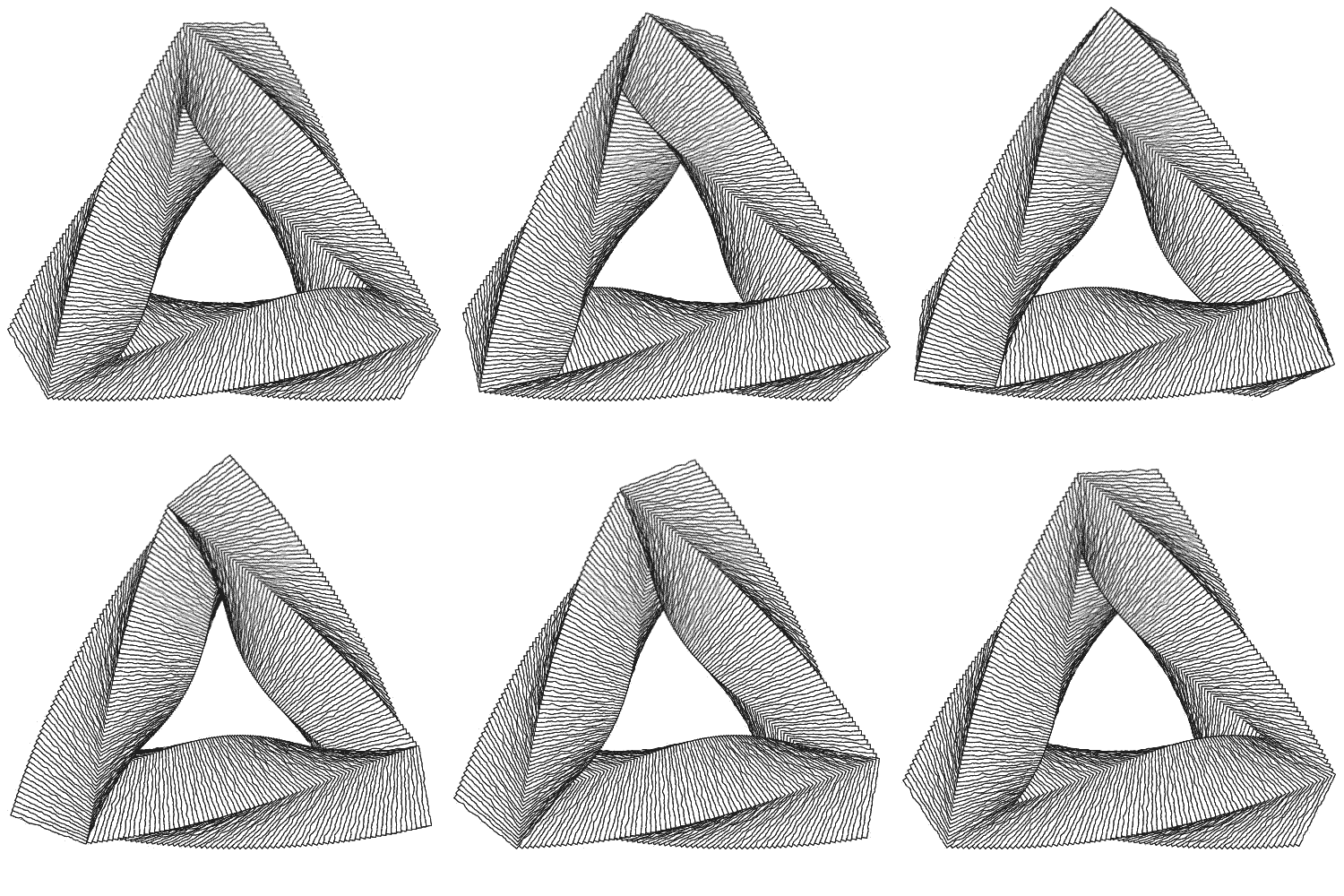
Paolo Čerić is an information processing student from Croatia. He’s developed a cool style of animated geometrical GIFs created using processing, which he posts on his Tumblr blog.
via Colossal