
Silly maths stories, like buses with a taxi sneaking into the bus lane behind them, come along four at a time, it seems. None of these stories merits being reported on here on its own, but we felt the fact that they all came to our attention so close to each other deserved recognition.
You're reading: Posts By Christian Lawson-Perfect
A new model theory blog: Forking, Forcing and back&Forthing
Mathematical niche-filling news: a few model and set theorists have got together to start a new shared blog “on that hard to define area that is perhaps 80% Model Theory and 20% Set Theory”.
It’s wittily called fff, short for Forking, Forcing and back&Forthing ((Reminds me of the old joke a biologist told me: “the hyptothalamus controls the four Fs: fighting; fleeing; feeding; and reproduction. Anyway, forking, forcing, and back&forthing are all terms from model and set theory)), and it’s run by Andrés Caicedo, Juan Diego Caycedo, Artem Chernikov, John Goodrick, Ayhan Günaydın, Goyo Mijares, Sonat Suer, Andrés Villaveces.
The new blog is inspired by communal-blogging trailblazers the Secret Blogging Seminar, started by some Berkeley PhD students, and the n-Category Café, run by a mixture of category theorists, physicists and philosophers. The fff chaps explain themselves thus:
… a group of Model Theorists and Set Theorists have decided to put up a blog to explain to ourselves (and whoever reads this) why some result we just submitted to a journal is interesting, why some “classical” theorem (or definition, or notion, or example) is worth revisiting, what is our view on some discussion, what on earth is “such and such fancy concept”.
The blog: fff (Forking, Forcing and back&Forthing)
via Richard Elwes on Google+
Mathagogy: two-minute mathematics education
In ‘asking people on the internet to do things for you’ news: mathagogy.com is asking for submissions from teachers of two-minute videos, describing how they would approach teaching a particular aspect of mathematics.
Peps Mccrea makes the pitch in this positively fleeting 69 second video:
[youtube url=http://www.youtube.com/watch?v=xVXyrFQY4dk]
Submit a video at mathagogy.com
via Johnathan Gregg on Twitter
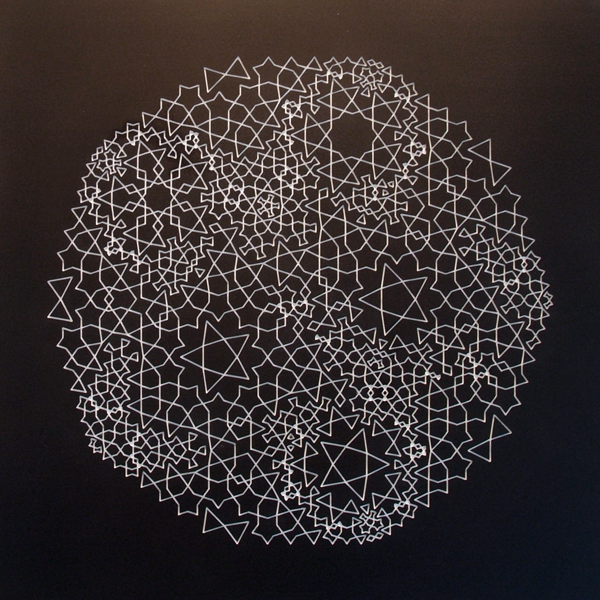
Girih patterns by Joe Bartholomew
Integer sequence review: A000959
The Online Encyclopedia of Integer Sequences contains over 200,000 sequences. It contains classics, curios, thousands of derivatives entered purely for completeness’s sake, short sequences whose completion would be a huge mathematical achievement, and some entries which are just downright silly.
For a lark, David and I have decided to review some of the Encyclopedia’s sequences. We’re rating sequences on four axes: Novelty, Aesthetics, Explicability and Completeness.
A000959
Lucky numbers.1, 3, 7, 9, 13, 15, 21, 25, 31, 33, 37, 43, 49, 51, 63, 67, 69, 73, 75, 79, 87, 93, 99, 105, 111, 115, 127, 129, 133, 135, 141, 151, 159, 163, 169, 171, 189, 193, 195, 201, 205, 211, 219, 223, 231, 235, 237, 241, 259, 261, 267, 273, 283, 285, 289, 297, 303, ...
First papers in Forum of Mathematics Pi and Sigma
I had hoped that The Future of Scholarly Mathematical Intercourse would arrive chaperoned by The Future of Publishing.
The first papers in Cambridge University Press’s new journals, Forum of Mathematics Pi and Forum of Mathematics Sigma, have been published — $p$-adic Hodge theory for rigid-analytic varieties by Peter Scholze in FoM Pi, and Generic mixing theory via vanishing Hodge models by Minhea Popa and Christian Schnell in FoM Sigma. But since the journals are more interesting for the medium they’re delivered by than their message, I’d like to take a look at the experience I had when accessing them.
EDF0 by Raven Kwok
[vimeo url=https://vimeo.com/43752422 w=600]
via NotCot.org