[youtube url=http://www.youtube.com/watch?v=2_P-8rArDnE]
More pictures at streetartnews.net
[youtube url=http://www.youtube.com/watch?v=2_P-8rArDnE]
More pictures at streetartnews.net
It seems that big mathematical advances are like buses – you wait ages for one, and then two come along at once. Also revealed yesterday was a proof of the odd Goldbach conjecture: that all odd numbers greater than 7 can be written as the sum of exactly three odd primes. The proof is contained in Major arcs for Goldbach’s theorem, a paper submitted to the arXiv by Harald Helfgott, who’s a mathematician at the École Normale Supérieure in Paris. This new paper completes the work started in Helfgott’s previous paper, Minor arcs for Golbach’s problem, published last year.
The strong Goldbach conjecture states that every even number can be written as the sum of two primes. This is still unproven, and remains one of the long-standing unproven results in number theory. Sadly, it’s the opinion of Terence Tao, among others, that the method used to prove the weak conjecture probably won’t work on the strong conjecture.
The paper: Major arcs for Goldbach’s theorem by Harald Helfgott
via Terry Tao on Google+
“The author has succeeded to prove a landmark theorem in the distribution of prime numbers. … We are very happy to strongly recommend acceptance of the paper for publication in the Annals.”
According to the Nature News blog, at yesterday’s seminar given by Yitang Zhang it was revealed that his proof that there are infinitely many pairs of primes less than seventy million apart has already been refereed for the Annals of Mathematics; that’s a quote from the referee’s report above.
It seems the proof doesn’t use any unconventional machinery (in contrast to Mochizuki’s Proof from Planet 9 of the abc conjecture) and is fairly uncontroversial. How pleasant! Of course, someone might find a problem with it once it’s publicly available, but that’s the way for all things.
Source: First proof that infinitely many prime numbers come in pairs at Nature News
The Online Encyclopedia of Integer Sequences contains over 200,000 sequences. It contains classics, curios, thousands of derivatives entered purely for completeness’s sake, short sequences whose completion would be a huge mathematical achievement, and some entries which are just downright silly.
For a lark, David and I have decided to review some of the Encyclopedia’s sequences. We’ll be rating sequences on four axes: Novelty, Aesthetics, Explicability and Completeness.
A051200
Except for initial term, primes of form “n 3’s followed by 1”.3, 31, 331, 3331, 33331, 333331, 3333331, 33333331, 333333333333333331, 3333333333333333333333333333333333333331, 33333333333333333333333333333333333333333333333331, ...
Update 14/05/2013: The seminar was successful: Zhang announced that his proof has already been refereed for the Annals, and everyone seems happy with it.
Hard Maths news now: there’s a rumour going round that Yitang (Tom) Zhang of the University of New Hampshire reckons he can prove that there are infinitely many different pairs of primes at most 70,000,000 apart.
[vimeo url=https://vimeo.com/65475425]
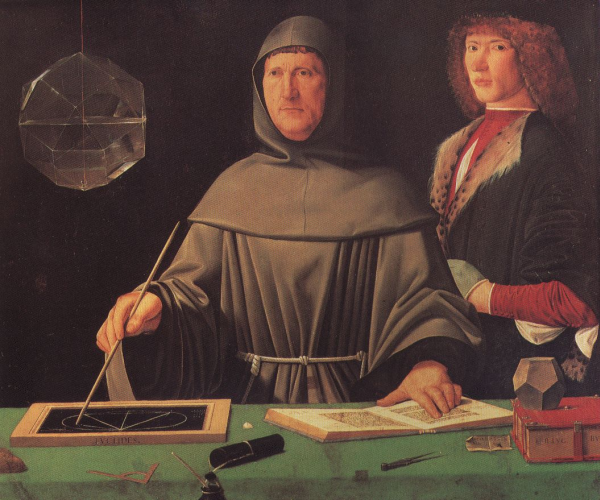
Good maths books are simultaneously plentiful and rare. While there are a few classics almost everyone knows about and has copies of (Gardner, Hardy, etc.), the trade in lesser-known maths books is considerably less well-organised. Very few bookshops have well-stocked maths sections, and insipid pop maths books dominate. Unless you hear about a good maths book through word of mouth, you’ll often only encounter it once it’s ended up in a second-hand bookshop, usually a refugee from an emptied maths department library.
But books, more than anything else, are where the beauty of maths really manifests itself. It’s where ideas are presented most clearly, after they’ve had time to percolate through a few more brains. We talked to David Singmaster, professor of maths and metagrobologist, about his favourite maths books.

Podcast: Play in new window | Download
Subscribe: RSS | List of episodes