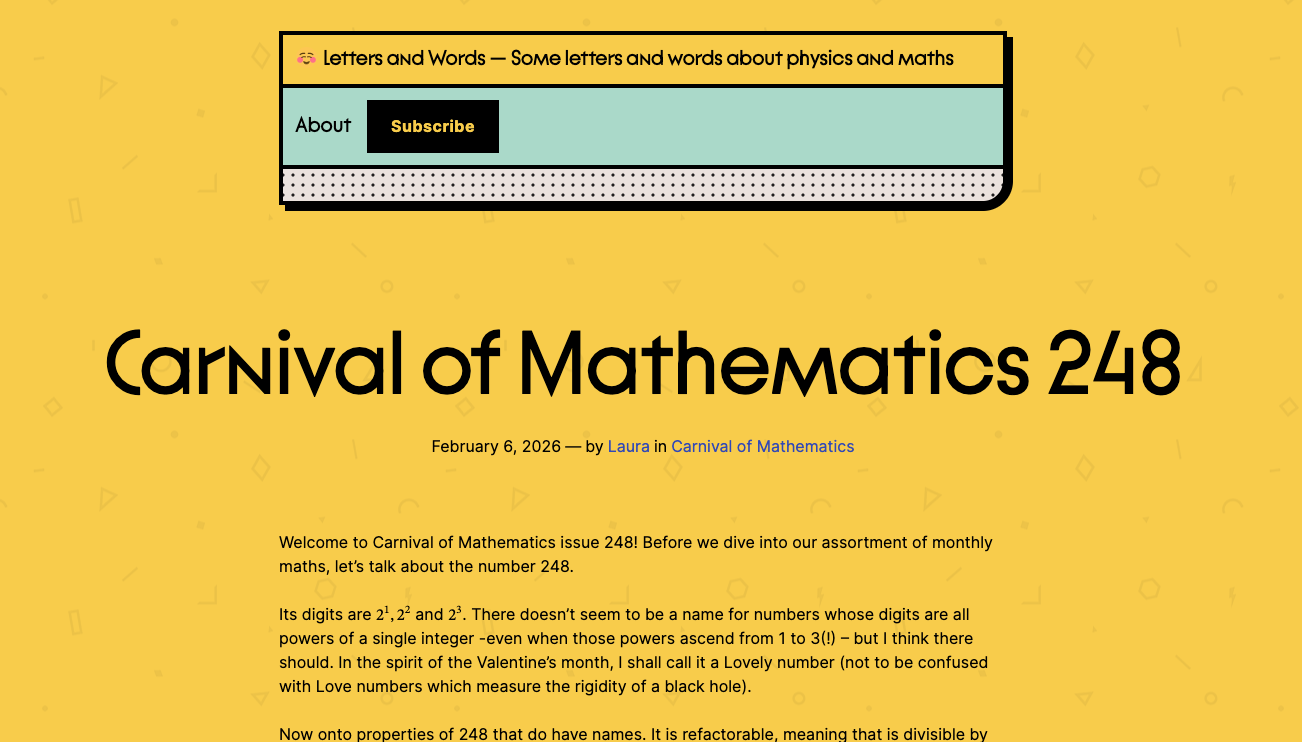
The next issue of the Carnival of Mathematics, rounding up blog posts from the month of February 2026, is now online at Tony’s Maths Blog.
The Carnival rounds up maths blog posts from all over the internet, including some from our own Aperiodical. See our Carnival of Mathematics page for more information.
Here’s a short round-up of mathematical and maths-adjacent news from this month.
The LMS are seeking Outreach Lecturers, who must work in UK HE mathematics, and will receive a two-year post during which they’re expected to deliver talks to a minimum of 4 schools around the UK each year. The talks should be free to the schools, targeted at a minimum 75% schools with a high proportion of pupils from disadvantaged backgrounds. The post comes with a small honorarium to cover travel and ‘associated costs’, and the deadline for applications is 9th March.
In a recent issue of DMFT posted here, Colin investigated the connection between Jeffrey Epstein and the Gathering 4 Gardner recreational maths events. (It turns out, he was on their mailing list but never registered to attend).
The next issue of the Carnival of Mathematics, rounding up blog posts from the month of January 2026, is now online at Letters and Words.
The Carnival rounds up maths blog posts from all over the internet, including some from our own Aperiodical. See our Carnival of Mathematics page for more information.
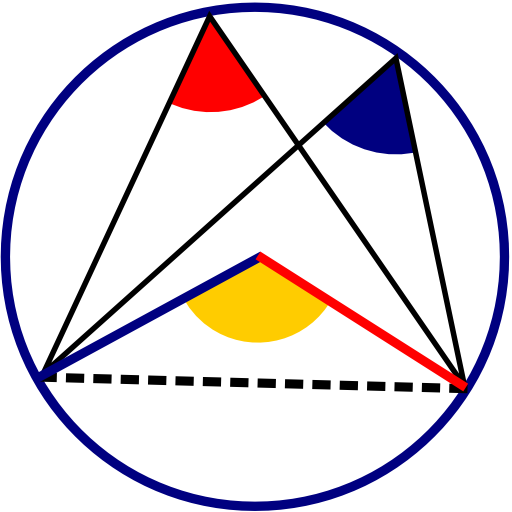
Accessibility of mathematical materials is often an afterthought, if it’s a thought at all. I had to hurry back to put alt-text on the picture above. It’s good to see that several of maths’s learned societies (the AMS, EMS, LMS and SIAM) have published author guidelines for preparing accessible mathematics content.
AI happenings
There’s a fair amount of chat lately about whether the current set of AI tools can be useful to research mathematicians. In establishing whether AI tools can really help with new maths or whether they’re just regurgitating something they’ve seen elsewhere, it would be useful to have a set of problems whose answers are definitely known to humans, but haven’t appeared in any text corpus that the AI might have been trained on.
Eleven Serious Mathematicians have announced a project called “First proof” (1stproof.org), aiming to do just that. They’ve come up with ten mathematical questions and solved them, but rather than publishing the answers straight away, they’ve encrypted them for a week. So people have a week to try to get AI tools to come up with solutions, after which the human answers will be published and the AI solutions verified.
(via Terence Tao, who noticed the similarities with the old practice of publishing encrypted proofs to establish priority before properly writing them up)
Opportunity
Applications are open for PROMYS Europe 2026, a six-week residential summer programme at the University of Oxford, UK (July 12th to August 22nd). It’s open to pre-university students (age 16+) from across Europe (including “all countries adjacent to the Mediterranean”); the deadline is March 8th, but PROMYS recommend allowing plenty of time to tackle the problems that form part of the application.
A conversation about mathematics and communicating mathematics inspired by a ‘Certified Mathematical Object’ sticker. Presented by Katie Steckles and Peter Rowlett, with special guest Chris Nho from Public-Math.org.