MathsJam this month fell on the day before my birthday, which meant not only was our ‘Jam well supplied with birthday cake, but there was a jubilant mood only aided by the presence of some puzzles I’d written for my birthday party. Everyone had a good crack at the maths-related one, and found it entertaining (see: future Puzzlebombs, where said puzzles will almost certainly feature).
You're reading: Posts By Katie Steckles
Puzzlebomb Presents: Special 1
 As part of Puzzlebomb’s commitment to bringing you all puzzles, all the time, we present a special one-off edition, containing a mildly topical cryptic crossword compiled by one of our regular puzzle setters. Enjoy! Solutions will be posted in roughly a month from now.
Happy Birthday Euler!
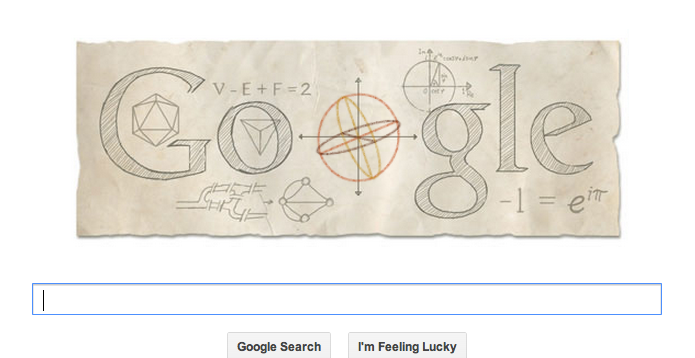
Today is Euler’s $-306 \times e^{i \pi}$th birthday, and Google have chosen to celebrate (despite ignoring several other prominent mathematical birthdays, including Erdős’s centenary – see the @MathsHistory twitter feed for a full list) by creating a Google doodle on their homepage.
For anyone who isn’t aware, this is when Google changes the image above the search box on the homepage at Google.com, so it still says ‘Google’ but using an appropriate image, which sometimes has built-in interactive elements. I thought it was worth pointing out some of the fantastic maths they’ve included in today’s doodle.
Not mentioned on The Aperiodical this month, March/April
Here’s a round up of some other recent (and now less so) news stories we didn’t cover in full.
13 New 3-body orbits discovered
Physicists from the University of Belgrade have discovered numerically 13 new solutions to the 3-body problem, in 2 dimensions. Described as “quite a feat in mathematical physics”, the discovery makes progress towards the long-standing problem of determining how three particles, when left to move under the action of their gravity on each other, will behave. The solutions they’ve found are all for particles moving in a 2-dimensional plane, and are represented using points on the surface of a sphere to describe the position of the three particles.
Claimed disproof of the Triangulation Conjecture
The Triangulation Conjecture, a result in topology, may turn out to be false as UCLA’s Ciprian Manolescu claims to have disproved it. The conjecture claims that every compact topological manifold can be triangulated by a locally finite simplicial complex, which means that, roughly, any surface (well, n-dimensional surface) can be divided into triangles in a specific way that topologists find exciting. The conjecture has already been disproved in dimension 4, although hope was held it might be true in higher dimensions. We’re still waiting for confirmation the disproof is correct, but if it is it wipes out many topologists’ hopes of being able to divide certain types of surfaces into triangles in a specific way.
Blog post on the topic, with an interesting comments discussion
(via Dave Richeson on Twitter)
Math Cannot be Patented
A patent suit filed in the Eastern District of Texas has been dismissed on the grounds that mathematics cannot be patented. Uniloc, described in an article on news blog Rackspace as ‘a notorious patent troll’, alleged that a floating point numerical calculation by the Linux operating system violated U.S. Patent 5,892,697. You can’t patent maths!
Mathematics Cannot Be Patented – Case Dismissed at Rackspace
Transactions of the LMS: an open access journal
Fans of Open Access journals will be pleased to hear that the London Mathematical Society is launching one, titled Transactions of the London Mathematical Society. The LMS would like to emphasise that:
By launching this journal, the LMS is not promoting any particular cause and we do not advocate one publishing payment model over another.
Details can be found on pages 8-11 of their most recent newsletter.
All Squared, Number 4: How interesting!
It’s a repeat booking for the Festival of the Spoken Nerd in number 4 (or 16 if you belong to Team All Squared) of our podcast. Standup mathematician Matt Parker joined us to talk about interesting coincidences.

Podcast: Play in new window | Download
Subscribe: RSS | List of episodes
Puzzlebomb – April 2013
Puzzlebomb is a monthly puzzle compendium. Issue 16 of Puzzlebomb, for April 2013, can be found here:
Puzzlebomb – Issue 16 – April 2013
The solutions to Issue 16 can be found here:
Puzzlebomb – Issue 16 – April 2013 – Solutions
Previous issues of Puzzlebomb, and their solutions, can be found here.
Follow Friday, 29/03/13
It’s Friday again! And with a seamless unbroken chain of Follow Friday posts stretching backward through time with no discernible gap, here’s another post with some recommendations of people to follow on Twitter if you’re into maths.