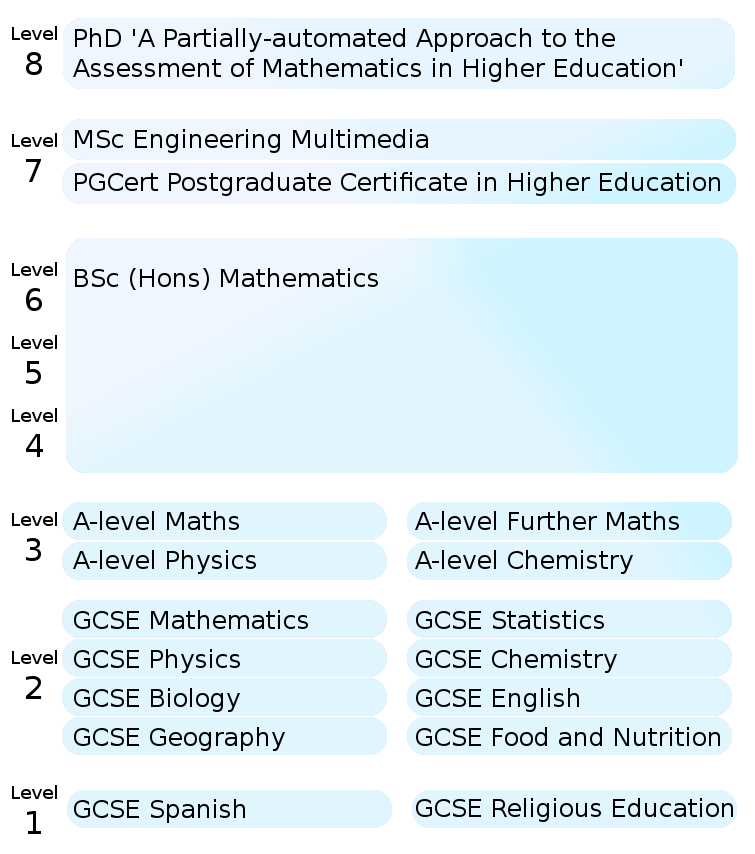
 (See QCF.)
That is to say, the university have sent me a degree certificate, and I’ve shown it to the bank. So that’s pretty darn official.

(See QCF.)
That is to say, the university have sent me a degree certificate, and I’ve shown it to the bank. So that’s pretty darn official.
Neuroscientists Semir Zeki and John Paul Romaya have put mathematicians in an MRI scanner and shown them equations, in an attempt to discover whether mathematical beauty is comparable to the experience derived from great art.
They’ve detailed the results in a paper titled “The experience of mathematical beauty and its neural correlates”. Here’s a bit of the abstract:
We used functional magnetic resonance imaging (fMRI) to image the activity in the brains of 15 mathematicians when they viewed mathematical formulae which they had individually rated as beautiful, indifferent or ugly. Results showed that the experience of mathematical beauty correlates parametrically with activity in the same part of the emotional brain, namely field A1 of the medial orbito-frontal cortex (mOFC), as the experience of beauty derived from other sources.
BBC News puts it: “the same emotional brain centres used to appreciate art were being activated by ‘beautiful’ maths”. This is interesting, according to the authors, because it investigates the emotional response to beauty derived from “a highly intellectual and abstract source”.
As well as the open access paper, the journal website contains a sheet of the sixty mathematical formulae used in the study. Participants were asked to rate each formula on a scale of “-5 (ugly) to +5 (beautiful)”, and then two weeks later to rate each again as simply ‘ugly’, ‘neutral’ or ‘beautiful’ while in a scanner. The results of these ratings are available in an Excel data sheet.
This free access to research data means we can add to the sum total of human knowledge, namely by presenting a roundup of the most beautiful and most ugly equations!
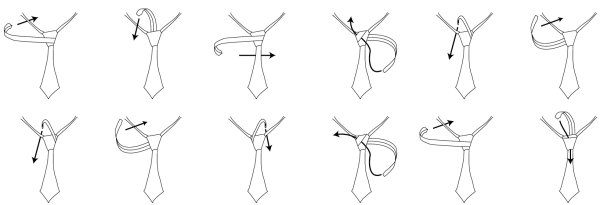
Novel knot news now! You might already be aware that there are 85 ways to tie a tie. Well, cast that preconception aside because there are actually loads.
The next issue of the Carnival of Mathematics, rounding up blog posts from the month of January, and compiled by Frederick Koh, is now online at White Group Mathematics.
The Carnival rounds up maths blog posts from all over the internet, including some from our own Aperiodical. See our Carnival of Mathematics page for more information.
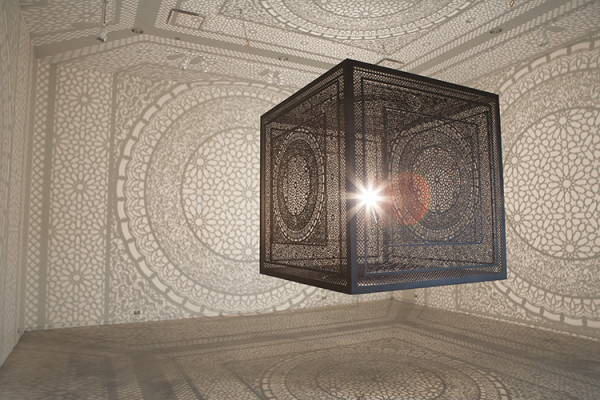
Intersections by Anila Quayyum Agha.
via Colossal.
The last two weeks my first year mathematicians and I have covered Taylor series.This means that several times I’ve had the conversation that goes “What’s $0!$?” “It’s $1$.” “Oh, erm, right. Why again?” “Because it works.” This may not be a completely satisfactory answer!
One of my students, Callum Mulligan, tweeted this question.
Why does 0! = 1 better yet, why does a^0 = 1 I must see a proof! #Mission #Unanswered #MathRage
— Callum Mulligan (@Calified) February 1, 2014
Saying “by definition” or “because it makes a bunch of stuff work” won’t cut it. So how to answer this question? To give a somewhat intuitive understanding of why this should be the case to a first year undergraduate. It may be obvious, but it wasn’t immediately obvious to me how to explain this, so I share some thoughts here.

Puzzlebomb – Issue 26 – February 2014
The solutions to Issue 26 can be found here:
Puzzlebomb – Issue 26 – February 2014 – Solutions
Previous issues of Puzzlebomb, and their solutions, can be found here.