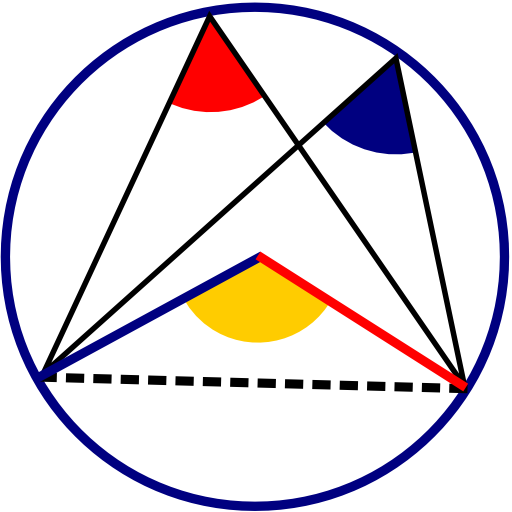
Here’s a nice idea: a journal for people to write about open problems, with the aim of inspiring someone to have a go at solving them. Open Problems in Mathematics is a new open-access journal set up by Krzysztof Burdzy and a few others, and it’s online now.
You're reading: Columns
Proof News: Designs exist!
The year in proofs has started with a big result in combinatorics: the existence conjecture for designs. As usual, weightier minds than ours have comprehensively explained the result, so I’ll just give a brief summary of the problem and then some links.
An Approach That Uses Computers a Bit to Ask Questions on Numbers and Stuff in Big School
Here I attempt to write the abstract for my thesis, ‘A Partially-automated Approach to the Assessment of Mathematics in Higher Education’, “using only the ten hundred words people use the most often“.
Carnival of Mathematics #106 – December 2013
 Happy New Year! And welcome to the first Carnival of Mathematics of 2014. The Carnival is a monthly roundup of blog posts on or related to mathematics, from all over the internet. Posts are submitted by authors and readers, and collated by the host, whose blog it’s posted on. This month, the Carnival has pulled in here at The Aperiodical, and we’re all ready with our party hats for the celebration of mathematical blogging that implies.
Puzzlebomb – January 2014

Puzzlebomb – Issue 25 – January 2014
The solutions to Issue 25 can be found here:
Puzzlebomb – Issue 25 – January 2014 – Solutions
Previous issues of Puzzlebomb, and their solutions, can be found here.
A morning in the office with CP and Cushing
CP walks into the office.
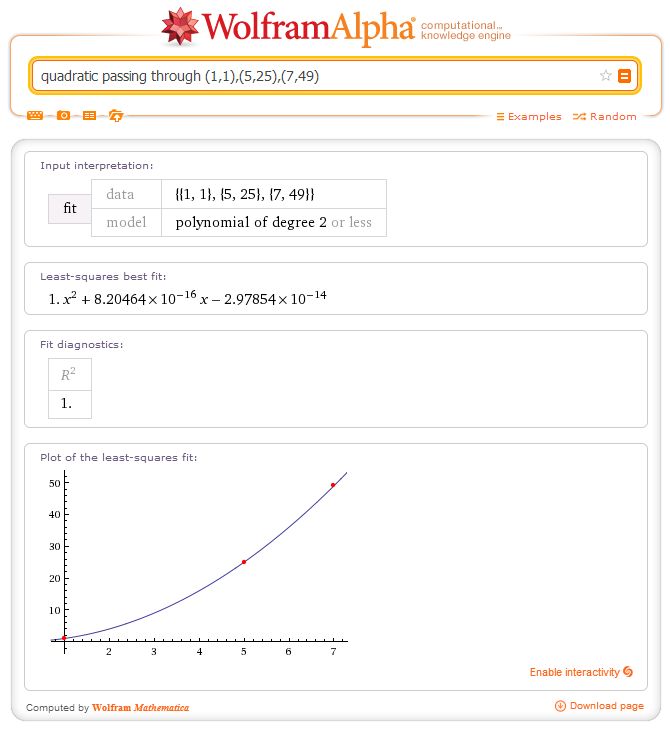
Cushing: Christian, look at this. I’ve asked Wolfram Alpha to plot a quadratic going through three squares.
Manchester MathsJam Recap, December-ish 2013
 Since I haven’t written a MathsJam recap for a few months, due to extreme busyness, this post will recap things which happened at December’s MathsJam as well as some other things I found in the pile of scrap paper when I went to tidy it all away over New Year.