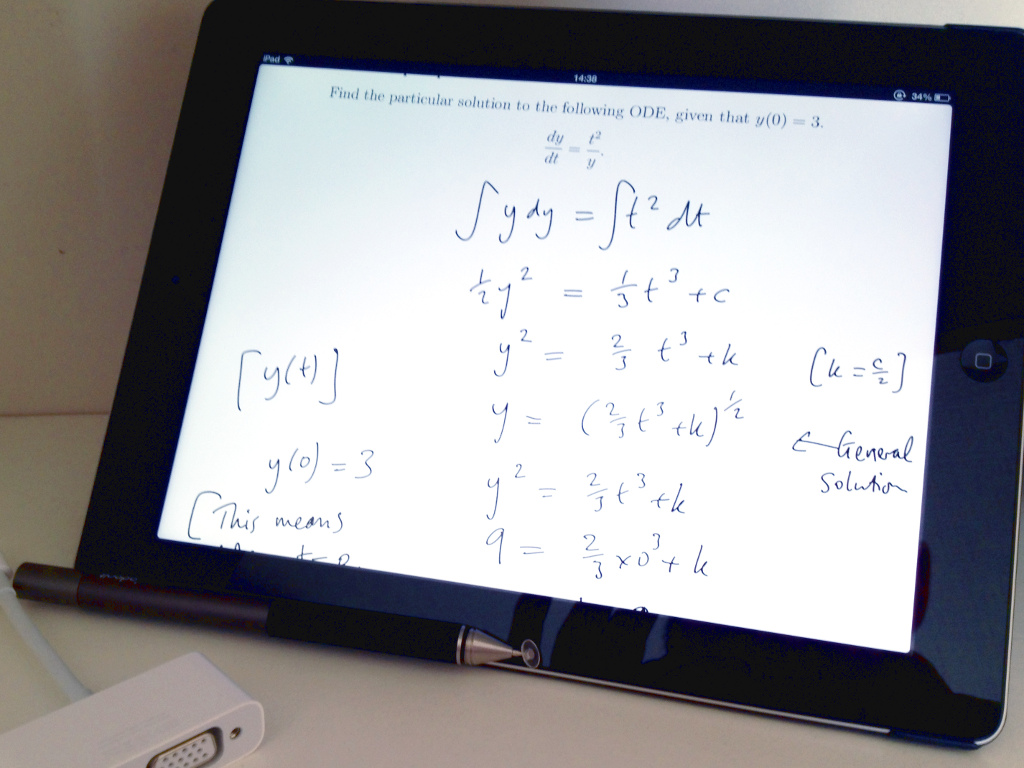
New game, everyone! Work have bought me an iPad. I have so far discovered this is basically a touch screen interface through which I can write email, read Twitter and play pinball, but I’ve heard a rumour that it can do even more than that. I’d like you to suggest what else I might do with it.
You're reading: Columns
Manchester MathsJam recap, August 2013
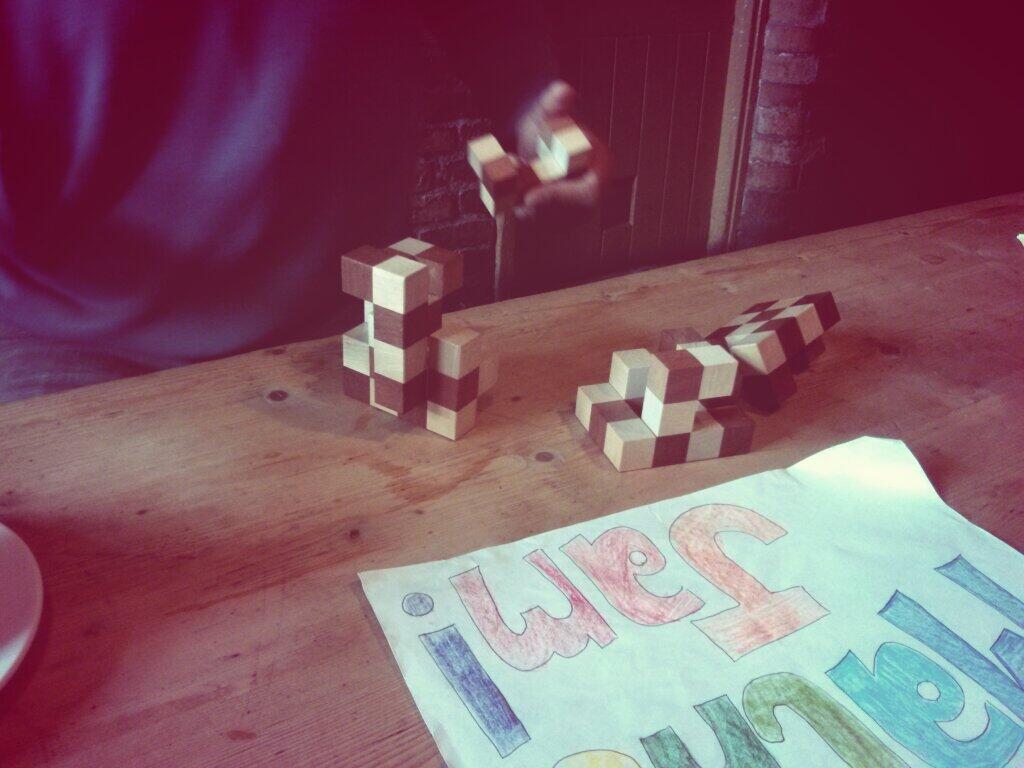
This month we had a few new faces, and plenty of regulars. We also had someone’s first MathsJam, and someone’s last (in the UK): Manchester regular Nicolette brought along her 6-week old baby Julia, who experienced her first recreational maths night in a pub, and by this time next month Nicolette will be back in her native New Zealand (obviously, setting up a new MathsJam there).
Julia Robinson and Hilbert’s Tenth Problem, by George Csicsery
Over on Google+, David Roberts just posted this trailer (via Антид Ото) to a lovely documentary about Julia Robinson and her contributions towards answering Hilbert’s tenth problem.
[youtube url=https://www.youtube.com/watch?v=e4x9XKNAYjU]
David Hilbert’s tenth problem was to find an algorithm to solve diophantine equations, that is, to find roots of polynomials with integer coefficients. We now know that the problem is unsolvable in general, and Julia Robinson did a lot of the work to get there; she wrote that she “couldn’t bear to die without knowing the answer.”
David asked if anyone knows of any present-day female mathematicians of similar standing to Julia Robinson. Apart from President of the IMU Ingrid Daubechies and people who are active on Twitter my knowledge of top mathmos is quite poor, so I thought I’d open the question up to The Aperiodical’s readers.
The full DVD of Julia Robinson and Hilbert’s Tenth Problem is available from George Csicsery’s ZALA Films site, and it looks like there are a few copies on Amazon as well.
Explaining things
I have discovered, or perhaps learned how to articulate, something fundamental: I like explaining things. Allow me to explain.
Carnival of Mathematics #101: Prime Numbered Special Edition
Welcome to the 101st edition of the Carnival of Mathematics. The Aperiodical took over running the Carnival when it launched in April 2012, at Carnival 85. Although it’s conventional to celebrate round number anniversaries (and even though I’m left-handed), we decided for a combination of reasons not to make a big deal out of Carnival 100 – instead inviting maths author Richard Elwes to host it on his blog – and instead to make the more exciting number 101 into our big celebration of how long the Carnival’s been running.
Manchester MathsJam recap, July 2013
This month we had a lovely MathsJam, with plenty of old and new faces and a disturbing quantity of activity related to black and white counters. I’d brought a big pile of them and some stuff to do with them, and we got cracking.
Aperiodical Round Up 9: Frank Nelson Cole is the best at math
Hello. My name’s Christian Perfect and I have some maths links for you.
Brad Neely, a member in good standing of my list of male role-models, once made a show called China, IL. Here’s a clip.
http://www.youtube.com/watch?v=r086uma9HBM
Mathematicians like to tell non-mathematicians (and themselves) that real maths isn’t like that; real maths is about seeing the structure behind the numbers and using pure logic to deduce true statements with enormous explanatory power. The platonic ideal of doing real maths involves going for a wander in your brain and then writing down a few of the true statements you saw along the way. But it almost never works out that way: you often have to start out by sitting down and crunching numbers, like any school-age chump, until you get a glimpse of what’s going on. Worse, sometimes it turns out that finishing the theory involves a reduction to cases, a.k.a. Yet More Crunching.
So, this one goes out to the number crunchers. Let these stories of quixotic computation give you solace.