Hello. I’m Christian Perfect and it’s finally here: Aperiodical Round Up 6!
It’s certainly been a while since the last Round Up. You might not even have the words to describe just how long it’s been. Maybe the book Naming Infinity will help.
Hello. I’m Christian Perfect and it’s finally here: Aperiodical Round Up 6!
It’s certainly been a while since the last Round Up. You might not even have the words to describe just how long it’s been. Maybe the book Naming Infinity will help.
Matt Parker (@standupmaths on Twitter) has tweeted the following Maths Puzzle, to wake you up:
Friday morning #MathsPuzzle! If you start the Fibonacci sequence 2,1 instead of 1,1 do you get more or fewer primes? (Check the first ten.)
— Matt Parker (@standupmaths) May 25, 2012
No spoilers in the comments! Send your replies to Matt on Twitter.
[vimeo url=https://vimeo.com/42582062]
You may recall that a while ago I wrote about Picture this!, an interactive problem/puzzle developed by one of our supported projects at work. Now the same group have developed a problem solving ‘starting point’ on linear programming.
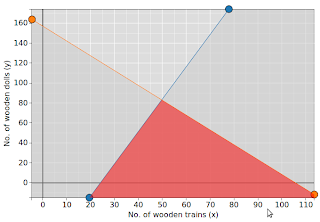
The problem pits you as a toy manufacturer producing wooden dolls and trains, with a limited number of carpentry hours available per day. You are invited to consider questions around how many of each object can be produced and what can be done to optimise profit.
Two more interactive problem starting points will be ready in due course but for now please try this one and, importantly, provide feedback.
Important: Once you have played with the virtual problem solving environment, please fill out this survey from the researchers. The researchers have said to me that they are happy for the page to be public and hope that anyone who uses it will fill out the survey. Doing so, you will help the researchers discover whether the use of this software to present problems is worthwhile and beneficial. The survey asks if you are a student or a tutor. If you choose “student” you will be asked about your use of the simulation and your understanding of the underlying mathematics. If you choose “tutor” (or leave the question blank) you will be asked about how you used it with undergraduate students.
This project seeks to produce “a virtual problem solving environment which hosts problems suitable for a range of undergraduate mathematics courses“. If you want to find out more about this project then you can read the interim report from this project over on my work blog.
Sir Michael Atiyah and Cédric Villani, Fields medallists, holders of a frankly embarrassing number of other awards, and highly entertaining speakers, will be having a conversation “to explore mathematics and topology” at Tate Modern, London, on June 2nd, following a screening of the film Au Bonheur des Maths.
The BBC and Scientific American report on a paper looking, “in an exploratory manner,” at the limiting shape of metro systems serving large cities. The BBC linked to the actual paper, which is nice of them. The Scientific American article goes into a bit more detail, though.
The authors contend that rather than the shape of subway networks being decided by central planning, which would produce a variety of shapes, the eventual shape of a subway network converges on an emergen structure consisting of a dense core with branches radiating from it.
Unhelpful framing news, now. A University of Michigan of press release begins:
A hidden facet of a math problem that goes back to timeworn Sanskrit manuscripts has just been exposed by nanotechnology researchers at the University of Michigan and the University of Connecticut.