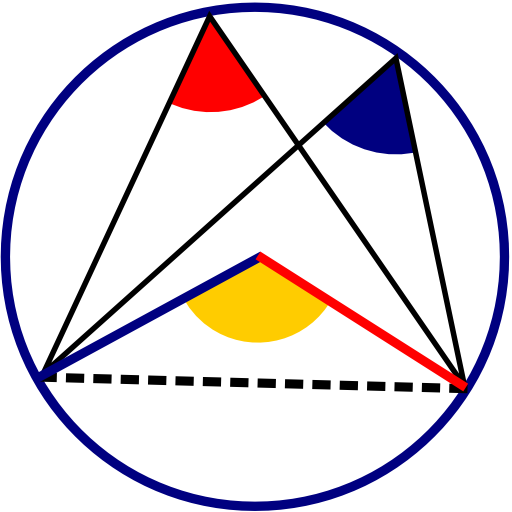
Hint: a man who started life with one name but later adopted the one he is today remembered as.
You're reading: Columns
Flat tori in three-dimensional space and convex integration
French researchers Vincent Borrelli, Saïd Jabrane, Francis Lazarus and Boris Thibert have described an isometric embedding of the flat torus in 3D space, using the convex integration theory developed by Gromov in the 1970s. That means they’ve produced a surface which is topologically a torus – it has a single hole — which preserves distances between points in the 4D flat torus. Interestingly, the tangent plane is defined everywhere — the surface is in a sense smooth — but the normal vector is not defined, so it’s also a fractal. This is impossible in higher dimensions
I’ve recorded a short video explaining in a handwavey fashion, with a few props made from things I had lying around, just what has been done.
Curved Crease Sculptures by Erik and Martin Demaine
Curved Crease Sculptures by Erik and Martin Demaine: 
The shapes remind me of the Danse Serpentine.
MAA Mathematical Petting Zoo
A figure 8 knot, a Temari ball with cuboctahedral symmetry and a Klein bottle in the MAA's mathematical petting zoo
The MAA recently displayed a mathematical petting zoo at the USA Science & Engineering Festival, along with a slideshow of pictures from their MAA Found Math collection.
The page about the event doesn’t have any pictures on it but it does have lots of links to the artists and their portfolios. The usual suspects are represented — non-orientable manifolds and polyhedra are in abundance — but there are a couple of unfamiliar objects, and they’re all pleasing to look at and think about.
(via MAA Found Math on Flickr)
Some infinities (and egos) are bigger than others
Here’s a tale of a rational (or irrational?) legal battle from the 1990s re: Cantor’s diagonal argument.
Cantor’s diagonal argument from 1891 was truly revolutionary: an ingenious way to demonstrate that no matter what proposed list of all real numbers (or, say, just those between $0$ and $1$) is put forth, it’s easy to find a number which is definitely missing from the list. ((One has to pay close attention to realise that the same proof doesn’t also establish that the rationals are uncountable, bearing in mind that the Cantor pairing function shows that the rationals most certainly are countable. See http://en.wikipedia.org/wiki/Countable_set))
In a nutshell, Cantor was the first to show that some infinities are bigger than others.
Cantor’s diagonalisation argument for the reals is watertight, and has proved to be a model of elegance and simplicity in the century plus that has passed since it first appeared.
That didn’t stop engineer William Dilworth publishing A correction in set theory, in which he refutes Cantor’s argument, in the Transactions of the Wisconsin Academy of Sciences in 1974.
Carnival of Mathematics 86
The next issue of the Carnival of Mathematics, rounding up blog posts from the month of April, is now online at The Math Less Travelled.
The Carnival rounds up maths blog posts from all over the internet, including some from our own Aperiodical. For more information about the Carnival of Mathematics, click here.
The number line is not an intuitive concept
Some cognitive scientists have done an experiment on some people in Papua New Guinea to test the hypothesis that the number line is based on an in-built intuition that all humans share. They concluded that it isn’t, and that you can use cardinal numbers without placing them mentally on a line.
