I’m organising a series of online public maths talks through my work, the School of Maths, Stats and Physics at Newcastle University.
The point is that talks will be delivered by disabled presenters. This came about because I and some other disabled people who do maths talks got tired of missing out on opportunities to do outreach because it involves travelling. Not every disability makes travelling harder, but we felt that there were enough people excluded by in-person events that it would be nice to put on a more accessible event.
My aim is for this to take place in December 2022, near to the International Day of People with Disabilities. Talks can be any mathy topic, or about your experience as a disabled mathematician.
I need speakers!
To give some idea of what I’m looking for, I’ll use myself as an example. I count myself disabled at least four ways: I’m colourblind, autistic, dyspraxic, and have Ehlers-Danlos syndrome.
I might talk about:
Use of colour in mathematical communication, for example how red chalk makes chalk-and-talks inaccessible.
How ambiguously-worded maths problems have stymied me in the past, and how to write them more clearly.
Integer sequences, which is just something I’m interested in.
The sessions will be delivered over Zoom, with live captions written by humans and a BSL interpreter. (If you can recommend a BSL interpreter with experience of interpreting maths talks, please get in touch!)
We’ll be advertising the talks to the general public, both grown-ups and schools, so I’m not looking for talks about high-level maths or education research.
This is open to anyone around the world, but if you’re a long way from the UK bear in mind that we’ll schedule the sessions at a convenient time for a British audience.
I’d like to have a list of presenters by the end of September, to leave plenty of time to arrange whatever needs to be arranged and to advertise the talks.
In the UK, schools have now broken up for the summer, or are about to, meaning parents face a long six-to-eight weeks of trying to find interesting things for the kids to do. If you or someone you know is in this situation, and the kid(s) in question would like to do some mathematics, we’ve got you covered.
Online resources for primary (ages 5-11)
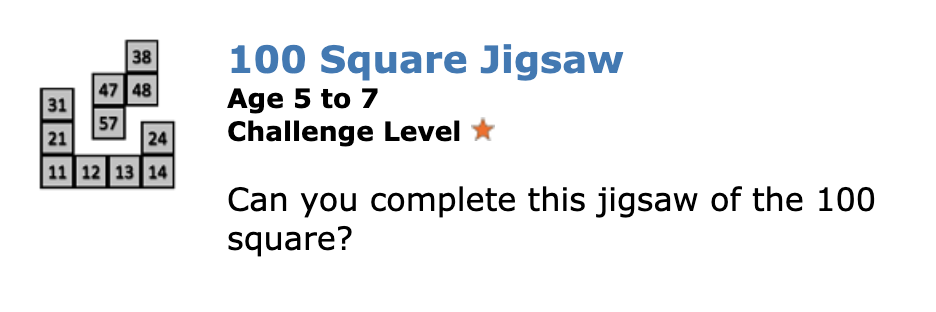
Always a good shout for mathematical things to do, the wonderful NRICH, who are based at the University of Cambridge, are posting interactive mathematical challenges every weekday from now until 2nd September.
Family maths charity Maths on Toast are posting weekly STEAM activities including craft, construction, puzzles, baking and games, under the banner of Summer Fun with Little Robot. They’re also running a ‘Join-in Project’ themed around Truchet tilings, called Infinity Tiles – participants can send in their own ideas to be featured in an online gallery.
While there aren’t specific summer-themed activities, there are plenty of great resources and thoughts about ways to engage with young mathematicians on the Talking Math With Your Kids website.
The good old BBC Bitesize website has a selection of good interactive games, including several maths-themed ones (now if you’ll excuse me, I’ll be playing Karate Cats).
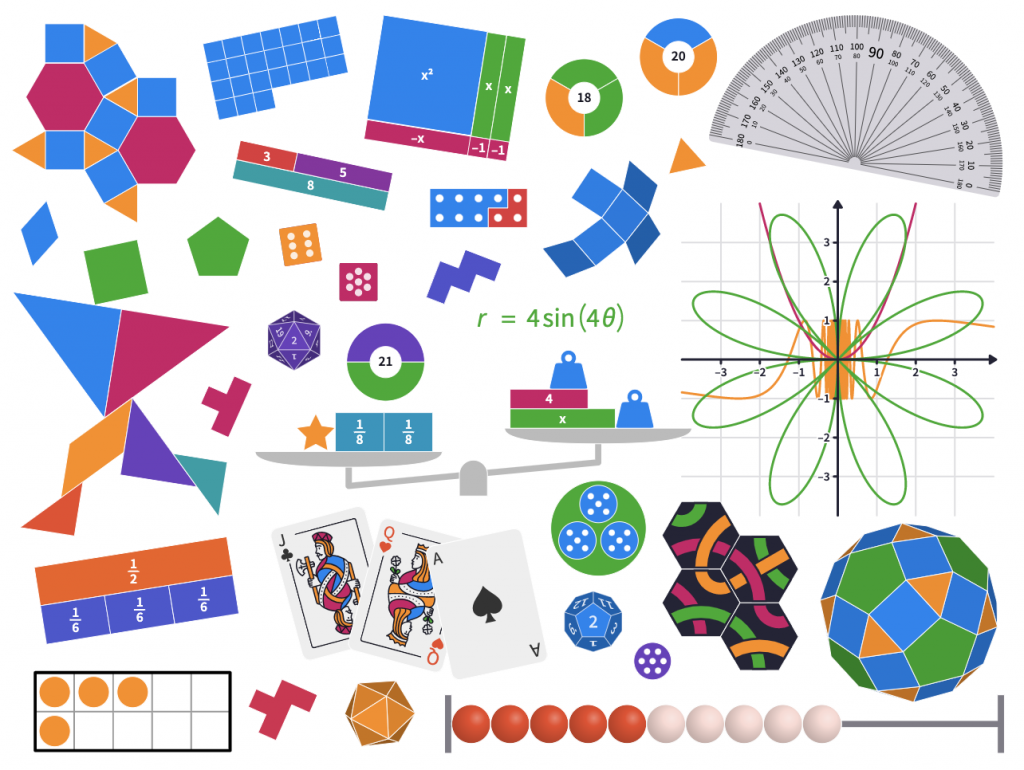
While they don’t have anything specific for the summer, we can always recommend Mathgon’s online courses and activities, including the incredibly versatile PolyPad, and plenty of puzzles and games.
Just some of the things you can play with in PolyPad
If you can get to Leeds, we can highly recommend the wonderful maths discovery centre at MathsCity – with tickets at £6.50 for adults / £4.50 for children aged 3-16 / £18 family ticket, and within easy reach of Leeds train station, it’s a great day out and you can spend hours playing with the interactive exhibits and puzzles. They’ve just launched a great new codebreaking exhibit for this summer, with over 20 interactive coding activities and crafts. There’ll also be bubble-related activities on 6th August, and they’ll be represented at Leeds’ Breeze in the Park events on 17th & 18th August.
In the north-east, numeracy initiative Multiply is running three Multiply Roadshow events in Gateshead. The events will feature much-loved celebrities including Johnny Ball, Scarlett Moffatt and Coronation Street’s Ryan Thomas, alongside family games, crafts, and activities, as well as information about short fully funded maths courses from Gateshead Learning and Skills. (Sadly the Johnny Ball event is happening as we write, but the others are 8th & 15th August).
The Royal Institution in London has a large programme of summer holiday workshops running from 25 July to 26 August, which cost £35 half-day / £50 full day, with discounts available for Ri Young Members. Bursaries to support attendance are available via the Potential Trust (details on the individual session pages under ‘About Our Workshops’).
Bletchley Park remains the classic mathematical historical day out: tickets are £24.50 for adults, £16.00 for 12-17 year olds and it’s free for under-12s – plus the ticket is an annual pass, so you can visit as many times as you want in a year. Over the summer they have a Summer Fun programme including Puzzles and Pastimes on Tuesdays, Wednesdays and Thursdays, family guided tours on Fridays, a summer concert series and Top Secret Mission Packs available on entry for £1. They also currently have a temporary exhibition on the Art of Data.
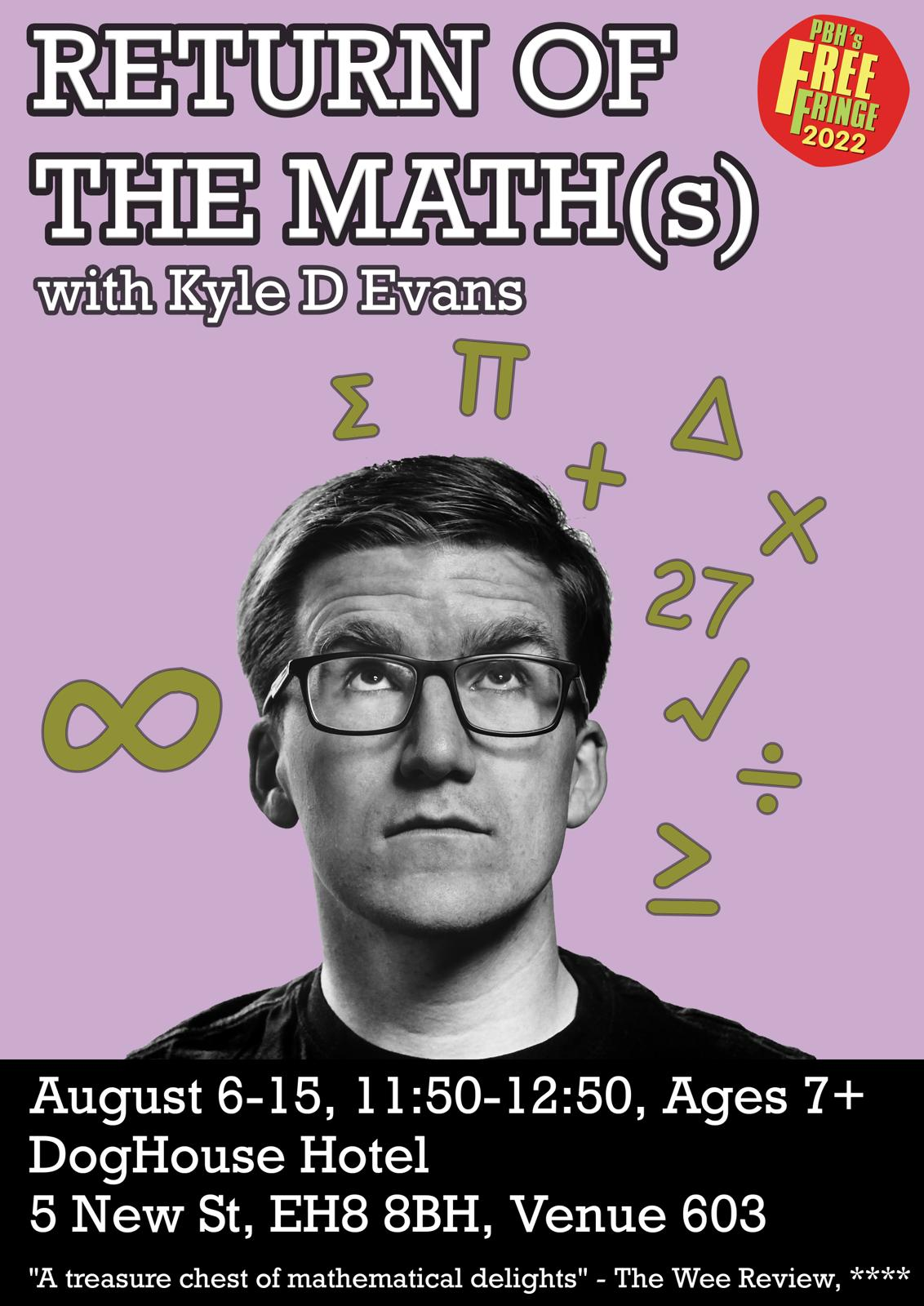
Honourable mention for site-friend Kyle Evans who’s performing his family (7+) maths show Return of the Math(s) (left) at the Edinburgh Fringe from 6-15 August – a ‘fast-paced hour of inclusive maths-based family fun [… including] madcap demos, loads of crowd participation and mind-melting mathematics.’
This semester I’ve been teaching a module that covers a couple of different maths topics, and have been setting little puzzles for my students to complement what they’re learning – and some of them have been quite fun to write and play with. I thought I’d share some of them here, so you can enjoy them too.
The next issue of the Carnival of Mathematics, rounding up blog posts from the month of June and hosted by Stormy, is now online at Storm Bear World.
The Carnival rounds up maths blog posts from all over the internet, including some from our own Aperiodical. See our Carnival of Mathematics page for more information.
You may have seen DALL·E mini posts appearing on social media for a little while now – it’s been viral for a couple of weeks, according to Know Your Meme. It’s an artificial intelligence model for producing images, operating as an open-source project mimicking the DALL·E system from company OpenAI but trained on a smaller dataset. Actually, since I had a play with this yesterday it’s renamed itself at the request of OpenAI and is now called craiyon. Since the requests all take between 1-3 mins to generate, I’m not going to re-generate all the images in this post using craiyon so that’s why they have the old ‘DALL·E mini’ branding.
AI image generation is a massively impressive technical achievement, of course. craiyon doesn’t create as stunning images as DALL·E 2, but still it can create some ‘wow’s.
What’s interesting, sometimes, is how it interprets a prompt. The data craiyon is trained on is “unfiltered data from the Internet, limited to pictures with English descriptions” according to the project’s statement on bias, and this can lead to problems including that the images may “reinforce or exacerbate societal biases”.
To see that in action, we can take a look at how the model manifests cultural expression around mathematics. When I gave it the simple prompt ‘mathematics’, it produced this.
The next issue of the Carnival of Mathematics, rounding up blog posts from the month of May and hosted by Rob, is now online at Rob Eby’s Math Blog.
The Carnival rounds up maths blog posts from all over the internet, including some from our own Aperiodical. See our Carnival of Mathematics page for more information.
Here’s a game I’ve been trying to make for a while.
For a while I’ve had a hunch that there’s fun to be had in moving between numbers by using something related to the prime numbers.
Over the years I’ve tried out a few different ideas, but none of them ever worked out – they were either too easy, too hard, or just not interesting. This time, I think I’ve found something close enough to the sweet spot that I’m happy to publish it.
Prime Run is a game about adding and subtracting prime numbers. You start at a random number, with a random target. Your goal is to reach the target, by adding or removing any prime factor of your current number.