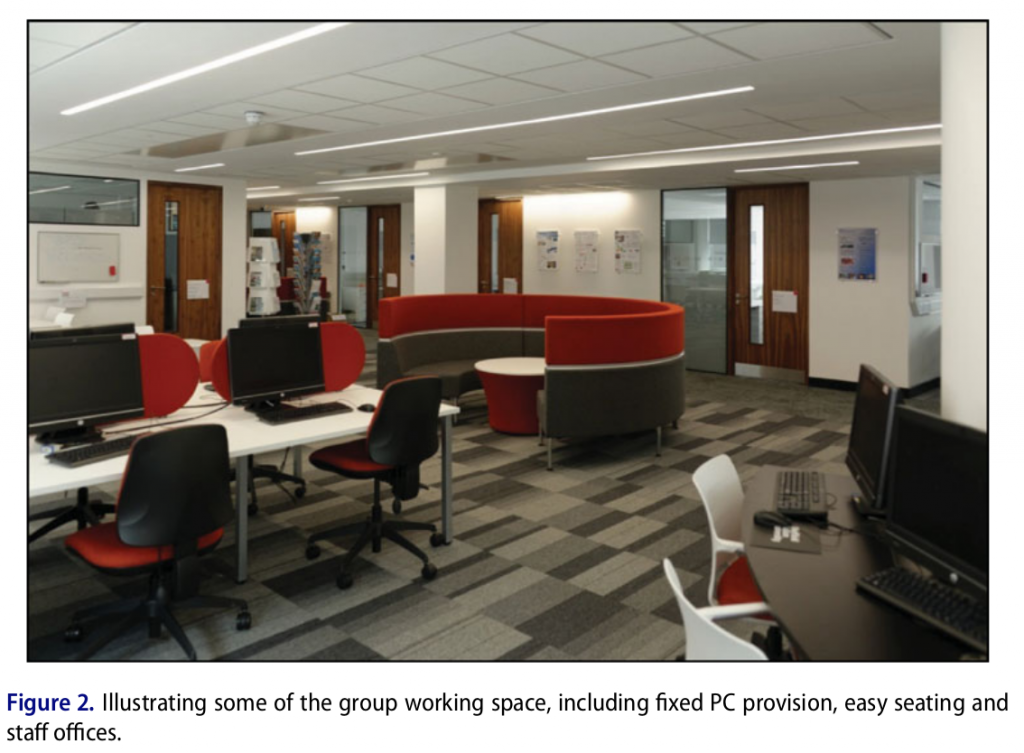
 One of the nice things about working in mathematics at Sheffield Hallam University is the environment in which I work. The maths department is a big, open learning space for students surrounded by staff offices. It’s a busy place, full of activity and plenty of opportunities to interact with students and other staff.
This space was renovated for mathematics a little before I arrived. It was designed to enhance student engagement and to create this sense of community, to allow collaborative learning and encourage inter-year interactions.
Over the last year, we conducted a study of use of the space. This included observations of use of the space as well as questionnaires and interviews with students about their use of the space, including students who had studied in the department in the old and new locations.
The results have just been published as ‘The role of informal learning spaces in enhancing student engagement with mathematical sciences‘ by Jeff Waldock, Peter Rowlett, Claire Cornock, Mike Robinson & Hannah Bartholomew, which is online now and will appear in a future issue of International Journal of Mathematical Education in Science and Technology (doi:10.1080/0020739X.2016.1262470).
 The next issue of the Carnival of Mathematics, rounding up blog posts from the month of October/November, and compiled by Tom, is now online at
 Puzzlebomb is a monthly puzzle compendium. Issue 59 of Puzzlebomb, for November 2016, can be found here: