
Gradually, gradually, the mathematicians are taking over the world. Having already conquered (by which I mean ‘colonised pubs once a month’) in places as far-flung as Melbourne, Houston, Bombay and Edinburgh, MathsJam will be making its debut in Cape Town, South Africa on Tuesday February 19th.
You're reading: Main
Join the Aperiodical News Team
There’s too much maths news for us to cover, so we’re looking for a few volunteers to help out in our new News Team.
A fairly big part of what this site is for is to cover mathematical news. We like to write short, to-the-point posts pointing to the relevant information about current events. These don’t have to be as in-depth as a feature or column blog post, but are a great way to keep everyone aware of what is going on in the mathematical world.
Most weeks we find more stories than we find time to write up, and the three of us (Katie, CP and Peter) have ever-growing work commitments, so we’re seeing if anyone wants to help out. Read on to find out what’s involved, or if you’re feeling nosy about how we write up news.
The invariant subspace problem is solved for Hilbert spaces?
Update 05/02/2013: Cowen and Gallardo say that a problem has been found in their proof and they no longer claim an answer to the invariant subspace problem.
At the congress of la Real Sociedad Matemática Española yesterday, Eva Gallarda and Carl Cowen presented an affirmative answer to the invariant subspace problem on separable Hilbert spaces. While it isn’t a Millennium Prize problem, it’s one of the big open problems in maths. As far as I can tell, it hasn’t been through any formal peer review yet, but they’re serious people and you’ve got to be quite sure about this kind of thing before announcing it at such a high-profile event.
Student placement with the Numerical Algorithms Group
Mathematical and statistical software specialists The Numerical Algorithms Group (NAG) are advertising a twelve month student placement in Oxford as a software engineer.
We are looking for somebody who has completed the equivalent of two years of a three-year degree course. A strong computing component in the course is important and some mathematical background or experience using software to solve scientific or engineering problems would be a big advantage. The ideal candidate should have experience of programming in a Windows, Unix or Linux environment. Some knowledge of C or Fortran would be useful, but is not essential.
The deadline is 31st January 2013.
Further details: Student Placement: Software Engineer.
Chrome now supports MathML
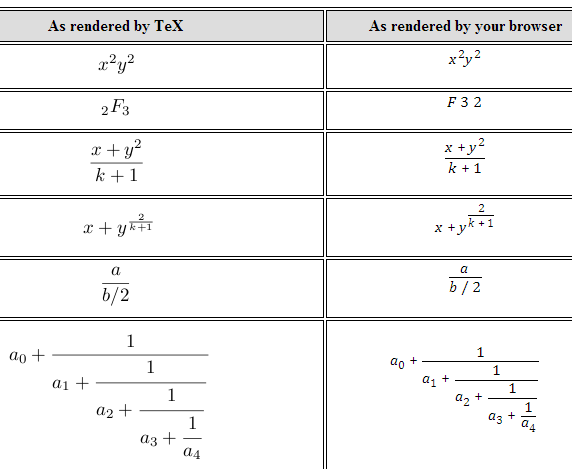
Update 07/02/2013: Google giveth, and it taketh away. MathML support in Chrome has been disabled until it’s “production-ready”.
Putting maths on the web has always been a tricky proposition. Typesetting notation is a highly complicated procedure, so for years people have got by either by compromising on aesthetics and writing equations in plain, unadorned text, or by using off-line LaTeX compilers to make blurry images of what they’re trying to say.
Save the Ri
It’s been in the news this week that the Royal Institution is having financial trouble, and is considering selling its London headquarters at Albemarle Street. The organisation has done a great deal for the popularisation of mathematics over the years, from including mathematics in its series of annual Christmas Lectures (delivered by Christopher Zeeman in 1978, by Ian Stewart in 1997 and Marcus Du Sautoy in 2006) as well as running an excellent series of mathematics and engineering masterclasses for primary and secondary schools, since 1981. They also have a dedicated maths team, who post maths resources on the Ri website.
Professor Sir Harry Kroto, a Nobel laureate in chemistry, has started a blog called “Save the Ri” and posted a highly outraged open letter calling on interested parties to “make it clear to the Government and others in positions of responsibility that we are outraged by the decision to put the premises up for sale”. He’s also posted a statement outlining the situation, and indicating his support of the ‘Save 21 Albemarle Street’ campaign, on Facebook and Twitter.
UPDATE: MP Valerie Vaz has tabled an Early Day Motion in Parliament about this, although it currently only has 9 signatures. There’s also an e-petition, calling for the government to purchase the building and let the Ri stay there permanently.
The Good, the Bad and Gowers
Prof Sir Tim Gowers has published a couple of very interesting posts on his blog this week, explaining his thinking behind a couple of announcements to do with Open Access.