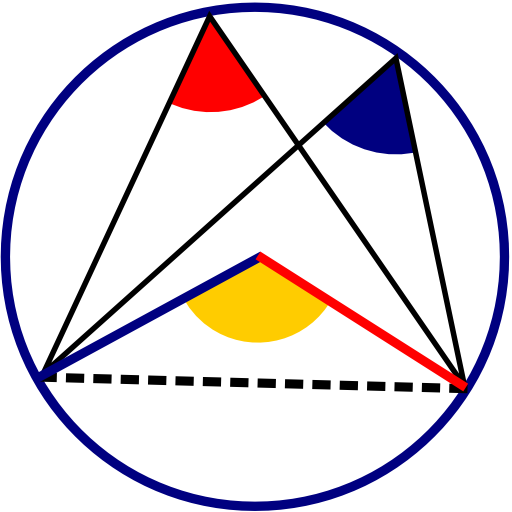
Some cognitive scientists have done an experiment on some people in Papua New Guinea to test the hypothesis that the number line is based on an in-built intuition that all humans share. They concluded that it isn’t, and that you can use cardinal numbers without placing them mentally on a line.
You're reading: Main
Math/Maths 95: Massively Multiplayer Online Mathematics
A new episode of the Math/Maths Podcast has been released.
A conversation about mathematics between the UK and USA from Pulse-Project.org. This week Samuel and Peter spoke about: Math Massive Open Online Course (MOOC); A-level sciences ‘lack the maths students need’; School maths should be more practical, say (some) teenagers; College Dropout Became Mathematical Genius After Mugging; Feminine math, science role models do not motivate girls; The Reason that Spies love Math; Rubik’s Challenge 2012; Concorde TSP App; The Traveling Salesman Version of Sam’s Face; Wikipedia adds MathJax display option; IMA YouTube channel; Protection of Freedoms Bill; The Aperiodcast; HUMANS V NATURE: Engineering FTW; and more.
Get this episode: Math/Maths 95: Massively Multiplayer Online Mathematics
Matt Parker’s maths problem page in The Telegraph
Matt’s latest set of puzzles, as part of the Make Britain Count campaign, are online at The Telegraph. This round of puzzles is all about factors, and there have been previous puzzle sets about consecutive numbers and prime numbers.
“Futurama theorem” slightly improved
The “Futurama theorem”, also known as Keeler’s Theorem after its creator, was a bit of maths invented for the Futurama episode The Prisoner of Benda, to solve a problem where the characters get their heads mixed up and need to swap them back without any one pair swapping heads twice. It was enthusiastically reported by the geeky press, and rightly so, because it’s a fun bit of real maths with a wonderful application. Dana Ernst has written some very good slides about the theorem, working from “what is a permutation?” up to the algorithm itself.
Anyway, some students from the University of California, San Diego have extended the result, giving a better algorithm for finding the minimum number of switches to put everyone’s head back in the right places, give optimal solutions for two particular situations, and give necessary and sufficient conditions for it being possible to represent the identity permutation as $m$ distinct transpositions in $S_n$.
Paper: http://arxiv.org/abs/1204.6086
via James Grime
Report criticises level of mathematics in A-level science
An article on the BBC website says that a report by SCORE has found that A-level science exams do not contain enough maths questions to prepare students to progress to science degrees or related jobs.
Grow Your Own Food
I recently heard about Herman, the German Friendship Cake (bear with me), a cake which is divided and spread among friends, and it got me thinking about some other foodstuffs I’ve heard of which are made in such a way that the amount you have will grow exponentially. A Herman cake is a special type of sourdough cake which is made with yeast. It’s explained fully here, but the idea is that you start with a solution of yeast, which lives in a little milk, sugar and flour. This small amount of goo can live happily at room temperature on a shelf, and if you stir it every day and give it a little more flour and sugar to eat every few days, after ten days it’s ready to make into a cake.
IMA YouTube page launched
The Institute of Mathematics and its Applications have launched a YouTube channel.