 |
 |
If you’re looking for a fun hands-on project that’s mathematical and Christmassy, look no further than Think Maths‘ classic Fractal Christmas trees – building a Sierpinski tetrahedron tree, Menger Sponge base and Koch Snowflake star.
|
|
If you’re looking for a fun hands-on project that’s mathematical and Christmassy, look no further than Think Maths‘ classic Fractal Christmas trees – building a Sierpinski tetrahedron tree, Menger Sponge base and Koch Snowflake star.
|
|
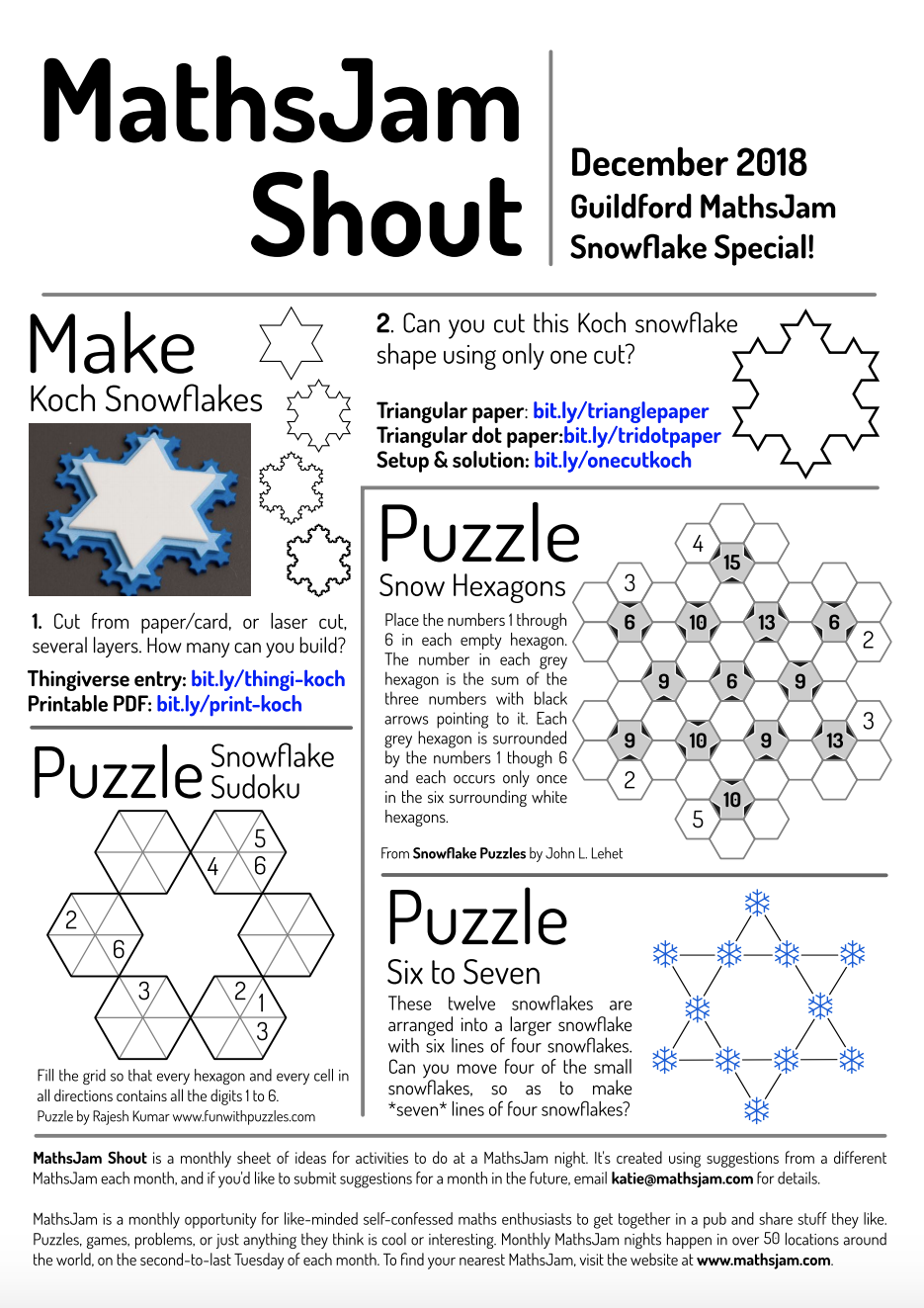 Today is the regular monthly MathsJam date for people to meet in pubs and do maths all over the world (some are meeting next week instead – check MathsJam.com to find your nearest). Their internal puzzle sharing sheet is snowflake themed this month, and is shared online so you can join in from home.
This post is part of the Aperiodical’s 2018 Aperiodvent Calendar.
|
 |
 Before he entered Aperiodical’s Big Internet Math-Off, contestant Jim Propp wrote this lovely blog post about dimensional analysis back in February, using it to predict how well Michael Jordan would be able to play basketball on the moon and how long it would take to roast a large bird. Make use of it when you’re planning Christmas dinner!
This post is part of the Aperiodical’s 2018 Aperiodvent Calendar.
On the first day of Christmas, my true love gave to me… some mildly interesting combinatorics! The Twelve Days of Christmas is a Christmas favourite, and whether you interpret the lyrics to mean that each day only one type of present is given, or more literally to mean that on each day you are given all the previous presents again, the question of how many gifts are given in total has been a classic festive brain-teaser for as long as we’ve had summation formulae.

Enjoy a wonderful 11 minutes of @FryRSquared talking about the probability problems associated with assigning Secret Santa presents by drawing names from a hat:
This post is part of the Aperiodical’s 2018 Aperiodvent Calendar.
By stitching carefully between a set of points, you can create a parabola – these Christmas cards have taken this idea and given it a festive twist.
Six is the number of sides on a hexagon, and hexagonal symmetry is one of the most wintry symmetries – due to the bond angle of water when frozen into ice, all snowflakes (with some minor exceptions) have hexagonal symmetry.