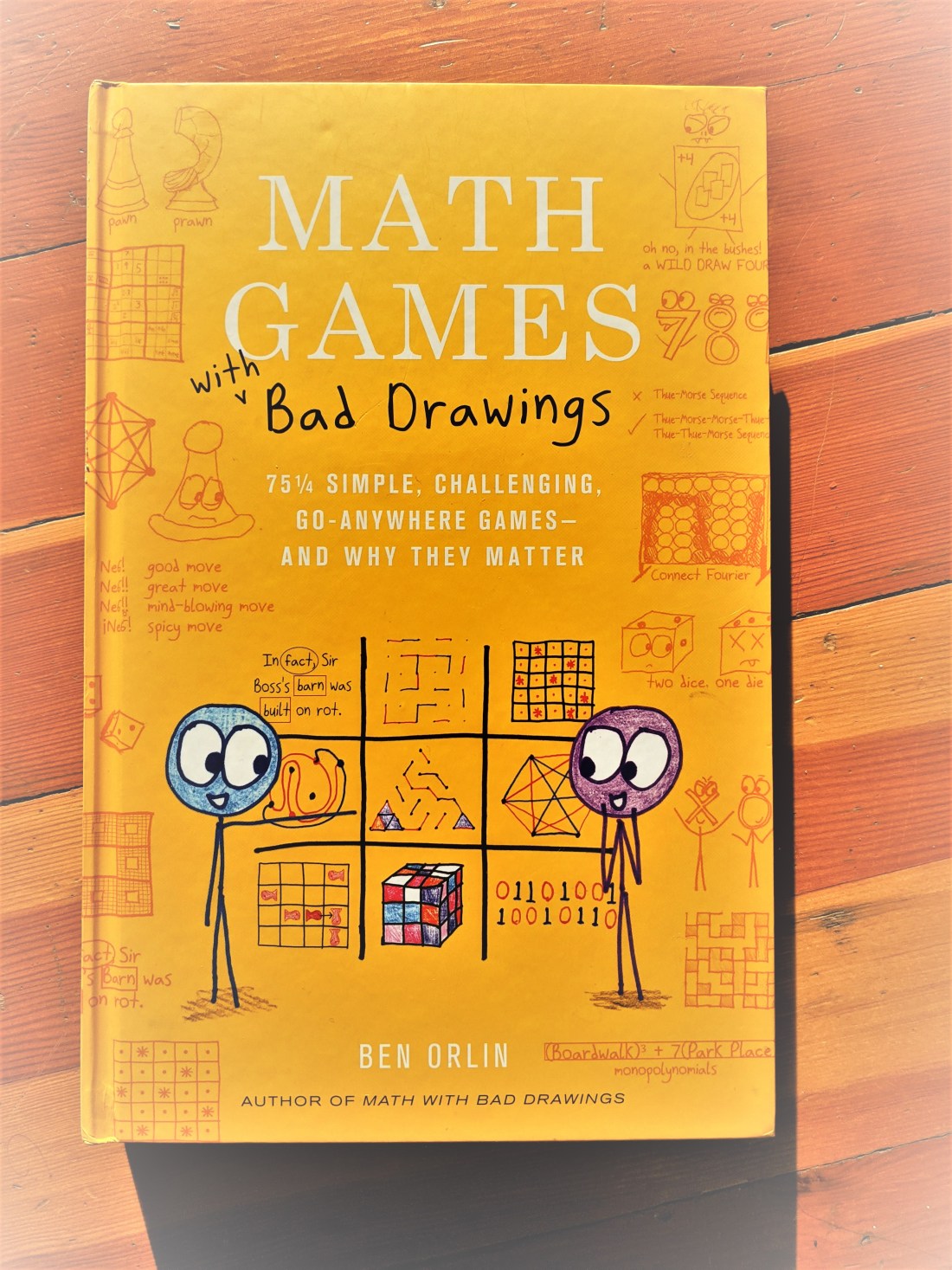
Friend of the site and good writer/bad drawer Ben Orlin has recently released a new book, and we were kindly sent a copy to play with and review.
You're reading: Posts Tagged: games
Introducing hexboard – a LaTeX package for drawing games of Hex
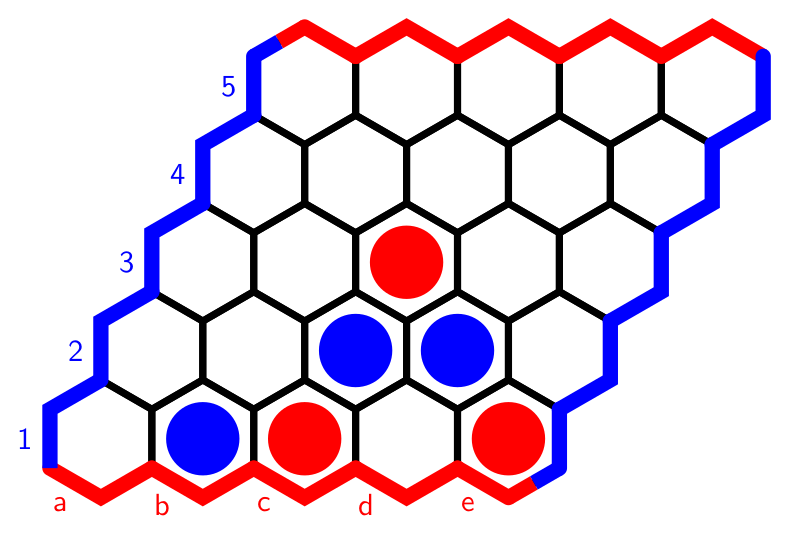
Chris Sangwin and I wrote a LaTeX package for drawing Hex boards and games called hexboard. It can produce diagrams like this.
First: why? Then: how do you use it?
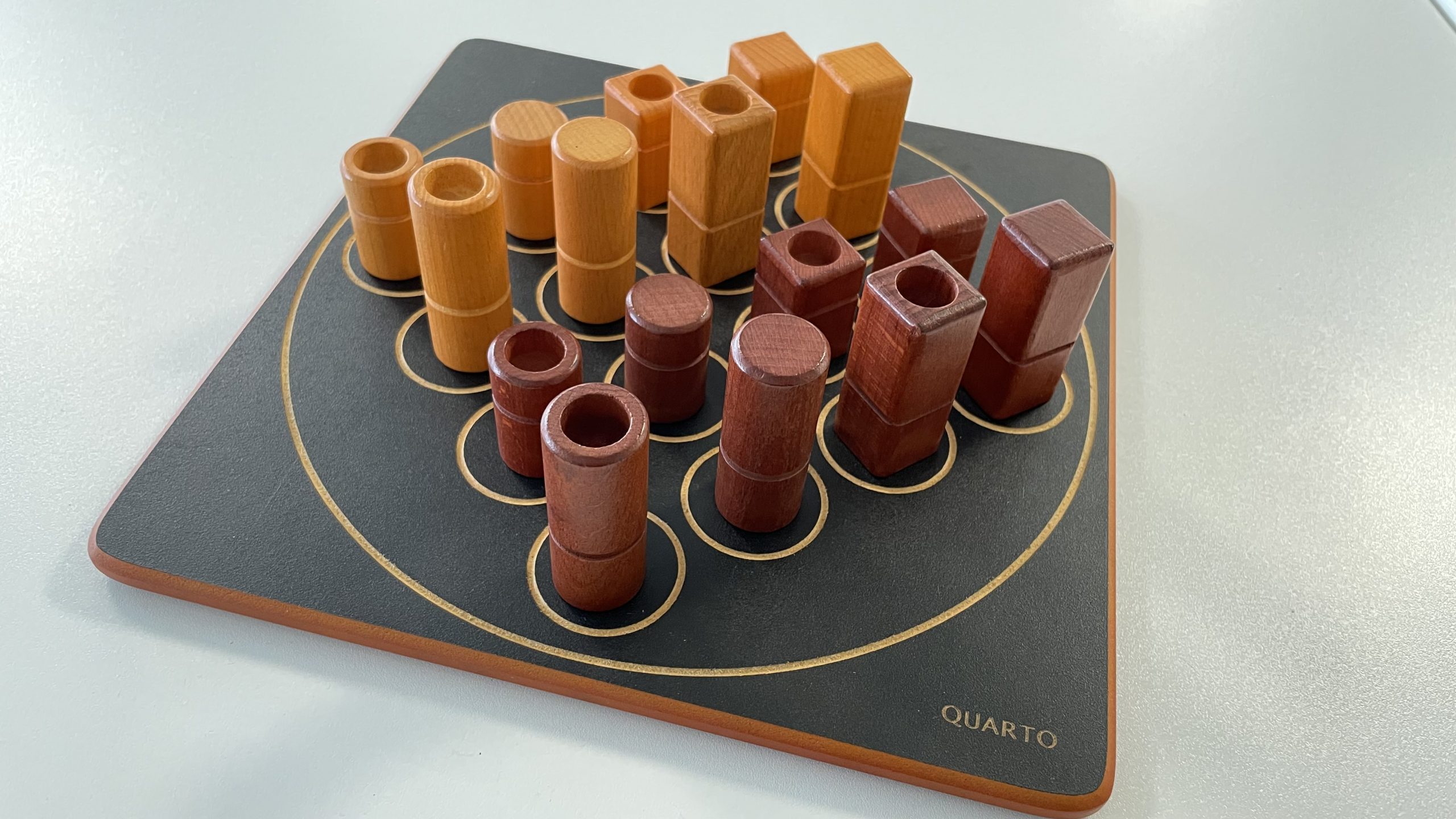
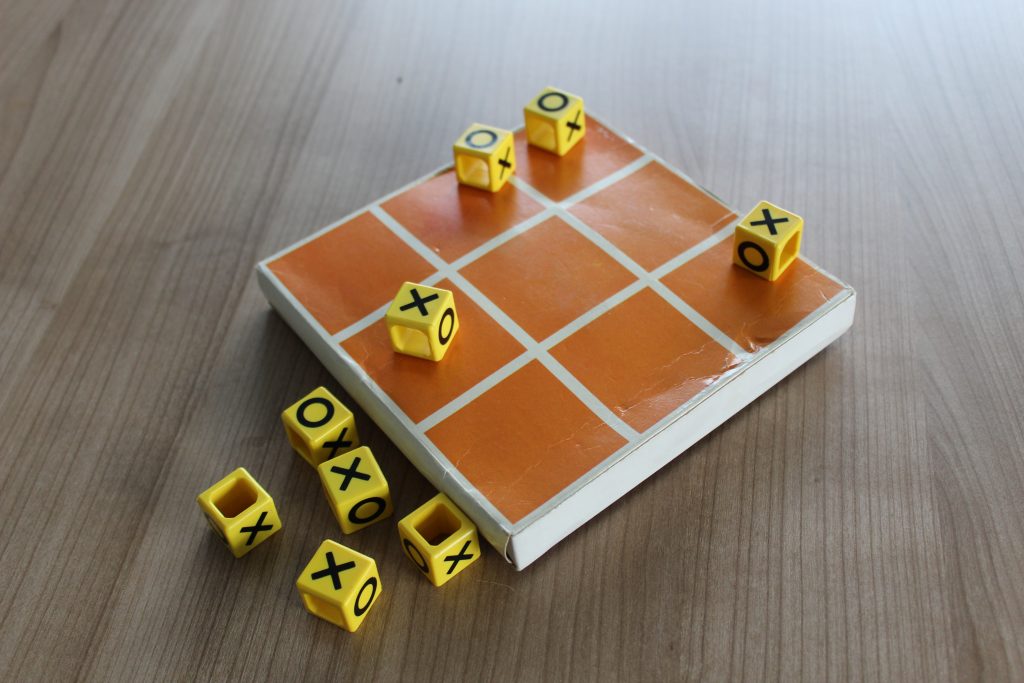
Mathematical Objects: Ox Blocks

A conversation about mathematics inspired by the game Ox Blocks. Presented by Katie Steckles and Peter Rowlett.

Podcast: Play in new window | Download
Subscribe: RSS | List of episodes
“Transposition”, a sliding block puzzle by Jacob Siehler

This is just a quick post to tell you about a nice puzzle game I spotted on Mathstodon.
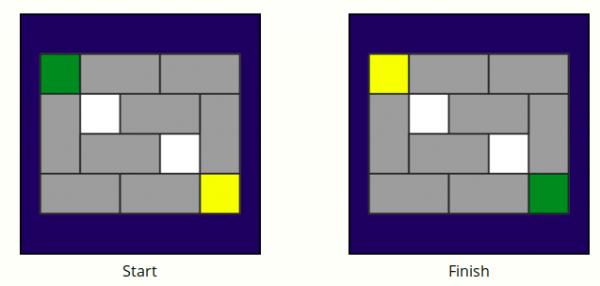
It’s called Transposition, and it’s a sliding block puzzle in the vein of the popular game Rush Hour. You’re given a grid that’s almost full of rectangular blocks, and you have to slide them around each other until the two coloured blocks have swapped places.
The puzzle was invented by mathematician Jacob Siehler, who says he used a computer search to generate a pool of puzzles, given the rules of the game. I took quite a while to solve all 5 “easy” puzzles – as with any logic puzzle, you need to play about for a while to get a feel for the mechanics. I hadn’t appreciated at first that the grey blocks don’t need to be in their starting places when you solve the board – only the coloured blocks need to in the right positions.
There are 26 puzzles at the moment, ranging from “easy” to “very hard”. Have a crack at it! I really enjoyed it.
Play: Transposition, by Jacob Siehler
Carnival of Mathematics 158
This is the 158th Carnival of Mathematics, a monthly round-up of interesting maths bits from across the internet. Convention dictates that I now therefore specify some interesting facts about the number 158. Unfortunately I am writing this on a train with no internet access, which will make fulfilling this obligation more than usually challenging.

New YouTube videos by me and James Grime
I’ve been at it again, making videos for that YouTube – this time, a collabo with James Grime. We have each posted a video on the topic of a mathematical game, as we both had things we wanted to make videos about but nobody to play with, so we met up after school and made some YouTubes.
My video features two games which *SPOILER* turn out to have maths in them. I’m also doing a bit of a giveaway on Twitter, where you can win the actual cards used in the video (I will post them out in the IRL post mail), so reply to this tweet if you want a chance to win:
Here’s my video again from the other day. If you’d like to win a set of cards, reply with your own version of ⭐& 🌍: https://t.co/rppBeftpbf
— Katie Steckles (@stecks) August 17, 2017
James has also posted his video, which is about a different game:
Review: Factris
Removing four lines at once with an I-piece in Tetris is the most efficient way to score, which creates a tension: on one hand, you want to build high enough to score quickly, but on the other, building too high puts you at risk of ending the game. The balance between the two is exquisite.
I mention that, because I was about to grumble that the corresponding balance in MEI Maths’s new game app thingummy Factris isn’t quite as good – of course it isn’t. Nothing ever will be.