Here’s a round-up of some news from the last couple of months.
You're reading: Posts Tagged: Geometry
Double Maths First Thing: Issue 56
Double Maths First Thing no longer runs marathons.
Hello! My name is Colin and I am a mathematician on a mission to spread the joy and delight of doing maths, figuring things out and generally taking pleasure in doing clever things.
Like everyone else, I was thrilled to see Sabastian Sawe and Yomif Kejelcha break the two-hour barrier in the London Marathon this weekend. I was thrilled enough to break the five-hour barrier a decade ago in Manchester, and have dreams of a two-hour half-marathon at some distant future point. I wouldn’t normally link to an ad, but here are some regular people trying to run at two-hour-marathon pace – for comparison, the course record at Weymouth Parkrun is 14:47. Sawe’s effort is roughly equivalent to beating that by 40 seconds, then running seven and a half more parkruns at the same pace. Meanwhile, the maths community’s own Mats Vermeeren ran a very creditable 3:06 (a parkrun-equivalent of 22 minutes) and Hari from Maths City Leeds ran the distance in aid of the Samaritans, and I’m sure he and they would be grateful for support. Well done to Mats and Hari and anyone else who took part.
Links
Following up from last week’s geometric poetry, Mark Jones Jr prodded me to mention Piet Hein, mathematician, designer and poet best known for his “grooks”, including:
Problems worthy of attack
Prove their worth by fighting back.
Elsewhere in Europe, Ionica Smeets reminded me of the Leiden wall formulas, the sort of mathematical art project I’d love to see more of. Also in lovely things, here’s a picture from Peter Tait’s 1885 paper “On Knots Part III”, showing all of the 10-crossing knots.
I’ve got far too much on my plate to investigate this paper by Anton Petrunin, which has close to 200 geometric problems with elegant solutions. Feel free to read it and tell me if it’s any good.
Personally, I’m not in the set of people who loves Venn diagrams – but I am in the set of people who enjoys incredibly complicated but also gorgeous graphical representations, so I’m slightly torn. Here are more, and if that’s not enough, Peter Hamburger’s archive is here. (Thanks to @pozorvlak).
Karen Campe notes that some of the US administration could use a refresher on how percentages work. I refrain from political commentary in DMFT (at least today), but you can probably infer my position towards the US administration without too much guesswork.
Currently
Kit Yates has a new book out, You Don’t Know What You’re Missing. I’m hopeful that my review of Richard Elwes’s Huge Numbers will also be live by the time this is published.
If you’d like your 2D mathematical artwork to be featured at the ICM in Philadelphia, you can let IMAGINARY know about it here. Deadline is tomorrow, April 30.
Annoyingly, I didn’t hear about Samira Mian’s InHERited LINES exhibition at the Royal Albert Hall until after last week’s edition – but if you’re at the RAH for a show, you can still see her amazing Islamic patterns in the Amphi Corridor until May 12th. If you’ve got events you think I’d like to point people at, please let me know about them!
EAKING NEWS … BREAKING NEWS … I understand Ayliean was on Radio Scotland this morning, talking about the World Cup sticker book … BR
[Edited 2026-04-29]: Part of Ayliean’s prepared piece aired around 7:50am on the Breakfast show, so around one hour fifty into the audio — but “they cut out all the maths”. Bah.
[Re-edited later the same day]: Thanks to Chris Smith, who points out that Ayliean’s segment on the Breakfast show aired in full at around 6:26am (so about 26 minutes into the audio). Thanks!
That’s all I’ve got for this week. If you have friends and/or colleagues who would enjoy Double Maths First Thing, do send them the link to sign up – they’ll be very welcome here.
If you’ve missed the previous issues of DMFT or – somehow – this one, you can find the archive courtesy of my dear friends at the Aperiodical.
Meanwhile, if there’s something I should know about, you can find me on Mathstodon as @icecolbeveridge, or at my personal website. You can also just reply to this email if there’s something you want to tell me.
Until next time,
C
Double Maths First Thing: Issue 55
Double Maths First Thing: Northerly 3-5, moderate, fair, good, some kraken later.
Hello! My name is Colin and I am a mathematician on a mission to spread the joy and delight of doing maths, solving puzzles, and making the world a better place.
I’m currently in the middle of writing a song about how the Shipping Forecast ought to include information about sea monsters, in case you’re wondering how a sensible grown-up mathematician spends their working week.
I should also mention that the podcast project is making progress – we’ve recorded one (out of two) interviews for it and we’re hoping to have the pilot episode available by the end of May. You’ll hear about it here.
Links
There’s a new issue of Chalkdust (a magazine for the mathematically curious) hitting the department coffee-tables this week. Relatedly, Scroggs explains the front cover and a huge congratulations to Tom Briggs, the first author to win both the Readers’ and Editors’ Choice Book Of The Year awards. The Mathematician’s Library is available wherever good books are sold. Also in Issue 23 Ffreuer Bristow grabs my attention with an article about the evils of Tetris and Elinor Flavell has a 380-year-old way to construct the solution to a cubic.
Another way to grab my attention, is to mention elections and/or tournaments. Christian Lawson-Perfect mentions that there’s a sequence in the OEIS related to the D’Hondt method, which, frankly, I dhond’t understand. (I understand the method, just not what the sequence is doing.)
In geometry news, Henry Segerman has been 3D-printing cool stuff, Katie Steckles points me at some terrific geometric poetry, and David K Butler shows off how to construct arithmetic from vectors.
When is a knot not a knot? Raphael Appenzeller and José Pedro Quintanilha have a proof by sleight of hand as well as some demonstration videos.
Some smashing cartoons come to me via Tomáš Znamenáček (in Czech) about the perils of data-driven decision making (in English).
Currently
You probably want to drop everything and get along to MathsWorld in Southwark this evening (Wednesday 22nd April) for Ayliean’s mathematical art workshop from 7pm UK time. Tickets are £8, or £5 for MathsWorld members.
Kevin Houston and Costas Loizou are running a free workshop on transitioning into education research, in Leeds and online on Wednesday April 29th. In-person registration is closed, but you can register by April 22nd (today – not sure when, but don’t hang about) to participate remotely.
A grant I approve of, but wish there was no need for: the Grace Chisholm Young Fellowships are designed to allow mathematicians to take a break in their career for – for example – family responsibilities, while not leaving a gap on their CV. While it’s administered by the LMS’s Committee for Women and Diversity in Mathematics, it’s not restricted to women. (I’m a man who took a career break to be primary carer for the kids, and think it should be more common.) Deadline for applications is Monday April 27th.
Over at the Finite Group, there’s a livestream on Tuesday April 28th at 7pm UK time, in which Scroggs and Katie talk about crossnumbers – and I can think of few people I’d rather listen to talk about puzzles than those two.
Karrie Liu is hosting the upcoming Carnival, and you can submit items at the usual page.
That’s all I’ve got for this week. If you have friends and/or colleagues who would enjoy Double Maths First Thing, do send them the link to sign up – they’ll be very welcome here.
If you’ve missed the previous issues of DMFT or – somehow – this one, you can find the archive courtesy of my dear friends at the Aperiodical.
Meanwhile, if there’s something I should know about, you can find me on Mathstodon as @icecolbeveridge, or at my personal website. You can also just reply to this email if there’s something you want to tell me.
Until next time,
C
200 3D printed shapes, 480 children, and a lot of paint 😬
Maths Week England happened a couple of weeks ago. I had put my name on the speaker directory, and sure enough a maths lead from a primary school in County Durham emailed me to ask if I could go in and do something for them.
Double Maths First Thing: Issue 3F
Double Maths First Thing needs to collect its tickets, don’t let it forget.
Hello! My name is Colin and I am a mathematician on a mission to spread the joy and delight of maths as far and wide as possible.
This week, I’m steeling myself up for a double whammy of a long train journey and trusting the computer shop to repair my power supply, both of which are enormously stressful.
Links
I’m not on BlueSky (I lose enough time to mathstodon, thank you very much), but some of the prolific ex-Twitterers are still doing whatever you do on BlueSky these days. Andrew Stacey has collated what he thinks is a complete collection of Catriona Agg’s geometry puzzles. Catriona is a superstar. Andrew’s a good egg, too.
In the good place, Amapanda cracks her knuckles and finds the towns furthest from a Wetherspoons. The interesting thing for me is the discussion about “what does town mean?” and “what does furthest mean?”.
Modelling sport mathematically always seems fraught with problems – the difficulty with humans is that they get all emotional and don’t follow the model – but Gabel and Redner have found that they can model “essentiall all statistical features of basketball” with a random walk model. Cool!
Need a random number and don’t have a die to hand? Jon Bentley in Programming Pearls has some ways you can code something up, assuming you’re too good for random.random().
Finally, a puzzle game: Ain’t It Funny How The Knight Moves?, a challenge to visit every square on the board that isn’t attacked by a queen.
Currently
There may be a few tickets left for Big MathsJam in Milton Keynes this weekend (November 21-23) – online attendance is available and I’m pretty sure that if you like DMFT, you’ll love MathsJam.
I’ve not yet got my hands on a copy of the new Chalkdust magazine (I’ll put that right this weekend), but on Tuesday 25th their book club will be discussing Matt Parker’s Humble Pi.
You’ll want to submit anything for the next Carnival of Maths, hosted by Tom Briggs, via the Carnival submission page.
That’s all I’ve got for this week. If you have friends and/or colleagues who would enjoy Double Maths First Thing, do send them the link to sign up – they’ll be very welcome here.
If you’ve missed the previous issues of DMFT or – somehow – this one, you can find the archive courtesy of my dear friends at the Aperiodical.
Meanwhile, if there’s something I should know about, you can find me on Mathstodon as @icecolbeveridge, or at my personal website. You can also just reply to this email if there’s something you want to tell me.
Until next time,
C
Carnival of Maths #241
Welcome to the 241st Carnival of Mathematics, hosted here at the home of the Carnival, The Aperiodical. The Aperiodical is a shared blog written and curated by Katie Steckles (me), Christian Lawson-Perfect and Peter Rowlett, where we share interesting maths news and content, aimed at people who already know they like maths and would like to know more. The Carnival of Maths is administered by the Aperiodical, and if you’d like to host one on your own blog or see previous editions, you can visit the Carnival of Maths page.
Mathematical Objects: Parallelepiped with Ayliean MacDonald
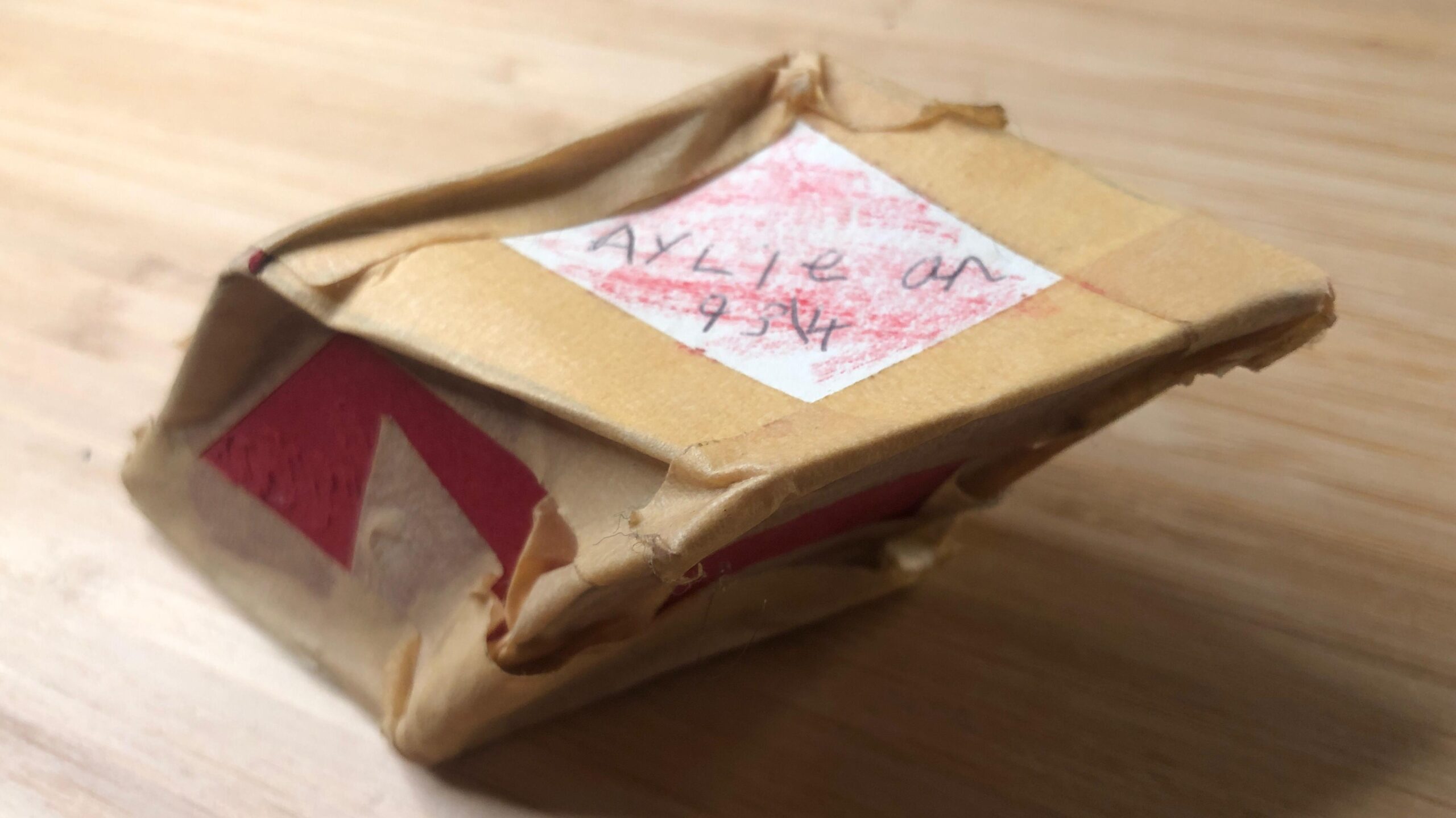
A conversation about mathematics inspired by a very special parallelepiped. Presented by Katie Steckles and Peter Rowlett, with special guest Ayliean.

Podcast: Play in new window | Download
Subscribe: RSS | List of episodes