
I recently gave a public talk about George Green’s mathematical education and influences, the audio for which is now available online.
You're reading: Posts Tagged: history
Beautiful Science at the British Library
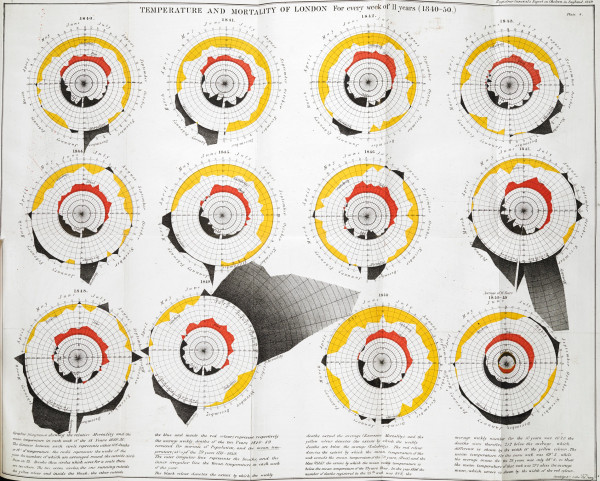
The British Library has an exhibition on at the moment that you might like to see.
Beautiful Science: Picturing Data, Inspiring Insight is all about data visualisation. Here’s the blurb:
Turning numbers into pictures that tell important stories and reveal the meaning held within is an essential part of what it means to be a scientist. This is as true in today’s era of genome sequencing and climate models as it was in the 19th century.
Beautiful Science explores how our understanding of ourselves and our planet has evolved alongside our ability to represent, graph and map the mass data of the time.
From John Snow’s plotting of the 1854 London cholera infections on a map to colourful depictions of the tree of life, discover how picturing scientific data provides new insight into our lives.
Beautiful Science is in the British Library’s Folio Society Gallery until the 26th of May and admission is free.
More information
Beautiful Science at the British Library.
Why maths isn’t like science (and may be evil)
Yesterday I gave a talk to the Nottingham Trent University Maths Society, ‘A brief history of mathematics: 5,000 years from Egypt to Nottingham Trent’. I had a slide in this where I said something about what the Greek style of proof means for mathematics. It has helped me put my finger on something of why mathematics isn’t like science, and I thought I would share it here so I can look it up when I’ve forgotten again.
Recent history
I am preparing a talk for our undergraduate Maths Society (perhaps ill-advisedly) with the title ‘A brief history of mathematics: 5,000 years from Egypt to Nottingham Trent’. This will be a stampede through some very selected hightlights, starting with some arm waving about pyramids and ending with something modern. In fact, as well as some recent results that have been reported on this site this year, I intend to end with a recent piece of research published in the department (and a colleague has promised a nice picture of a brain for this ((Something to do with complexity and computational graph theory.))).
Relatedly, a colleague who teaches on our Financial Mathematics degree suggested I include Black–Scholes in my talk, as one of the most recent results included in an undergraduate degree. It’s from 1973. Can we do better? I asked Twitter.
Éditions Hermann donates its Bourbaki archives to the Bibliothèque nationale de France
A collection of material pertaining to Nicolas Bourbaki, author of the famous Elements of Mathematics, has been donated to the French national library by his publisher, éditions Hermann. Bourbaki set out to reframe modern maths in terms of set theory, to give the subject a coherence that would lead to more rigour and cross-application of results.
The donated material consists of “original texts, corrected proofs of the Elements of Mathematics, as well as various items related to the publication of the books including catalogues, press releases, contemporary journal articles on Bourbaki, and letters.”
More information (all in French)
Les éditions Hermann font don d’archives Nicolas Bourbaki à la Bibliothèque nationale de France – (PDF) press release from the BNF and Hermann.
Les Archives Bourbaki à la BNF – potted history of Bourbaki in Libération.
Nicolas Bourbaki fait son entrée à la BNF! – hour-long radio programme on France Culture, including contributions from Pierre Cartier, former avatar of Bourbaki, and Guillaume Fau, curator of manuscripts at the BNF.
Nicolas Bourbaki entry on MacTutor (in English)
Mathematics: a culture of historical inaccuracy?
Earlier this year, back when I somehow managed to find time to write blog posts (sorry!), I wrote a couple of pieces on incorrect but oft-repeated stories in history of mathematics, basically describing some issues and expressing my frustration. These were Apparently Gauss got in this bar fight with Hilbert… and Why do we enjoy maths history misconceptions?
Today Thony Christie wrote on Twitter (as @rmathematicus) with a link to this post by Dennis Des Chene (aka “Scaliger”): On bad anecdotes and good fun. As Thony points out, this is an “excellent piece of maths history myth busting” and I am writing this quick note to commend you to read it.
Bletchley Park Turing First Day Cover

For my recent birthday I was given a wonderful present: a special UK stamp commemorating Alan Turing, who was born 100 years ago today. The stamp was issued by the Royal Mail not for the Turing centenary but as one of a series of special stamp sets to mark the Queen’s Diamond Jubilee.
This stamp is particularly special because it is one of 1000 which originated at the Bletchley Park Post Office that were stuck onto a specially designed envelope (Turing, mathematics and patterns) and cancelled on the day the stamp was issued, 23 February 2012, using a special Bombe-themed postmark.