This year, π day will be celebrated, as always, on 14th March. Unlike most years, π day will be more accurate than usual – owing to the fact that the year, 2015, will give the date 3/14/15 (provided you’re using a US calendar date format) – and for this reason, some people are calling it Ultimate π day. But how truly Ultimate is it?
You're reading: Posts Tagged: Pi Day
Mandelbrot’s bum is full of π
They say that $\pi$ is everywhere. (They say that about $\phi$ too, but I’m not buying it.) I thought it would be interesting to discuss the most unexpected place I’m aware it’s ever appeared.
Video: The Aperiodical’s π approximation challenge
As part of our massive π day celebrations, The Aperiodical has challenged me with the task of assembling a group of mathematicians, some bits of cardboard and string, and a video camera, and attempting to determine the exact value of π, for your entertainment.
The challenge, which was to be completed without a calculator, involved using known mathematical formulae for π and its occurrence in the equations of certain physical systems. In the video below, seven different methods are used – some more effective than others…
If you reckon you too can ineptly compute a value in the region of π (in particular, if you can get a more accurate approximation than the date of π day itself, which gives 3.1415), feel free to join in the challenge and see how close you get.
How I Wish I Could Celebrate Pi
People with an interest in date coincidences are probably already getting themselves slightly over-excited about the fact that this month will include what can only be described as Ultimate π Day. That is, on 14th March 2015, written under certain circumstances by some people as 3/14/15, we’ll be celebrating the closest that the date can conceivably get to the exact value of π (in that format).
Of course, sensible people would take this as an excuse to have a party, so here’s my top $\tau$ recommendations for having a π party on π day.
3.142: a π round-up
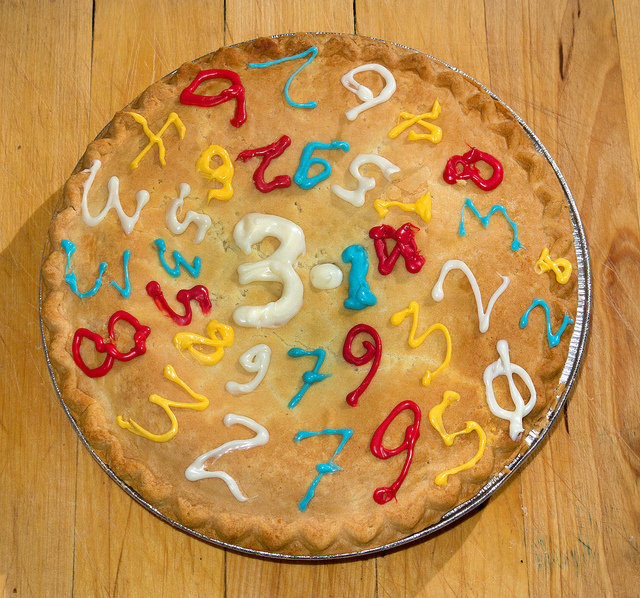
π pie by Robert Couse-Baker. Photo used under the CC-BY 2.0 licence.
‘Tis the season to celebrate the circle constant! ((Pedants would have me revise that to “a circle constant”.)) Yes, that’s right: in some calendar systems using some date notation, the day and month coincide with the first three digits of π, and mathematicians all over the world are celebrating with thematic baked goods and the wearing of irrational t-shirts.
And the internet’s maths cohort isn’t far behind. Here’s a round-up (geddit – round?!) of some of our favourites. In case you were wondering, we at The Aperiodical hadn’t forgotten about π day – we’re just saving ourselves for next year, when we’ll celebrate the magnificent “3.14.15”, which will for once be more accurate to the value of π than π approximation day on 22/7. (Admittedly, for the last few years, 3.14.14 and so on have strictly been closer to π than 22/7. But this will be the first time you can include the year and feel like you’re doing it right.)
All Squared, Number 3: As Easy As…
Remember, remember,
The fourteenth of March.
While the previous number of All Squared failed to achieve topicality by appearing several weeks after the event it was about, this time we’ve hit the nail bang on the head with a podcast all about π day… on π day!
We chatted to Festival of the Spoken Nerd’s Steve Mould about remembering π – how much can you memorise; how much should you memorise; and if you really insist on memorising it, what’s the best way to do it?

Podcast: Play in new window | Download
Subscribe: RSS | List of episodes
Pi day live, starring Marcus du Sautoy
Since it’s Pi Day in March, and ridiculously there are still people who haven’t spurned π completely in favour of τ, maths/media pixie Marcus Du Sautoy is running a free online event, called Pi Day Live (hashtag: #pidaylive). Since everything is more exciting when it’s happening LIVE, actually and IN REALITY, they’ll be conducting a live experiment, using circle measuring, marble arranging, Buffon-y needle dropping and in some extreme cases, river length approximation to calculate, LIVE, in REAL LIFE, approximations to the value of Pi.