The UK Government have announced the latest list of honours, and we’ve taken a look for the particularly mathematical entries. Here is the selection for this year – if you spot any more, let us know in the comments and we’ll add to the list.
Kenneth Falconer, Regius Professor of Mathematics at the University of St Andrews, appointed CBE for services to mathematics.
Roger Heath-Brown, Emeritus Fellow, University of Oxford, appointed OBE for services to mathematics and mathematical research.
Colva Roney-Dougal, Professor of Mathematics, University of St Andrews, appointed OBE for services to education and mathematics.
Chris Smith, teacher of mathematics at Grange Academy, Kilmarnock, appointed MBE for services to mathematics education and to the community in East Ayrshire.
Steven Underwood, lately mathematics teacher at Ryedale School, Beadlam, North Yorkshire, appointed MBE for services to Education
Laura Dawson (Laura Gilbert), Director of Data Science in the Prime Minister’s Office, appointed CBE for services to technology and analysis.
Thomas Critchley, Data Scientist, Prime Minister’s Office, appointed OBE for services to evidence-based policy.
Tori Olphin, Chief Data Scientist and Head of Research, Thames Valley Police, appointed MBE for services to technology in the public sector.
As well as the New Year Honours, another list has been published – Liz Truss’s Resignation Honours. This list includes a damehood for Shirley Conran for services to mathematics education as founder of the Maths Anxiety Trust.
In this series of posts, we’ll be featuring mathematical video and streaming channels from all over the internet, by speaking to the creators of the channel and asking them about what they do.
We spoke to Howie Hua, who runs a TikTok channel sharing short videos to help people understand mathematics.
In this series of posts, we’ll be featuring mathematical podcasts from all over the internet, by speaking to the creators of the podcast and asking them about what they do.
We spoke to Colm O’Regan, author, comedian and broadcaster, whose podcast The Function Room invites mathematicians on to tell him something interesting.
In this series of posts, we’ll be featuring mathematical video and streaming channels from all over the internet, by speaking to the creators of the channel and asking them about what they do.
We spoke to Ben Sparks, the author of the SparksMaths YouTube channel, who shares recordings of live Geogebra builds illustrating various maths concepts.
This post is both a video and text. The content is largely the same in both versions, so you can pick one to look at.
I’d like to show you a puzzle, or game for one person, that Ed Kirkby came up with. Ed showed this to me at the Big MathsJam gathering last year.
I was walking around MathsJam and people were doing all sorts of stuff and Ed was quietly sat at a table with some cards in front of them, and a couple of people were gathered around with thoughtful faces, so I thought “oh that looks interesting” and I walked over and Ed explained the rules of this game to me.
And like most things at MathsJam, I didn’t immediately know the solution but it really got to me, so I went away and tried to find a solution myself. It was really fun and it was one of those pure experiences of mathematical discovery that you really remember.
I kept grabbing other people and saying, “have you seen Ed’s puzzle? Come over here. Ed, explain this puzzle to this person!” I did that for the duration of the weekend, and for a little while after I got back home.
I’ll show you what the puzzle is.
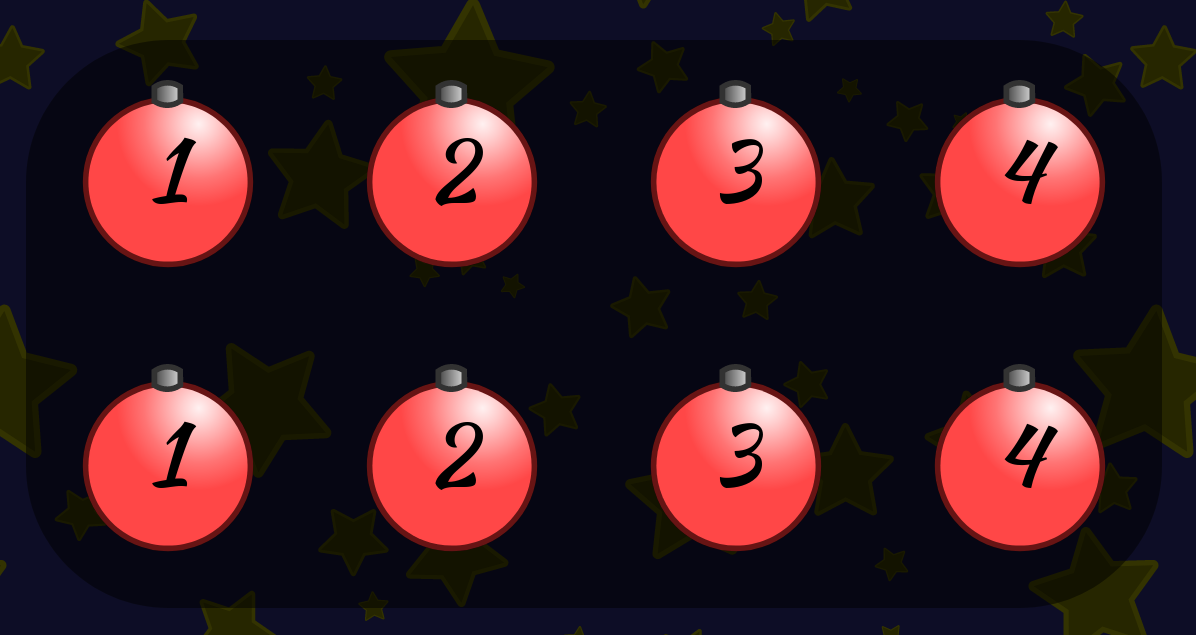
Take two sets of cards numbered 1 to 4, and lay them out in two rows. The game is to get them the other way round, so each row goes 4, 3, 2, 1.
The things you are allowed to do are to swap two cards that are adjacent numbers and in adjacent columns.
So you can swap the four and three here:
You can also swap to the other row.
You can’t swap the four and the two here because they’re not adjacent numbers.
It’s a permutations puzzle. And with a bit of thinking, a lot of just making random moves, eventually I worked out how to do it for four cards (or two lots of four cards, to be precise).
It took me a few more goes to be sure that I’d found the shortest solution — the fewest moves — but then five really stumped me.
When I tried six cards, I wasn’t sure it was possible at all: there was a point where I kept getting stuck.
So I was really unsure, and Ed was unsure as well – they didn’t know if there was a solution for every number of cards. They’d written some code that very slowly churned out solutions for small $n$, but didn’t have a general solution.
So I did my usual problem solving technique which was, if I couldn’t do it with four cards, do it with three cards, and very briefly with two cards. Then after a while I sort of started seeing a pattern.
I came away from Big MathsJam not knowing how to solve this puzzle.
I kept playing with it when I should have been working, and eventually I think I’ve sort of got the vibe of how it works and I’m pretty sure now I can solve it for any number of cards. I haven’t written down a really rigorous algorithm for doing it but I’ve got a general idea.
Interactive version
Something that often happened when I was playing with cards was that I’d forget which way I was going, because when you don’t have a strategy you’re sort of making lots of moves to see where they’ll go, and then maybe you want to backtrack a bit, and you go like wait wait — which end did the aces start at? You’re continually picking up cards and moving them, and if you’re as clumsy as I am they scatter all over the place and you end up unsure if you’re in a valid state.
Big MathsJam happens in November, and by the time I’d got this online version working it was getting close to Christmas and I thought, “we need something that’s not playing cards to be the pieces – why shouldn’t it be baubles? They’re circles, they’re easy to draw.”
So I spent some time drawing a bauble image and making it look Christmassy. I didn’t quite get it ready for last Christmas, so I spent some more time improving the interface and I made it fully keyboard accessible.
And then I made a note to write a post about it in December 2023. And here we are!
I think this is a nice Christmas puzzle: I think the set-up and the rules are easy to remember, and it only needs a pack of cards, which you’ll probably have lying around.
So over Christmas, if there’s a quiet moment, if you get some playing cards in your Christmas cracker or just some pieces that you can put in an easy to identify order, try showing this to someone.
So there you go, that’s the Double Back puzzle, invented by Ed Kirkby, online version made by me.
Since it’s the time of year when you might be looking for mathematical gifts to buy for your friends, colleagues and loves ones, I thought I’d share some recommendations and suggestions for places to find gifts online.