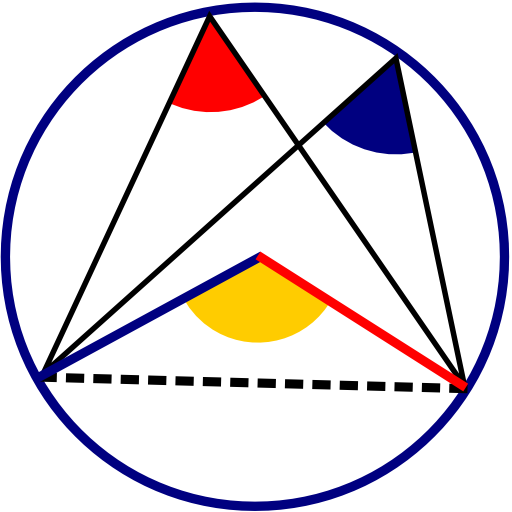
Implied Geometry by Jim Sanborn:

Implied Geometry by Jim Sanborn:

There’s no Nobel Prize for Mathematics
This is a common statement. I’ve certainly used it myself. Recently it occurred to me to be annoyed with this.
Nobel Prizes are awarded in physics, chemistry, medicine, literature, peace and economics, but not mathematics.
On the other hand, mathematics is widely applicable and I think I could convince you it is certainly used in physics (career), chemistry (career), biology (career), medicine (career) and economics (career). (Links to the excellent Plus Magazine and Maths Careers.) The case for literature and peace might be a bit harder to sell. But even without these two we still have a majority.
So perhaps from now on I will try to remember to say:
Most of the Nobel Prizes are for Mathematics1
[1. there is a fallacy here: for example, saying that some mathematics can be applied to economics does not mean that all economics involves mathematics. But, shh!]
What did I get for Christmas (mathematically, at least)? My big present was an Acme Klein Bottle, whose website claims it to be one of “the finest closed, non-orientable, boundary-free manifolds sold anywhere in our three spatial dimensions”. This is a 3D representation of a 4D Klein bottle; a pale shadow, of course, although the cheerful and entertaining information leaflet that came with the bottle claims this an advantage: “You can actually hold an Acme Klein Bottle in your hand. Those highfalutin’ 4-dimensional ones can only be held in your mind”. Here is a photo of mine:
I also got a set of physical puzzles which are nice to have a supply of. I find I am sometimes laying puzzles on a table for students to play with and solid, physical puzzles, while perhaps not the most mathematically interesting, are certainly an attractive draw. People can’t resist picking up and playing with wooden blocks, it seems!
I got a copy of The Great Mathematicians by Raymond Flood and Robin Wilson, a past and present President of BSHM, which claims to present “mathematics with a human face, celebrating the achievements of the great mathematicians in their historical context”. You can watch a lecture given by Raymond and Robin at the launch of the book at Gresham College.
As a bit of Christmas day craft, inspired by the escapades of the Manchester Maths Jam, we made dodecahedron star lanterns. Unlit, these are like this:
And lit they come alive like this:
Merry Christmas everyone! What mathematical presents did you receive and what mathematical activities did you do this year?
I received this message from Alan Stevens, Nottingham Maths Jam attendee. I am putting it here so readers of this blog and the other Maths Jams might consider the topic as well.
Although I won’t be able to make the next MathsJam at Nottingham I’ve thought of a theme you might like to consider. I don’t know if you have themes, but, if you do, how about “Pictorial proofs and derivations”?
Probably the most obvious pictorial proof is of Pythagoras’s theorem (in fact there are probably several such). Do your mathsjammers know of any more?
I thought of this while viewing James Tanton’s YouTube channel, where he has a very pictorial way of looking at maths, including a very nice pictorially based derivation of the geometric series 1/3 + 1/3^2 +1/3^3 + … = 1/2.
If you haven’t seen someone in a t-shirt displaying a pictorial proof of Pythagoras, you haven’t been going to the right sort of conferences! The James Tanton video reminds me of a pictorial demonstration of summing 1/2 + 1/4 + 1/8 + … which I used in a lecture, after Zeno’s paradox of Achilles and the tortoise, when I was trying to get across the idea of an infinite series summing to a finite amount. Shading half a square, then a quarter, then an eighth, and so on it looks like you will eventually shade the whole square and nothing more, a useful illustration that the series converges to one. In fact, I repeated this in the micro-teaching session of my Postgraduate Certificate in Higher Education course and a screenshot of the slide after I drew on it using the interactive whiteboard is below. I’m not sure if this constitutes a proof, though.
Figurative Sculptures by Manuel Martí Moreno:

My two most recent posts here have been about a story reporting a coincidence as more exceptional that it is and ‘bad maths’ reported in the media. Both are examples of mathematical stories being reported in a way that is not desirable. Somehow, though, I like the whist story and dislike the PR equations. I have been thinking about why this might be the case.
The PR-driven, media-friendly but meaningless equations from the first article are annoying because they present an incorrect view of mathematics and how mathematics can be applied to the real world. Applications of mathematics are everywhere and compelling, yet the equations in these sorts of equations seem to present little more than vague algebra. The commissioned research with seemingly trivial aims I find more difficult because, as commenters on that article pointed out, it is really difficult to decide what is trivial. Still, reporting that a biscuit company has commissioned research into biscuit dunking is either meaningless PR or else a matter of internal interest, and certainly nothing like what I expect mathematicians do for a living.
Coming back to our Warwickshire whist drive: what do I like about this story? It too presents incorrect information about mathematics and the real world, claiming that the event, four perfect hands of cards dealt, is so unlikely that it is only likely to happen once in human history (and it happened in this village hall!).
I think the difference is that the mathematics used, combinatorics and probability, appear to be correctly applied. The odds quoted, 2,235,197,406,895,366,368,301,559,999 to 1, are widely reported and I see no reason to doubt them.
The problem, then, is one of modelling assumptions. Applying a piece of mathematics to the real world involves describing the scenario, or a simplified version of it, in mathematics, solving that mathematical model and translating the solution back to the real world scenario. In this case, the description of the scenario in mathematics assumes that the cards are randomly distributed in the pack. This modelling assumption, rather than the mathematics, is where the error lies.
The result is still a bad maths news story, presenting a mathematical story as something other than what it is, but while the PR formulae are of little consequence, this incorrect application of a correct combinatorial analysis is something we can learn from.
On the Math/Maths Podcast, we frequently cover ‘bad maths’ stories. A recent example was the bobbing apples story we spoke about in episode 71: Halloween Fruit Special. This proposed a “mind-bogglingly complicated equation”, provided by a supermarket, for finding the perfect bobbing apple:
D = 3 x (2 + T^2) x M / (10 x T), where D is diameter, T is typical texture of an apple, and M is average mouth size.
Along with another formula from a rival supermarket (I reproduce this as reported; I imagine the second equals is supposed to be a plus):
B = (BU + S) x (C = BI), where B is bobability, BU is buoyancy, S is size, C is colour and BI is biteability.
A headline like “Mathematician finds formula for the perfect bobbing apple” is a tell-tale sign of bad maths in the news. Or is it? Actually there are several types of story that all appear under this same style of headline.
A couple of years ago Simon Singh launched a mini-campaign against ‘phoney formulae’ being reported in the news. Simon describes being asked by a PR company for an equation to say that the perfect shopping day coincided with the launch of a shopping exhibition, saying to the PR company,
I would engineer the equation so that the graph peaked on the day you require. There would be no real science behind the equation, but it would look sensible and convincing.
and getting the response,
Your ideas and formulas are perfect and exactly what we are looking for and it would be great to confirm you working with us.
As well as calling them “absurd PR equations”, Simon also gave a more serious warning, saying this,
demeans mathematics and science by giving the impression that academics waste their time on frivolous topics and are willing to come up with the appropriate answer if someone is prepared to pay them enough money.
A 2004 BBC article, “Formula for the perfect formula“, claims the origin of this media fascination with formulae was a piece of work by Len Fisher on how to dunk biscuits, sponsored by a biscuit company. What is described in that article is, I think, something subtly different from what Simon is railing against.
Len seems to be taking corporate sponsorship to do real experiments (the original article describes a “two-month investigation”), just that they are experiments with fairly trivial goals. The article describes a scientist who is aware that newspapers just want “to make a story look scientific” but motivated by a desire to communicate science to the public through any means available. In the case of the biscuit dunking, Len is quoted describing the physical processes and saying: “As with most things in physics, we can write equations which govern this”.
I doubt the biscuit manufacturer cared in advance how long a biscuit should be dunked for (though they are presumably interested in getting their brand in the news) and Len claims to be doing real science to answer the question. I have also heard people describe being approached by PR companies with ready-made meaningless formulae to which the approachee is asked to put their name, on behalf of some brand. This seems similar to but slightly different from Simon’s case, where he is apparently asked to manufacture a realistic-looking piece of pseudo-mathematics to back up a pre-determined conclusion, or Len’s, where a brand name is associated with some trivial piece of research.
Simon also speaks about the danger of confusing real research with these PR equations. In Math/Maths 52: World’s Smallest Klein Bottle we covered side-by-side the formula for the perfect cup of tea and that for the perfect golf putt. The former appears to be just PR for a milk company but the latter, although you could imagine a headline like “Mathematicians discover the formula for the perfect putt” being dumb PR for a golf equipment company, appears to be based on genuine research. Using mathematics to improve the performance of sports people and manufacturing of sports equipment is big business. The author, a physics professor at Yale, filed a patent in 2005 through the university for a golf training aid, marketed through a spin-off company. This was described by the Dean of the Engineering Faculty at Yale as “a great example of the joy in practical application of basic science and engineering“. Over in the UK, I expect this would be an example of ‘knowledge-transfer’ and much sought-after evidence of the positive impact university research has on wider society.
There is another interesting case, when a real piece of research is explained using a metaphor which then gets reported as its real purpose. This may be what happened in a 2010 story in the Guardian, which is about a paper on Recursive Binary Sequences of Differences published in Complex Systems that we spoke about on Math/Maths 7. Attempting to explain potential applications to blending problems, the researcher seems to have given the trivial example of pouring coffee. The work is reported under the headline “How to pour the perfect cup of coffee” with explanation: “Years of research have resulted in the definitive way to pour the best second cup of coffee”. I don’t know what happened here but it looks to me like some number theory with potential applications to chemistry is being presented in a way that might lead you to believe it is one of Simon’s “absurd PR equations”.
So what have we learned? Rail against bad maths in the media when you see it, but be careful to check you’ve found what you think you’ve found and be aware there are levels of severity.