We spotted this photograph of a letter to The Telegraph, shared by Card Colm on Twitter earlier in the year. It’s exactly the kind of mathematical claim we like to enjoy verifying, so we thought we’d dig in.
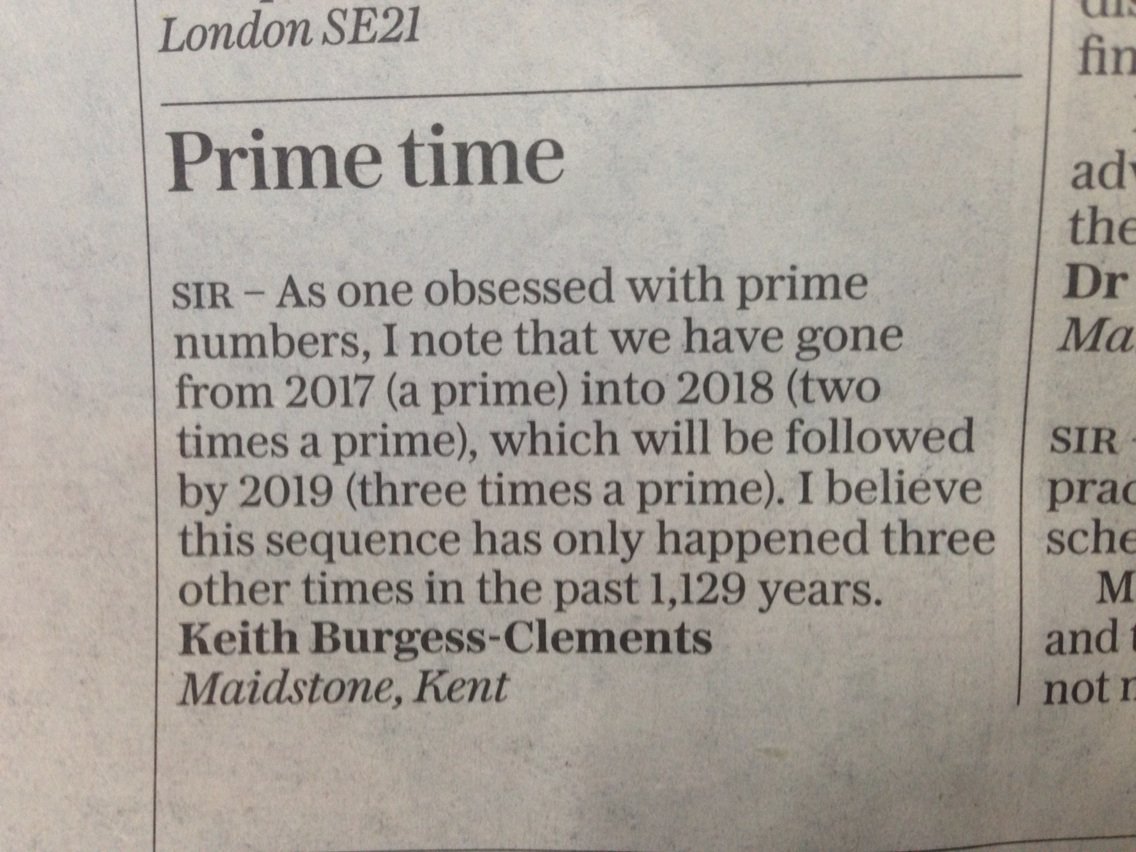
We spotted this photograph of a letter to The Telegraph, shared by Card Colm on Twitter earlier in the year. It’s exactly the kind of mathematical claim we like to enjoy verifying, so we thought we’d dig in.
 Inspired by the BBC’s Sport Relief fundraising campaign, I’ve decided to set myself a vaguely mathematical running challenge. My current routine does involve a little running, but nothing serious, so I’ve given myself a bar to aim for that’s both vaguely achievable, and completely irrational.
I’ll aim to run π kilometres (or as close as I can get, with the measuring instruments I have access to) each day during the month of March. This will either be on the treadmill at my gym – in which case I’ll try to get a photo of the ‘total distance’ readout once I’ve finished – or out in the real world, for which I’ll use some kind of running GPS logging device, to provide proof I’ve done it each day. Some days I’ll run on my own, and others I’ll be accompanied by friends/relatives, who’ll be either running as well or just making supportive noises. At the end of the month, I’ll post an update documenting my progress/success/failure.
Serious request: if you know of anywhere in the UK I can reasonably get to where there’s an established circle that’s exactly 1km in diameter, I can try to come and run round the circumference of it. Drop me an email if so.
If you’d like to support my ridiculous plan, you can follow my progress and donate on my fundraising page, or encourage others to do so by visiting pikm.run (I paid £4 for the URL, so now I have to do it). Sport Relief is the even-numbered-years-counterpart of Comic Relief, which together raise money for thousands of projects all over the UK and in the developing world, to help the vulnerable and those in need.
This post is in response to Peter’s post introducing the Approximate Geometric Mean.
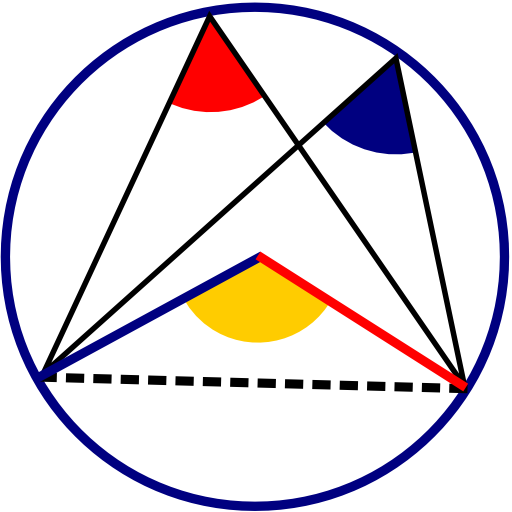
The approximate geometric mean $\mathrm{(AGM)}$ is a nice approximation of the geometric mean $\mathrm{(GM)}$, but it has some quirks as we will see. After a discussion at the MathsJam gathering, I was intrigued to find out how good an approximation it is.
To get a better understanding, we first have to look again at its definition. For $A=a\cdot 10^x$ and $B=b \cdot 10^y$, we set
\[ \mathrm{AGM}(A,B):=\mathrm{AM}(a,b)\cdot 10^{\mathrm{AM}(x,y)} \]
where $\mathrm{AM}$ stands for the arithmetic mean. This makes also sense when $a$ and $b$ are not just integers between 1 and 10, but any real numbers. Note that we won’t consider negative $A$ and $B$ (i.e. negative $a$ and $b$), as the geometric mean runs into issues if we do so. The values of $x$ and $y$ may be negative, though. The $\mathrm{AGM}$ looks like a mix between the $\mathrm{AM}$ and the $\mathrm{GM}$, so what can possibly go wrong?
I gave a talk on Fermi problems and a method for approaching them using the approximate geometric mean at the Maths Jam gathering in 2017. This post is a write up of that talk with some extras added in from useful discussion afterwards.

Enrico Fermi apparently had a knack for making rough estimates with very little data. Fermi problems are problems which ask for estimations for which very little data is available. Some standard Fermi problems:
Hopefully you get the idea. These are problems for which little data is available, but for which intelligent guesses can be made. I have used problems of this type with students as an exercise in estimation and making assumptions. Inspired by a tweet from Alison Kiddle, I have set these up as a comparison of which is bigger from two unknowable things. Are there more cats in Sheffield or train carriages passing through Sheffield station every day? That sort of thing.
On 31st January 2008, I gave my first lecture. I was passing my PhD supervisor in the corridor and he said “there might be some teaching going if you fancy it, go and talk to Mike”. And that, as innocuous as it sounds, was the spark that lit the flame. I strongly disliked public speaking, having hardly done it (not having had much chance to practice in my education to date – I may have only given one talk in front of people to that point, as part of the assessment of my MSc dissertation), but I recognised that this was something I needed to get over. I had just started working for the IMA, where my job was to travel the country giving talks to undergraduate audiences, and I realised that signing up to a regular lecture slot would get me some much-needed experience. I enjoyed teaching so much that I have pursued it since.
I just noticed that last Wednesday was ten years since that lecture. It was basic maths for forensic science students. I was given a booklet of notes and told to either use it or write my own (I used it), had a short chat about how the module might work with another lecturer, and there I was in front of the students. That was spring in the academic year 2007/8 and this is the 21st teaching semester since then. This one is the 15th semester during which I have taught — the last 12 in a row, during which I got a full-time contract and ended ten years of part-time working.
I have this awful feeling this might lead people to imagine I’m one of the people who knows what they are doing.
P.S. The other thing that I started when I started working for the IMA was blogging – yesterday marks ten years since my first post. So this post represents the start of my second ten years of blogging.
 The next issue of the Carnival of Mathematics, rounding up blog posts from the month of January, and compiled by Rachel, is now online at The Math Citadel.
The Carnival rounds up maths blog posts from all over the internet, including some from our own Aperiodical. See our Carnival of Mathematics page for more information.
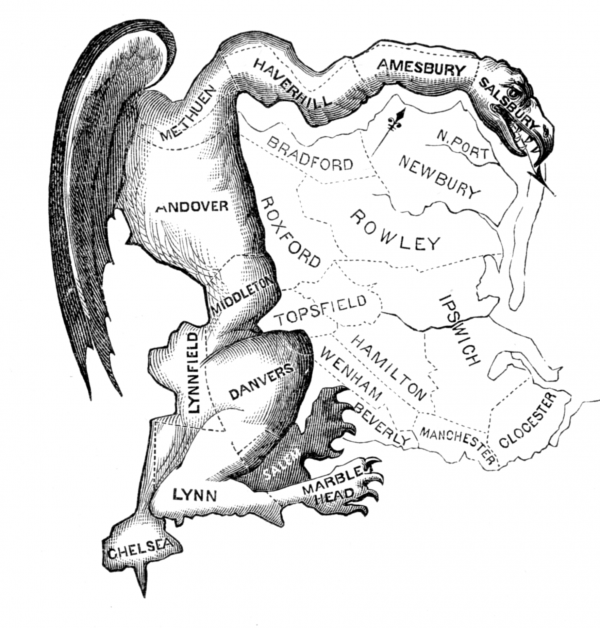
If you pay attention to United States politics you have probably noticed that mathematics is currently enjoying a rare moment of relevance. You probably also know this is not happening because all of a sudden politicians have decided that mathematics is clearly the coolest thing in the world, even though it clearly is, but instead because gerrymandering has become one of the major issues du jour.